Boxwood Care
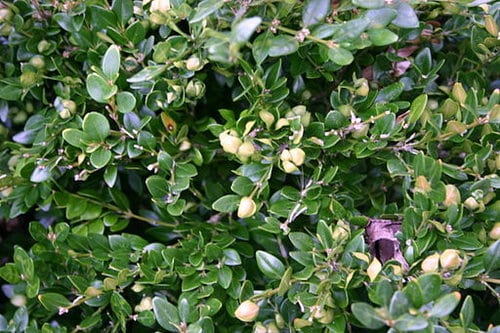
When healthy, boxwood’s glossy, deep green leaves, tidy shape and fine texture make them popular and effective landscape plants. Unfortunately, boxwood are often yellowed or dull in color, plagued by insects or disease pests, poorly maintained and “ratty” looking. There are ways to improve the look of your problem boxwood with regular maintenance-read on!
The first step is to improve the growing environment as much as possible. As with all plants, boxwood are more susceptible to damage by pests when the growing environment is not ideal and causes stress to the plant. Some common examples of poor growing environments are compacted soil, poor drainage, excessive sun or wind, or soil that is too acidic.
Proper siting and soil preparation can give boxwood an advantage against many of these issues. Choose a northern or eastern exposure for best results (or situate boxwood in the shade of other, taller trees and shrubs). Adding organic soil amendments at planting can help with compacted soil and poor drainage, though any area that ever gets standing water should be avoided-constantly wet roots are fatal to boxwood. And because the ideal soil pH for each is pretty different, avoid planting boxwood and azaleas or other acid-loving shrubs in the same area.
If you have boxwood and they don’t look their best, regular attention to their needs can improve their health and appearance.
- Mulch regularly with organic material. Boxwood are shallow rooted and moisture fluctuations affect these roots. Mulching keeps soil moisture even, and increases organic content of soil as it breaks down. When applying new mulch, be sure that it does not contact the stem.
- Test pH and apply a calcium product to reach a pH of 6.5 to 7.2. It may take several applications to reach ideal pH. We recommend Solu-Cal or Bonide Turf Turbo, please follow the label directions for application rate and frequency.
- Test pH every year until the target range is achieved, then every other year to keep it in range, applying calcium as needed.
- Boxwood are relatively heavy feeders, so fertilize with a non-acidifying slow release organic fertilizer around Thanksgiving. Boxwood roots are most active at this time and will make the best use of the available nutrients.

Psyllid damage on boxwood results in cupped leaves at the tips
Common Pests of Boxwood
Monitor closely for insect pests and treat if observed:
- Mites Pale speckles on leaves, beginning on the undersides. More of a problem when boxwood are planted in too much sun. Spray with horticultural oil.
- Leafminers Light-colored tracks visible on leaves. Prune off any new growth with tracks when first seen in early spring, and spray with spinosad (Captain Jack’s Dead Bug Brew).
- Psyllids Cupping of leaves. Prune out the damaged areas and spray horticultural oil or soap when new growth appears.
- Leaf miners and psyllids can also be prevented with a soil drench of systemic insecticide applied in spring before new growth is visible.

Volutella: affected branch (in center of picture) turning from dull green to tan
Common Boxwood Diseases
Watch for symptoms of these diseases. Many are reversible only if caught early and addressed with TLC:
- Phytopthora Initially, individual branches turn dull and light green, then tan. This can spread rapidly and kill the whole shrub. Often a problem in compacted or waterlogged soils. Regular soil drenches of systemic fungicide may hold the disease at bay, but the plant usually succumbs eventually. Any boxwood subsequently replanted where one died of phytopthora will likely also succumb.
- Volutella boxwood blight Branches show new growth late or not at all, then parts of branches turn light green to tan; powdery spores may be visible on undersides of leaves. Prune out affected areas. Volutella is controlled by proper thinning to allow good air circulation.
- Nematodes Plants bronze, become stunted and generally lose vigor. Nematodes are endemic and can only be controlled by good cultural practices (pH management is very important) and keeping plants healthy and strong.
- Boxwood decline A poorly understood complex of reduced vigor, defoliation and eventual death, possibly involving a combination of several of the aforementioned diseases and poor planting environment. Again, cultural practices and planting environment have the most effect on prevention. American and Korean boxwood seem less susceptible.
- Boxwood Blight (Emerging Pathogen) Initial symptoms of Boxwood Blight include circular, tan leaf spots with a dark purple or brown border. Leaf spots may or may not have yellow to reddish halos surrounding the spot. Black stem lesions or blackening of the stems is often seen. Infected leaves become tan and drop from the stems in sections, with defoliation happening rapidly. The speed of defoliation is one characteristic that indicates Boxwood Blight rather than another boxwood disease. Non-curable, remove affected plants and do not replace with boxwood. If seen, consider the entire property infected.
Additional Tips
Spray boxwood in winter with horticultural oil to smother any overwintering mites or other insects. This also provides some protection against winter burn.
Make sure soil around boxwood roots is not too dry when freezing or windy weather is forecast in winter. This will also help to prevent winter burn.
In early spring, prune boxwood to allow light and air into the center of the shrub.
Photo Credits:
- Psyllid damage and Volutella by SB_Johnny (Own work) [GFDL, CC-BY-SA-3.0 or CC BY-SA 2.5-2.0-1.0], via Wikimedia Commons