
North Carolina clay compacts a little more each season, water runs off rather than soaking in, and the turf canopy thins until weeds find the gaps. Nature's Select® runs hollow-tine core aeration, paired with overseeding and a biological soil amendment on cool-season lawns, timed to your grass type and matched to your property at a free on-property assessment. Done in the right window, the result is denser turf, fewer weeds, and a lawn that holds up through summer.
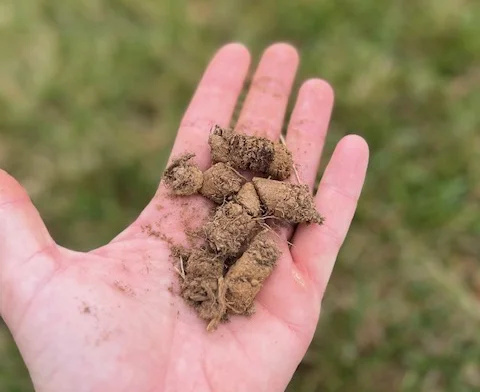

Pulls plugs out and relieves compaction. Spike aerators only push soil sideways and seal the hole back.

Every lawn benefits from aeration. Overseeding is added only on cool-season fescue lawns, not warm-season bermuda or zoysia.

Fall for fescue (September through October), May through August for warm-season lawns. The window matters as much as the work.

Done in the right season, aeration and the right seeding plan produce denser turf for two to three growing seasons.
Core aeration uses hollow tines to pull cylindrical soil plugs from the lawn, relieving compaction in a way that spike aerators cannot. Overseeding plants new grass seed into that open soil in the same visit, and a biological amendment supports establishment. The plugs decompose back into the lawn over two to three weeks and feed the surrounding soil. Nature's Select® has been running this service across North Carolina since 1994, and the year-round program now cares for roughly 8,086 acres of lawn for more than 5,356 customers.
The two services are not always paired. Aeration benefits every lawn. Overseeding is added only when the lawn is a cool-season grass, because warm-season grasses spread on their own and fill in the gaps themselves.
| Lawn Type | What It Receives | Why |
|---|---|---|
| Cool-season (tall fescue) | Aeration + overseeding | Fescue grows only from seed, so overseeding rebuilds the canopy density it loses to summer heat. |
| Warm-season (bermuda, zoysia) | Aeration only | Bermuda and zoysia spread by rhizomes and stolons, and fill in on their own |
| Mixed lawn | Confirmed on site | The technician identifies the dominant grass and matches the plan to it. |
Your grass type decides the plan, though the typical mix does shift by market. Cool-season fescue dominates the Triad, while warm-season grasses make up the majority around the Sandhills and a large share of the Triangle.
| Market | Cool-Season (fescue) | Warm-Season (bermuda, zoysia) | Typical Plan |
|---|---|---|---|
| Winston-Salem | ~95% | ~5% | Aeration + overseeding |
| Greensboro | ~95% | ~5% | Aeration + overseeding |
| Chapel Hill | ~40% | ~60% | Confirmed on site; many lawns aeration only |
| Pinehurst | ~3% | ~97% | Aeration only |
Percentages are typical for each service area and confirmed at the on-property assessment. Timing follows the grass type: fall (September through October) for fescue, May through August for warm-season lawns. The seed blend matters as much as the timing: on cool-season lawns, a custom-blended, multi-cultivar turf-type tall fescue designed for North Carolina gives the canopy a higher chance of density across sun, shade, traffic, and disease pressure, and better withstands summer heat.
Compaction is not cosmetic. By the time the lawn looks tired in July, the underlying soil structure has already failed for that season. If you are throwing money at a lawn that still looks patchy, the answer often lives below the surface, where treatments cannot reach without an open path. Annual aeration is the mechanical reset that allows water, oxygen, and biological inputs to reach the root zone, where they actually do work.

Foot traffic, mower weight, and summer drought combine. Water runs off the surface instead of soaking in. Oxygen cannot reach the roots. The result is shallow root systems that fail under the first stretch of summer heat, then thin out before fall arrives.

The canopy is the lawn's primary defense against weeds. Once it thins, weed seeds germinate in the open soil. On cool-season lawns, overseeding closes the door before crabgrass and broadleaf get a foothold, which is why it is paired with aeration in a single visit. Warm-season lawns close their own gaps as they spread, so aeration alone does the work.

Spike tines push soil sideways and seal the hole back. Only hollow-tine cores pull material out and open the soil structure. This is the difference between making holes and relieving compaction, and it shows up in the lawn the following spring.

Soil health is the foundation of biological lawn care. Aeration is what gives that foundation room to work. Living soil microbes need oxygen to metabolize nutrients and organic matter, and compacted soil starves the microbiome, limiting what the year-round program can deliver. Aeration is the mechanical reset that opens the soil so the biological work can reach the root zone, and it is part of the year-round program at many Nature's Select® properties.

Fescue establishes in the cooling soil of September and October. Spring overseed loses out to summer heat before the roots take hold. Fall slots across the Triad and Triangle fill quickly once soil temperatures drop, so the right time to request an assessment is before the window opens, not during it.
No long phone call, no obligation. From your first request to the work landing in your soil's window, the process runs on a published timeline.
A trained technician walks the lawn, identifies the grass type (tall fescue, bermuda, or zoysia), reads compaction signs and soil temperature, and confirms whether you are in the right window for aeration or whether the visit becomes the planning step for the next one. The assessment is free and there is no obligation.
A customized estimate, recommended date for the work, seed blend matched to the grass type, and a soil amendment plan. The plan reflects the unique needs of your lawn, measured by hand, rather than a one-size-fits-all formula drawn from satellite imagery.
Hollow-tine core aeration first (typically two passes). On cool-season lawns, the technician then overseeds with the custom-blended fescue and applies a biological soil amendment that supports germination. You receive seed-care instructions with the best practices to follow over the next two to three weeks to support establishment.
Most homeowners considering professional aeration have also looked at renting one for a Saturday. The honest comparison spans five dimensions that actually matter, and the gap between a worn rental and a well-maintained commercial machine is wider than most homeowners expect.
| Dimension | DIY Rental | Nature's Select® |
|---|---|---|
| Equipment quality | Rental units cycle through hundreds of properties. Tines wear blunt and punch-and-seal instead of pulling a core. | Commercial-grade hollow-tine aerator with maintained tines. Each pass actually pulls plugs out. |
| Timing knowledge | Driven by rental availability rather than soil temperature, so the work often lands outside the window the lawn actually needs. | Driven by soil temperature. Cool-season lawns typically September through October, warm-season lawns typically May through August. |
| Seed selection | Based on whatever the box store stocks. Generic blends are selected for broad geographic areas, not specifically for North Carolina. | Custom-blended, multi-cultivar tall fescue designed for North Carolina. Warm-season lawns are not overseeded. |
| Equipment transport | Hauling a 200-pound aerator on and off a trailer, plus the rental pickup and return. Cores decompose on their own either way. | Done by the technician. Cores are left in place to decompose into the lawn over two to three weeks. |
| Total cost over two years | Rental plus seed plus amendment plus the Saturday, often producing thin results that require re-aeration the following year. | Guaranteed service and continuous biological lawn care, including soil amendments, producing results that compound for two to three growing seasons. |
Skip the rental.
Founded in Winston-Salem in 1994, Nature's Select® has expanded across North Carolina into the Triad, the Triangle, and the Sandhills, and continues to add franchises across the region. Call the toll-free number and you'll be routed to the office that covers your address.

Serving the Research Triangle (Chapel Hill, Carrboro, Hillsborough, Durham, Pittsboro)
Serving the Piedmont Triad (Greensboro, High Point, Burlington, Summerfield, Oak Ridge)
Serving the Sandhills (Pinehurst, Aberdeen, Southern Pines, Seven Lakes)
Serving the Piedmont Triad (Winston-Salem, Clemmons, Kernersville, Lewisville, King)
Not sure which office covers your address? Call (888) 786-9735 and we will point you to the right local team.
Core aeration uses hollow tines to pull cylindrical plugs of soil out of the lawn. This relieves compaction in a way that spike aerators cannot, because spike tines push soil sideways and seal the hole rather than removing material. The plugs decompose back into the soil over two to three weeks. Most North Carolina lawns benefit from annual aeration because clay soil compacts under foot traffic, mower weight, and summer drought.
No. Mechanically raking dethatches the layer of dead grass material at the soil surface. Aeration addresses compaction below the surface. Most North Carolina lawns do not have a thatch problem; most have a compaction problem. A property assessment confirms which intervention your lawn actually needs.
No. Biological lawn care is an approach that starts with the soil. It uses living microbes, organic matter (a soil science term for decomposed biological material), and biological inputs to build soil health before applying any synthetic inputs. Nature's Select® has used this approach in North Carolina since 1994.
Commodity organic lawn care is a different thing. In lawn care, "organic" is not governed by the USDA or any certifying body, so the label is unregulated. An "organic" label also does not guarantee a gentle product, since some organic-labeled inputs carry toxicity comparable to conventional herbicides. The result of the biological approach is a lawn that holds color longer, recovers faster from heat and drought stress, and needs less synthetic and chemical input over time.
The lawn will look marked for a few days. Plugs sit on the surface for two to three weeks and break down naturally into the soil. Under proper watering, fescue seedlings start emerging in seven to fourteen days, and the canopy knits back in. Warm-season cores close more quickly during active growth. The visible recovery is faster than most homeowners expect.
You can. Most homeowners who do find that the result is variable because rental tines are often worn, the timing is driven by rental availability rather than soil temperature, and the seed selection is whatever the box store has on the shelf. A DIY visit takes a Saturday and yields results that vary widely depending on equipment condition. A professional visit occurs within the soil-temperature window, with properly maintained equipment and a seed blend matched to your grass type.
A custom-blended, turf-type tall fescue with multiple cultivars designed for North Carolina. The blend approach matters because no single cultivar handles every condition (sun, shade, summer heat, traffic, disease pressure). A multi-cultivar blend gives the lawn a higher chance of achieving canopy density under whatever conditions your specific property experiences.
September through October, wherever the lawn is cool-season fescue. Soil is still warm enough for seed germination, but cool enough for the new fescue to root before next summer's heat. Fall is the only window where overseeded fescue has the time it needs to establish a root system before the stress season arrives.
May through August, when the turf is actively growing. Active growth allows the lawn to close the cores quickly and recover from the wound. Fall aeration on warm-season lawns leaves the wound open through dormancy and slows recovery.
Most North Carolina properties pay between $350 and $750 for a single visit, depending on lot size, seed quantity, and whether the property needs only aeration or aeration plus overseeding. Final pricing is delivered the same day as the on-property assessment. Request a free estimate at (888) 786-9735.
Nature's Select® serves North Carolina from four locations. The Winston-Salem office (336-729-3122) is the original 1994 company and serves Winston-Salem and the surrounding Forsyth County communities across the Piedmont Triad. The Greensboro office (336-221-7680) serves the rest of the Piedmont Triad around Guilford County. The Chapel Hill office (919-335-4656) covers the Research Triangle. The Pinehurst office (910-634-3886) covers the Sandhills
Free on-property assessment within 48 hours, customized estimate the same day. Aeration and overseeding at the right time for your soil. Local franchises, one team. Nature's Select® Guarantee.