Why Weeds Keep Coming Back (Even When You Treat Every Weekend)
Weeds keep coming back because a treatment only removes the plants you can see. In North Carolina lawns, new weeds sprout from seeds already waiting in the soil, perennial weeds regrow from taproots and tubers, and thin turf, compacted clay, low mowing and poor timing leave open ground for the next crop. Treating every weekend addresses the result. Changing the soil and the grass addresses the cause.
If you walk the yard with a weed treatment in hand every Saturday, the frustration makes sense. The dandelions brown out, the clover curls, and two weeks later the same spots look the same again. The product did its job on those plants. The lawn simply gave the weeds another opening.
This guide looks at the question homeowners ask most, why do weeds keep coming back, from a soil-first point of view. You will learn how to tell which kind of weed you are fighting, read what it says about your soil and grass, and plan the changes that make weekly treatments less necessary over time.
Why Do Weeds Keep Coming Back After You Treat Them?
Most weed treatments act on the plant that is already growing. They do nothing for the seeds below it, the roots that survive under it or the conditions that let it grow in the first place.
A treatment reaches leaves, not the seed bank
Every lawn holds a supply of weed seeds in the top layer of soil, built up from years of plants that flowered and dropped seed. Wind, birds, mowers and shoes keep adding more. When a treated weed dies, it leaves a gap, and the next seed in line gets the light it needs to germinate.
That is why a yard can look clean in May and weedy again by July. The new weeds are not the old ones coming back to life. They are new plants from seed that was there all along.
Perennial weeds regrow from what is underground
Some weeds live for years. The NC State Extension describes common dandelion as a perennial weed with a thick, fleshy taproot, and notes that its parachute-like seeds are carried by the wind. If a treatment burns the leaves but the taproot survives, the crown sends up new leaves.
Yellow nutsedge works the same way below ground. NC State TurfFiles explains that it is a rapidly spreading perennial that forms tubers at the tips of its rhizomes. Each tuber can start a new plant, so pulling or burning the top rarely ends the problem.
The wrong product for the weed
A product for broadleaf weeds will not control a sedge, and grassy weeds need a different approach again. The same NC State nutsedge page points out that sedges resemble grasses but have three-sided stems, and that their management is totally different. If one weed survives every treatment, the label may simply not cover it.
What Your Weeds Say About Your Soil
Weeds are not random. Many of them are the plants best suited to the conditions your lawn has right now, which makes them useful clues about what to fix.
| Weed you keep seeing | Life cycle | What it often points to | What to change first |
|---|---|---|---|
| Dandelion and other perennial broadleaf weeds | Perennial, deep taproot | Weak, thin turf | Grass density, mowing height, feeding by soil test |
| Yellow nutsedge | Perennial, spreads by tubers | Wet or poorly drained soil, frequent irrigation | Drainage, watering habits, timing of control |
| Goosegrass | Summer annual | Compacted soil, close mowing, heavy traffic | Aeration, mowing height, less frequent watering |
| Weeds in bare or thin spots of any kind | Mixed | Open soil with light reaching it | Overseeding and steady care of the turf |
Read the pattern, not just the plant
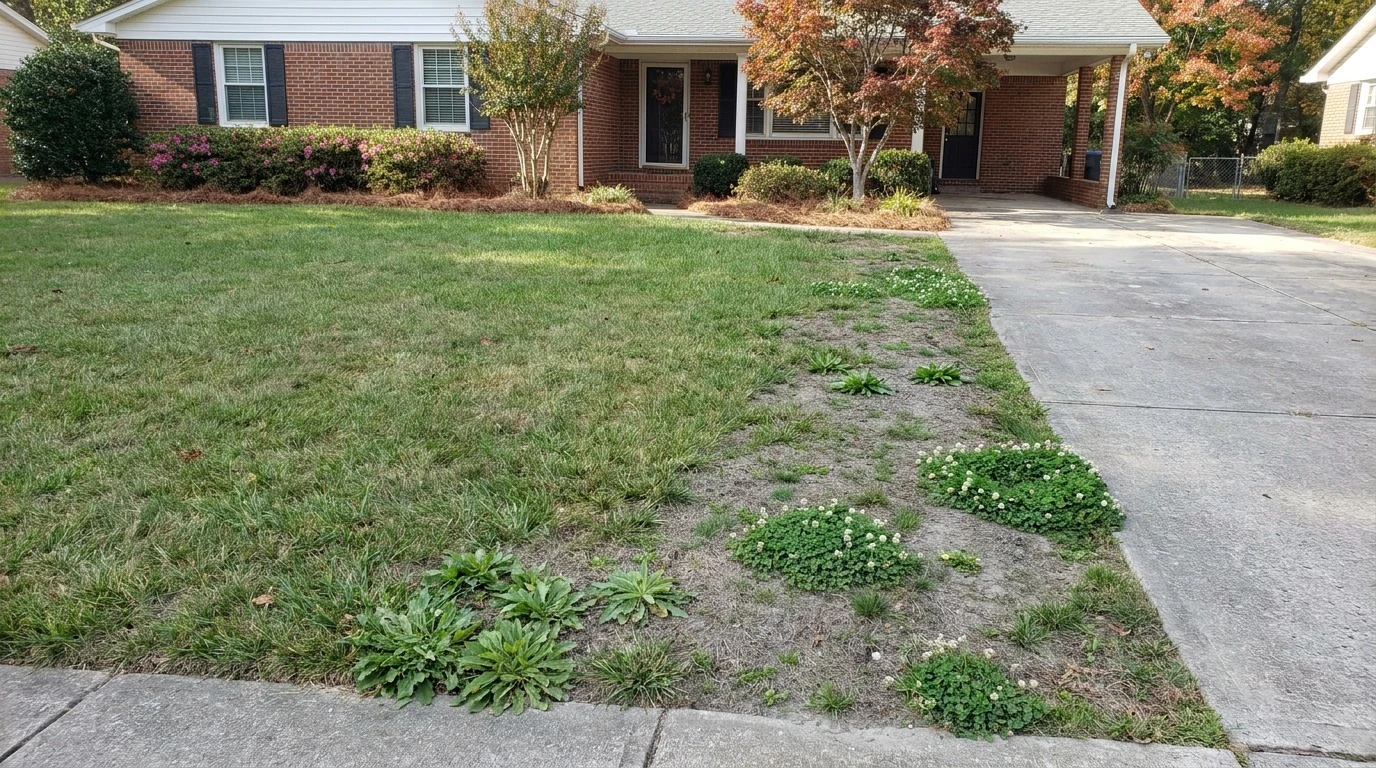
Look at where the weeds grow, not only what they are. Weeds along a driveway edge, a worn path or a low corner by the downspout usually point to a site problem in that spot. Weeds spread across the whole yard usually point to the lawn as a whole being thin or underfed.
One weed, one clue
Treat each type as a separate clue. A yard can have a compacted side strip, a soggy corner and a thin front lawn at the same time, and each one needs its own fix. A single treatment across all three ignores those differences.
Compacted Clay Gives Weeds the Advantage
Much of North Carolina sits on clay, and clay packs down under foot traffic, mowers and construction. Compacted soil holds less air, drains slowly and makes it hard for grass roots to grow deep.
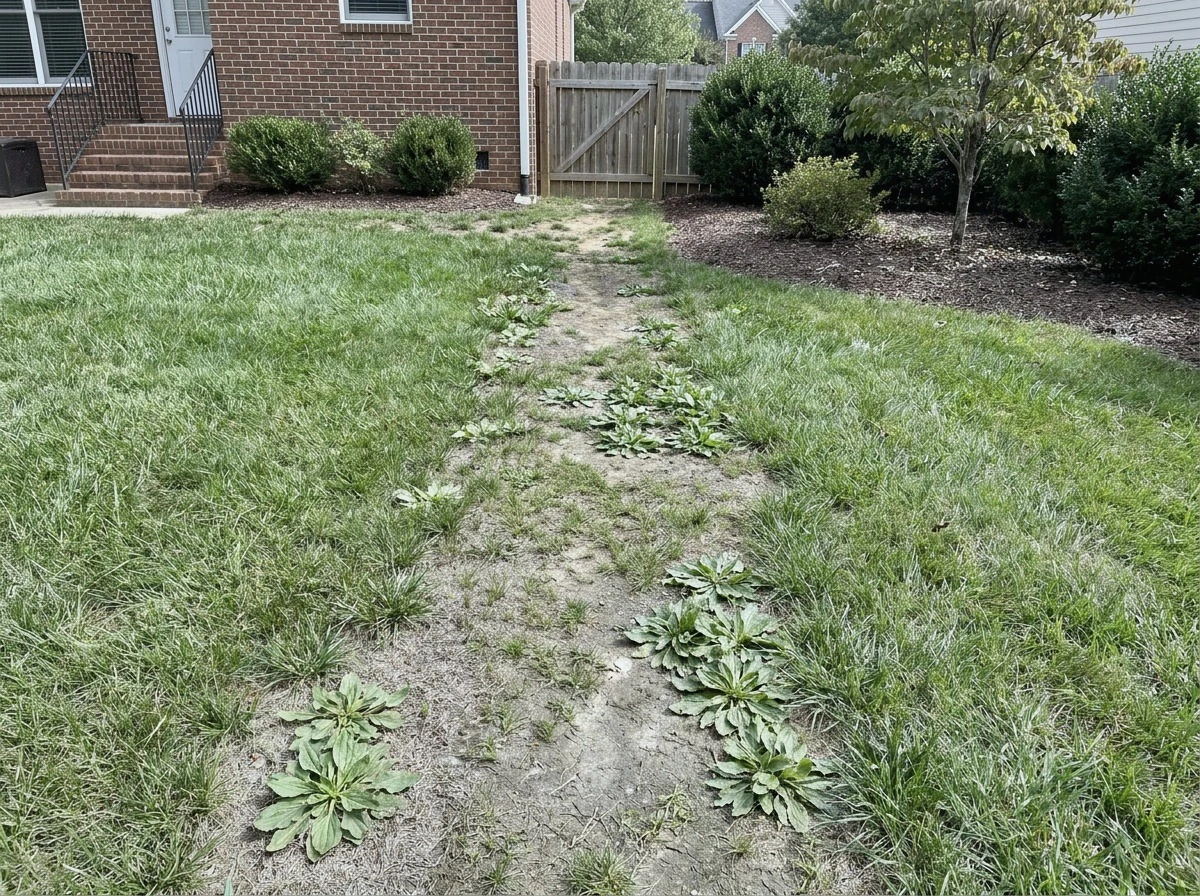
Goosegrass is the classic warning sign
North Carolina State University notes that goosegrass grows well in compacted soils and is most competitive in thin, open turf that takes intense traffic. It adds that close mowing and frequent watering help goosegrass compete, and that a severe infestation may indicate the need for aerification.
The same page says goosegrass germinates when soil temperatures reach about 60°F, usually at least two weeks later than crabgrass. A barrier timed only for crabgrass can fade before goosegrass arrives on a hard, sunny strip.
Why clay compaction keeps the cycle going
The N.C. Cooperative Extension Carolina Lawns guide states that clay soils are prone to compaction and require frequent aerification. It also notes that few lawns established on clay can absorb more than 0.5 inch of water per hour, so water runs off instead of reaching the roots.
Grass struggles in those conditions while tough weeds hold on. Treating the goosegrass does not loosen the soil, so the same strip fills in again. Our post on the screwdriver test for compaction shows a quick way to check your own lawn.
Core aeration changes the soil, not just the weed
Core aeration pulls small plugs of soil out of the lawn, which opens space for air, water and roots. For tall fescue lawns, the fall aeration and overseeding window is the time to pair it with new seed so the grass, not the weeds, fills the openings.
Thin Turf and Low Mowing Leave the Door Open
A dense lawn shades the soil surface, and most weed seeds need light at the surface to germinate. Thin turf does the opposite. Every bare inch is an invitation, which is why our older post on why a thin lawn invites weeds puts density first.
Treating alone can make a thin lawn thinner
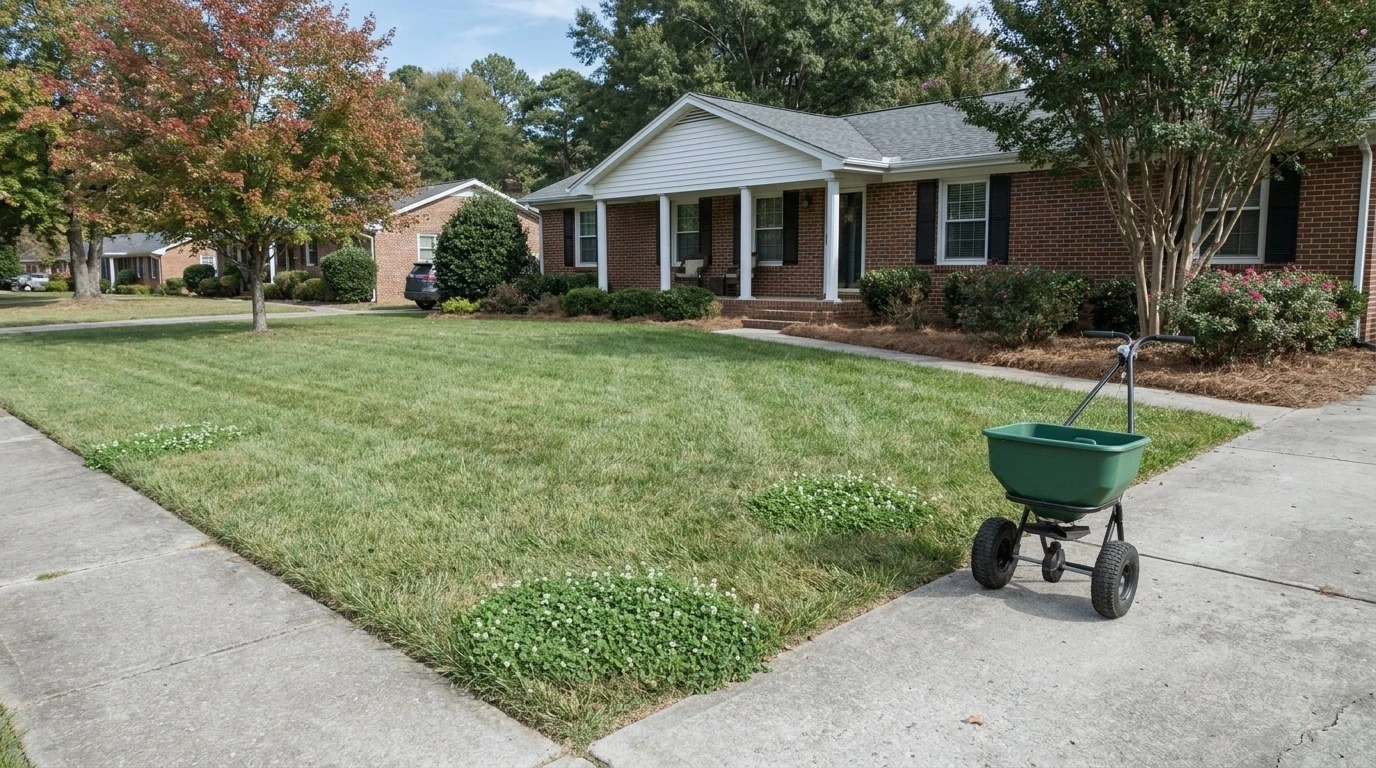
When a large weed dies, the space it covered stays open. A dandelion rosette the size of a saucer leaves a saucer of bare soil, and clover patches leave larger gaps. If nothing fills those spaces with grass, new weeds take them within weeks. Weekly treatments on a thin lawn often trade one crop of weeds for the next.
Mowing height matters more than most homeowners think
The Carolina Lawns guide reports that tall fescue performs best when mowed at 3 to 3.5 inches and should not be mowed shorter than 2.5 inches. It also advises cutting often enough that less than one-third of the leaf surface comes off at each mowing.
Mowing lower than that thins the canopy and lets more light reach the soil. NC State says the same about goosegrass, where close mowing helps the weed compete. Raising the deck is one of the cheapest weed control steps you can take.
Choose a grass that fits the site
NC State advises selecting adapted turfgrass cultivars for your area and then fertilizing, mowing and watering to encourage dense growth. In much of central North Carolina that means tall fescue in sun and light shade, while bermudagrass, zoysia and centipede suit warmer, sunnier sites and the Sandhills.
Wet Spots, Watering Habits and Sedges
Low corners, downspout outlets and areas that stay soggy after rain grow a different set of weeds. Sedges are the most common example, and they are a sign that water, not just weed seed, is part of the problem.
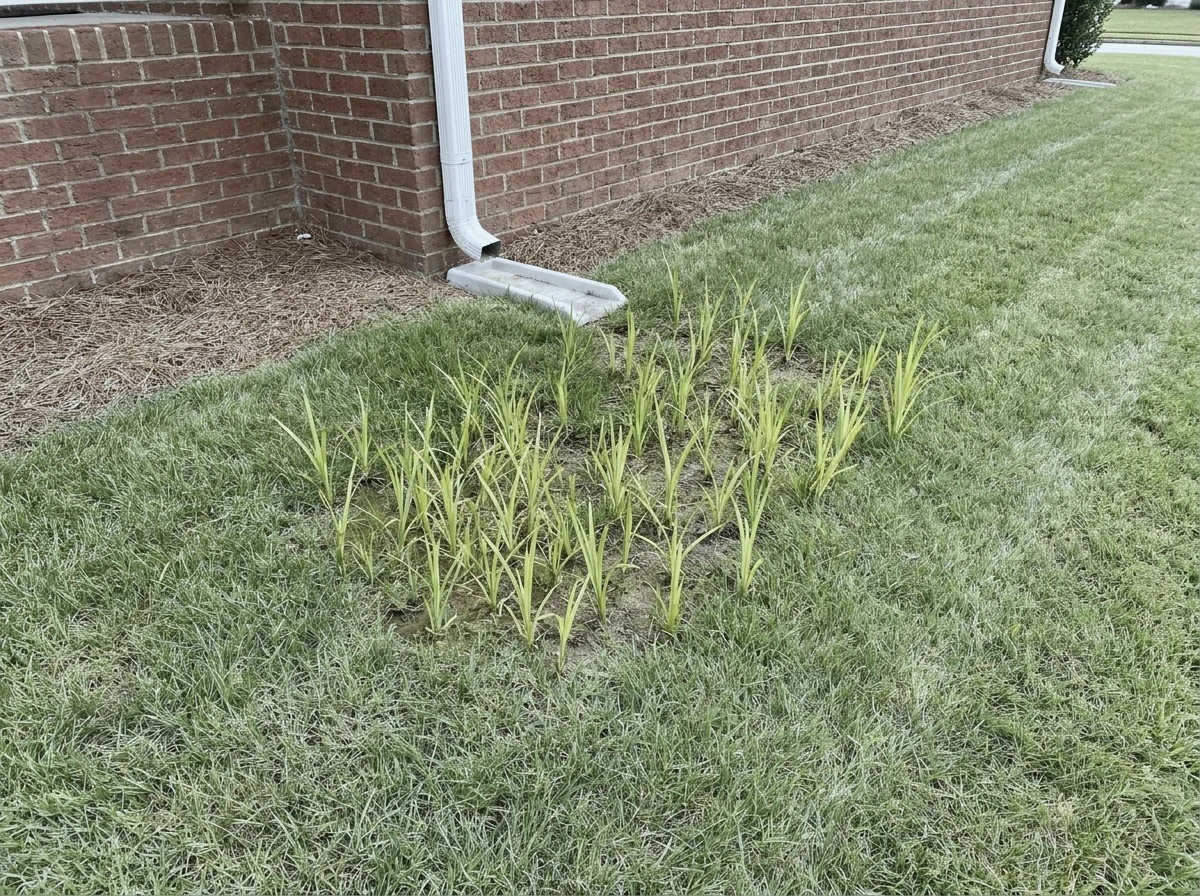
Why nutsedge keeps returning
NC State TurfFiles notes that sedges thrive in wet or poorly drained soils and that frequent irrigation helps them thrive in turf. Once established in a wet area, they can spread to drier parts of the lawn as well.
Timing makes a big difference with yellow nutsedge. The same page advises starting control in spring, after most shoots have emerged but before new tubers form. Beginning in late June and early July, the plant adds new tubers that lead to more weeds in future years.
Light, frequent watering helps the wrong plants
Short daily watering keeps the soil surface moist, which suits shallow weed roots and germinating weed seed. Deeper, less frequent watering moves moisture down to grass roots instead. On clay, apply water until runoff is about to start, wait for it to soak in, then continue, as the Carolina Lawns guide suggests.
Fix the water before you fight the weed
If a corner stays wet for days, look at the cause: a downspout that empties onto the lawn, a low spot that collects runoff or an irrigation zone that runs too often. Redirecting water or adjusting the timer can do more for a sedge patch than another treatment.
Soil Chemistry: Test Before You Feed
Grass that is short on nutrients or growing in soil with the wrong pH cannot grow thick enough to crowd out weeds. Guessing at fertilizer often feeds the weeds as much as the lawn.
Start with a soil test
The NCDA&CS Agronomic Division measures plant-available nutrients and soil pH to determine lime needs, and it gives homeowner recommendations in pounds per 1,000 square feet. As of October 2026, testing is free through November 30, 2026, with a per-sample fee starting December 1, 2026.
The Carolina Lawns guide recommends a soil test at least every two to three years for an established lawn. It also suggests a complete turf-grade fertilizer that provides about 1 pound of nitrogen per 1,000 square feet, or the amount on your soil test.
Lime and nutrients support density
Results show whether your soil is low, optimum or excessive in key nutrients. Correcting pH and feeding to the report gives the grass what it needs to fill in, which is the long-term weed control that treatments alone cannot provide.
How to Break the Cycle Instead of Treating Every Weekend
A plan beats a weekly routine. These steps move the work from the weeds to the conditions behind them.
A soil-first plan for the next twelve months
1. Identify the weeds: broadleaf, grassy or sedge, annual or perennial.
2. Map them: mark compacted strips, wet corners and thin areas.
3. Test the soil: lime and feed only to the report.
4. Raise the mower: keep tall fescue at 3 to 3.5 inches.
5. Fix compaction and water: aerate clay and redirect runoff.
6. Thicken the turf: aerate and overseed fescue in early fall.
7. Treat at a threshold: spot treat with a labeled product.
Plan the barrier, not just the treatment
Pre-emergent products stop seeds as they germinate, so they belong in the plan for annual weeds such as crabgrass and goosegrass. Our upcoming guide to pre-emergent timing in North Carolina covers the spring window in detail. Skip a barrier where you plan to seed fescue, because it stops grass seed too.
Be patient for one full season
The Carolina Lawns guide notes that the problems that caused a lawn to decline must be corrected before renovation begins. Weed pressure usually drops over a full year of better mowing, feeding and overseeding rather than in one weekend. Our earlier post on why your weeds keep coming back gives a short overview of the same soil-first idea.
How Nature's Select® Approaches Recurring Weeds
Nature's Select® has provided biological lawn care across North Carolina since 1994, and recurring weeds are treated as a lawn problem, not only a weed problem. Our weed control and fertilization program starts with a free on-property assessment and a same-day written estimate.
Treatment follows a threshold. Broad-spectrum products are used only when pressure crosses a treatment threshold, at the lowest effective rate, on the affected area. Weed control sits inside a year-round lawn care program of 7 visits, with one technician assigned to your property and no long-term contract.
Key Takeaways
- Weeds keep coming back because treatments remove visible plants but leave the seed bank, surviving roots and tubers, and the conditions behind them.
- Perennial weeds such as dandelion and yellow nutsedge regrow from taproots and tubers, so leaf burn alone rarely ends them.
- The weed type is a clue: goosegrass points to compaction, sedges to wet soil and broadleaf weeds to thin, weak turf.
- Tall fescue mowed at 3 to 3.5 inches, never below 2.5, shades out many weed seeds.
- A soil test and feeding to the report build the density that crowds weeds out.
- Fall aeration and overseeding fill the gaps that treatments leave open in a tall fescue lawn.
Frequently Asked Questions
Why do weeds keep coming back in the same spot?
A weed that returns to the same spot usually points to a site problem there. Compacted soil along a path, a wet corner by a downspout or a thin, sunny edge by the driveway gives weeds an advantage over grass. Perennial weeds can also regrow from a taproot or tubers left in the soil. Fix the conditions in that spot and the weed loses its edge.
Can you permanently stop weeds from growing?
No lawn stays weed free forever, because new seed arrives on wind, birds and shoes every season. What you can do is make the lawn a poor place for weeds to start. A dense, well-fed stand of grass mowed at the right height, on soil that drains and is not compacted, leaves few openings. Most remaining weeds can then be spot treated.
How do I get rid of weeds that keep coming back?
Start by identifying the weed and the reason it grows there. Then correct the cause: raise the mower, test and feed the soil, aerate compacted areas and redirect water from wet spots. Overseed thin tall fescue in early fall. Spot treat the remaining weeds with a product labeled for that weed and your grass, at the timing the label recommends.
Does pulling weeds make them come back worse?
Pulling is fine for small numbers of annual weeds, but it has limits. If part of a dandelion taproot or a nutsedge tuber stays in the soil, the plant can regrow. Digging also disturbs the soil and can bring buried weed seed closer to the surface. After pulling, fill the gap with grass seed or let healthy turf spread so the bare spot does not invite new weeds.
Why do weeds come back after a weed killer treatment?
The treatment may have reached only the leaves, while roots, tubers or seeds in the soil survived. The product may not be labeled for that weed type, since broadleaf, grassy and sedge weeds need different approaches. Each dead weed also leaves bare soil, and seeds in the soil fill it quickly. Treating without fixing thin turf or compaction keeps the cycle going.
Does mowing height affect weeds?
Yes. Mowing too low thins the grass and lets light reach the soil, where weed seeds germinate. NC State reports that tall fescue performs best at 3 to 3.5 inches and should not be cut below 2.5 inches. Close mowing also helps weeds such as goosegrass compete. Removing less than one-third of the blade at a time keeps the canopy thick.
Is it too late in the fall to fix a weedy lawn?
Late summer to early fall is the best time to renovate cool-season lawns such as tall fescue, so November is a time to plan rather than seed. Take a soil test, mark the weedy and compacted areas and set your mower height. Then the spring treatments and the next fall overseeding can target the right spots.
Conclusion
Weeds that keep coming back are a message, not a failure of your effort. Seeds in the soil, perennial roots and tubers, compacted clay, wet corners, low mowing and hungry soil all give weeds the edge. Each treatment removes this week's plants, and the conditions grow the next ones.
Turn the effort toward the lawn itself. Identify the weeds, test the soil, raise the mower, aerate and overseed, and treat what remains at a threshold. If you would like help building that plan, Nature's Select® can look at your soil, grass and weeds together. Request a free on-property assessment or call (888) 786-9735, and we will route you to the office covering your address.