
Nature's Select Logo
Nathan Reeves IMG

Nathan Reeves

Nathan Reeves is a Senior Content Strategist on the Marketing and Research team at Nature's Select®, where he helps product and marketing colleagues turn complex ideas into articles and resources that earn reader trust and generate qualified leads. Over roughly eight years in the lawn care field, he has developed a knack for pairing clear structure with accessible storytelling, making technical material easy for homeowners and internal teams to follow. He regularly hosts small-group workshops for clients and coworkers, a practice that sharpens his sense of what audiences actually want to know and keeps his writing grounded in the questions people bring. His work reflects a steady focus on clarity over cleverness.

Recent Blogs

Sod webworm silk webbing shimmering in dawn dew across a tall fescue lawn in central North Carolina during August peak damage window
Sod webworms are caterpillars of small light-brown moths (Crambus and Parapediasia species) that feed on tall fescue and warm-season turf at night from July through August across North Carolina, cutting grass blades at the thatch line and dragging them into silk-lined tunnels. The tells are dawn silk webbing shimmering in the dew, dusk zig-zag moth […]
August 12, 2026
14 minutes read
Read article →
Homeowner's hands cupping turf-type tall fescue seed above green lawn showing overseeding rate for North Carolina fescue.
For most North Carolina tall fescue lawns, plan on 3 to 4 pounds of seed per 1,000 square feet for a routine fall overseed, 5 to 6 pounds for a moderately thin lawn, and 8 to 10 pounds when you are renovating bare or badly damaged turf. That range comes from NC State Extension research, […]
August 9, 2026
7 minutes read
Read article →
Soil thermometer reading four-inch depth in a tall fescue lawn in central North Carolina during the fall aeration window with early-morning autumn light.
The best time to aerate a lawn in North Carolina is when soil temperature at four inches sits between 65 and 75 degrees Fahrenheit. For tall fescue in the Triad and Triangle, the ideal time to aerate and overseed falls between mid-September and early October and lasts roughly three weeks. For bermuda and zoysia in […]
August 6, 2026
14 minutes read
Read article →
Homeowner performing screwdriver test to check soil compaction on a central North Carolina tall fescue lawn.
To test soil compaction at home, wait two to three days after rain so the soil is moist but not muddy, then push a six-inch flathead screwdriver straight into the turf. If it slides in with hand pressure, the soil structure is intact. If it stops before three inches or needs body weight, the soil […]
August 3, 2026
13 minutes read
Read article →
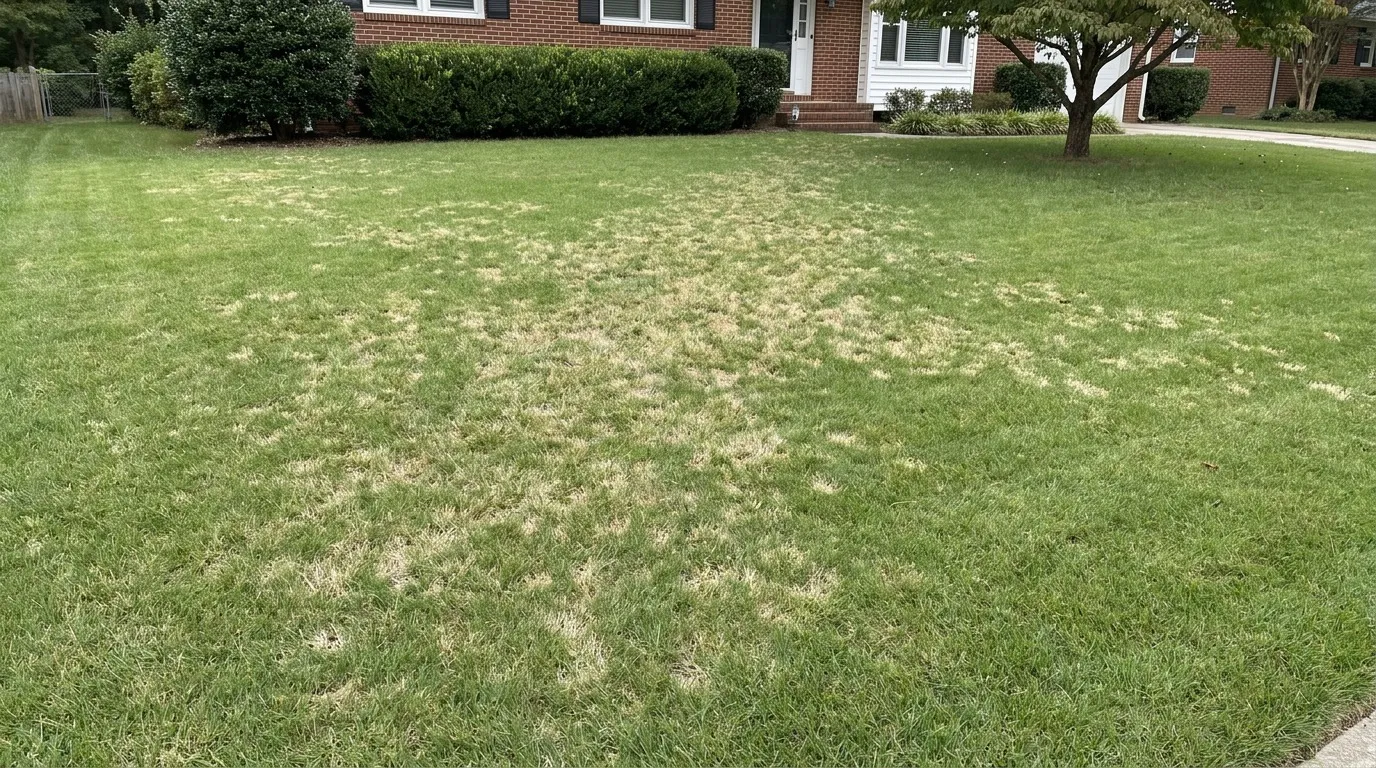
North Carolina residential lawn showing yellow summer stress patches in July heat, tall fescue diagnostic close-up
Your North Carolina lawn is yellowing in July because the transition zone breaks the rules cool-season and warm-season grasses were bred for. Tall fescue is signaling heat and root-zone stress; bermuda or zoysia is signaling nutrient, water, or disease pressure inside its peak growth window. The color shift is a diagnostic message about the soil, […]
July 23, 2026
10 minutes read
Read article →
North Carolina lawn showing chinch bug damage in yellow patches along sunny driveway strip next to drought-stressed turf
Chinch bug damage and drought stress can look nearly identical from the driveway: yellow patches, brown edges, wilted turf. The tell is location and behavior. Drought damage spreads uniformly across a lawn and greens back up within 48 hours of a deep watering. Chinch bug damage clusters in the hottest, sunniest strips (often along driveways, […]
July 16, 2026
11 minutes read
Read article →
userphone-handsetcrossmenu Skip to content