Dollar Spot Season in NC: The Shoulder-Season Disease Everyone Misdiagnoses
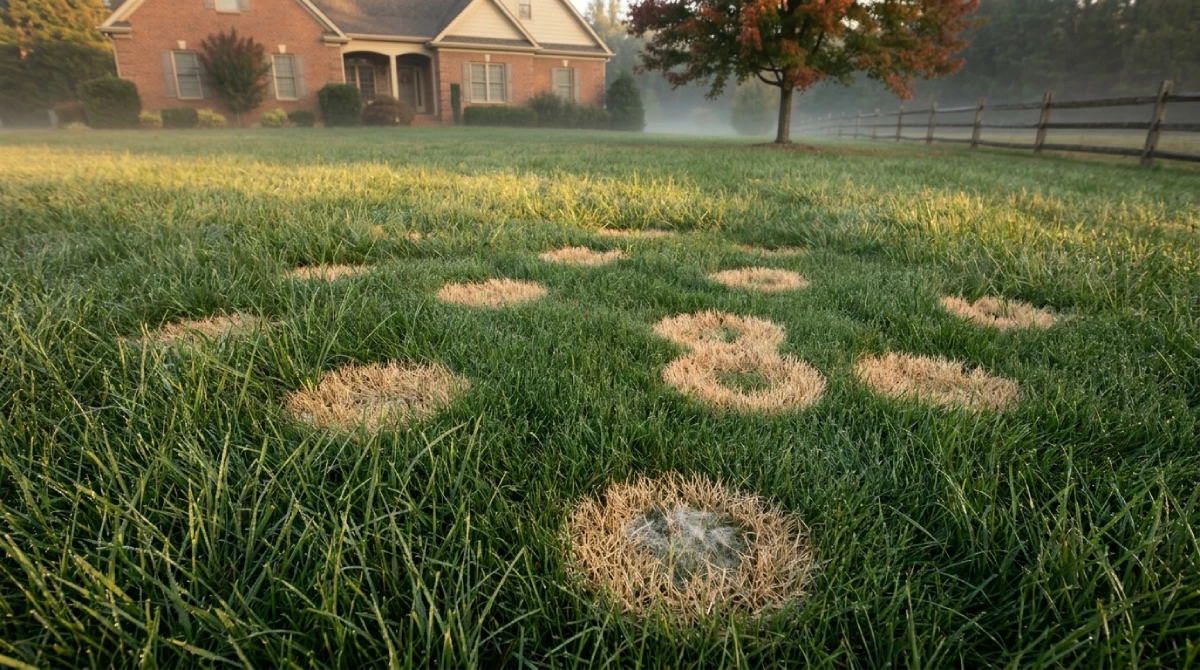
Dollar spot is a foliar lawn disease caused by Clarireedia fungi that produces bleached, silver-dollar-sized circles when nights turn cool, days stay mild, and dew sits on the canopy for hours. North Carolina homeowners routinely mistake it for drought, dull mower blades, insect feeding, or brown patch, which sends the wrong fix at the wrong time.
Every year, a North Carolina yard starts producing small bleached circles that weren't there a week earlier. They are roughly the size of a silver dollar. They show up in the mild stretch when nights finally cool off but afternoons are still warm, then again on the other side of summer when the pattern repeats.
Most homeowners reach for the wrong explanation. They water more, thinking it is drought. They sharpen the mower, thinking it is blade damage. They buy grub control, thinking something is eating the roots. Or they call it brown patch, because brown patch is the disease everyone in North Carolina has heard of.
It is usually dollar spot, and dollar spot behaves nothing like the diseases it gets confused with. This article walks through the diagnostic tells that separate it from every lookalike. It also explains why low nitrogen and long dew periods drive disease development, and how soil biology plus a handful of lawn-care corrections can change the odds before you consider a single fungicide application.
What Dollar Spot Lawn Disease Actually Is
Dollar spot is a foliar disease, meaning it attacks the leaf blades rather than the roots or the crown. That single fact explains most of its behavior. The grass plant underneath the patch is usually alive. What died is leaf tissue, which is why recovery is faster and more complete than homeowners expect.
The disease is caused by fungi in the genus Clarireedia. On tall fescue and other cool-season grasses across North Carolina, the dominant species is Clarireedia jacksonii. On bermudagrass and zoysia, the most common species is Clarireedia monteithiana. Both produce the same visual signature at the lawn scale, which is why identification usually happens by symptom rather than by species.
Why the Name Changed and What It Tells You
For most of the twentieth century, this pathogen was published under the name Sclerotinia homoeocarpa. Turfgrass pathologists reclassified this causal fungus into the new genus Clarireedia in 2018 after genetic work showed the original placement was wrong. Penn State Extension now publishes its dollar spot bulletin under the current name, which is why older references and newer ones disagree.
That detail matters more than it sounds. If a product label or an older article still calls it Sclerotinia, the information may predate two decades of research on fungicide resistance and cultural management.
Where the Fungus Lives Between Outbreaks
Clarireedia survives in thatch and infected leaf debris as dormant mycelium and small dark resting structures. It does not blow in from a neighbor's yard. It is already resident in the top layer of most established North Carolina lawns, waiting for the conditions that let it grow. The disease is not an invasion. It is a resident population that gets an opening.
Three Tells That Confirm Dollar Spot Fungus
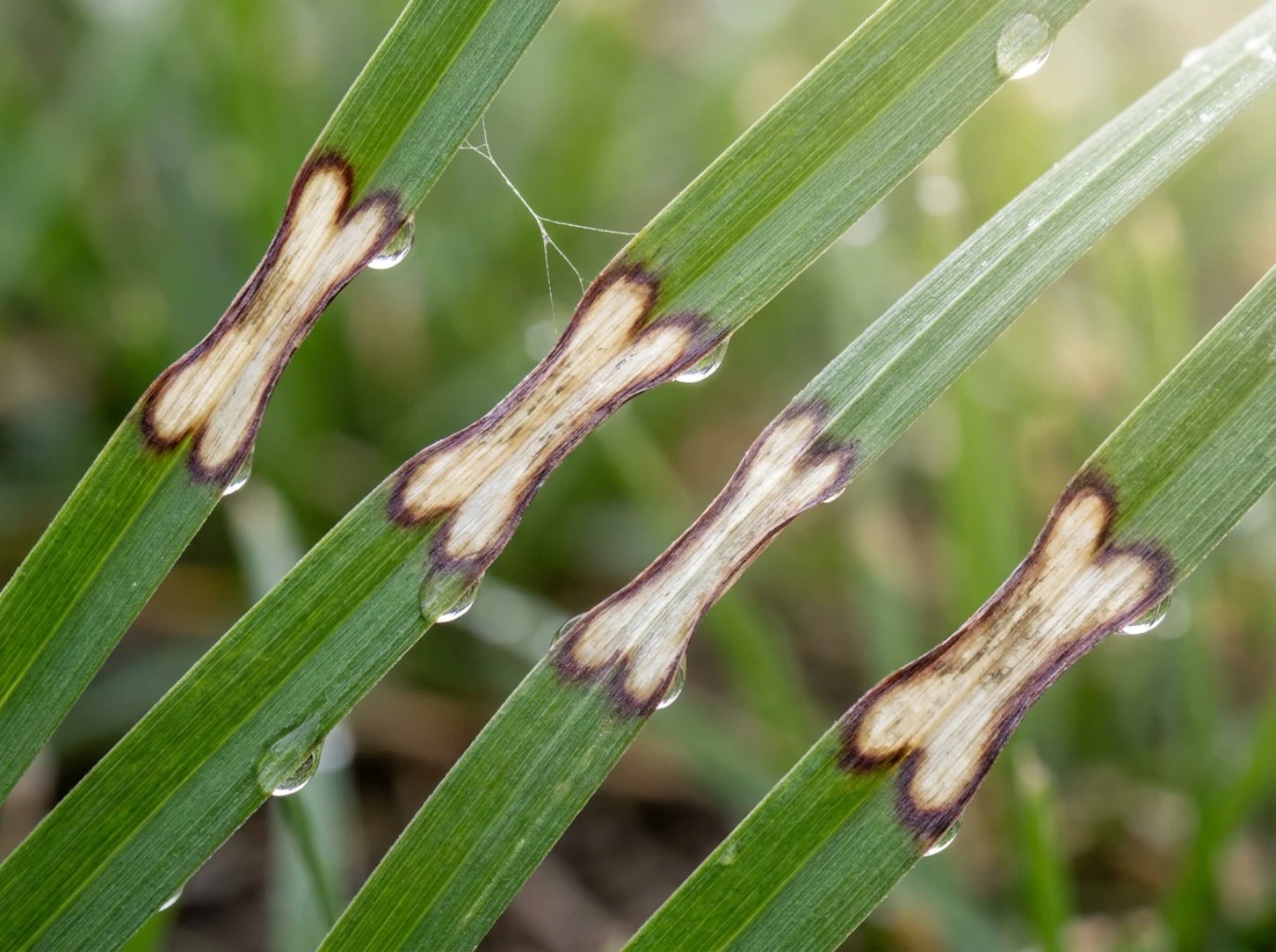
Three field signatures, taken together, confirm the diagnosis with high confidence. Any one of them alone can be ambiguous. All three together are conclusive.
| Diagnostic Tell | What You Are Looking For | Best Time to Check |
|---|---|---|
| Silver-dollar-sized bleached circles | Well-defined round patches, roughly 1 to 6 inches across, straw or bone-white in the center, with a crisp edge against healthy green grass | Any time of day |
| Hourglass lesions on individual blades | A bleached tan band crossing the width of a single blade, pinched in the middle, bordered top and bottom by a reddish-brown or purple-brown line | Mid-morning onward, using a hand lens |
| Cobwebby white mycelium | Fine white webbing draped across the canopy inside the patch, looking like a spider web that got rained on | Sunrise to roughly 9 a.m., while moisture is still present |
Tell 1: The Patches Are Small and Sharply Defined
The patches are small. On a home yard cut at normal residential height, they typically run 2 to 6 inches across, and closer to 1 to 2 inches on closely mown grass. The classic description is the diameter of a silver dollar, and it holds up.
The edges separate them from almost everything else. A dollar spot circle has a clean boundary that a leaf spot or a drought edge never shows. Healthy green grass sits right against bleached straw-colored blades with very little transition zone. When the weather holds, circles expand and merge into irregular blotches, but you can usually still see the round outlines that made them.
The color inside the patch is also distinctive. The pathogen bleaches the grass toward bone-white or pale straw, not the tan-brown or smoky gray tones brown patch leaves behind.
Tell 2: The Hourglass Lesion Is the Confirming Detail
This is the tell that ends the argument. Pull a few blades from the edge of a suspect patch and look at them closely, ideally with a hand lens or a phone camera at macro focus.
The lesion crosses the entire width of the grass blade. The center of the lesion is bleached tan or straw. Above and below it, a narrow reddish-brown or purple-brown border separates the dead tissue from the remaining green tissue. Because the lesion is often slightly narrower in the middle, the shape reads as an hourglass or a bowtie.
No other common North Carolina turf problem produces that pattern. Brown patch lesions are irregular and run lengthwise along the blade. Drought produces uniform tip dieback with no border line. A dull mower blade shreds the very tip and leaves a frayed white edge, not a banded lesion in the middle of the blade.
NC State Extension identifies the banded, hourglass-shaped leaf lesion as the defining symptom of dollar spot on North Carolina turf.
Tell 3: The White Webbing Shows Up Only at Dawn
Walk the lawn before the sun burns off the overnight moisture. Inside an active patch, you may see fine white webbing stretched across and between the grass blades. It looks cobwebby, delicate, and slightly wet.
That webbing is mycelium, the thread-like body of the fungus, and it shows only while free moisture holds it together. By mid-morning it collapses and disappears, which is why a homeowner who checks the lawn after work never sees it and assumes the diagnosis is wrong. It is also why a professional inspection happens early in the day.
The Misdiagnosis Matrix: What Dollar Spot Gets Confused With
Here is the differential that most content skips. Five different problems produce bleached or browned grass in a North Carolina yard during the shoulder seasons, and homeowners regularly assign the wrong one.
| Condition | Patch Size and Shape | Individual Blade Sign | Mycelium Present? | Primary Trigger | Fastest Confirming Check |
|---|---|---|---|---|---|
| Dollar spot (Clarireedia spp.) | Sharply defined circles, 1 to 6 inches, bone-white to straw, may merge | Hourglass band across the blade with reddish-brown borders | Yes, fine white cobwebby webbing at dawn only | Cool nights, mild days, long leaf wetness, low nitrogen | Hand-lens check for the hourglass lesion |
| Brown patch (Rhizoctonia solani) | Rough circles, 6 inches to several feet, tan to smoky brown, often with a dark smoke-ring border | Irregular lengthwise lesions with dark brown borders | Yes, gray cottony webbing at dawn | Night temperatures above 65°F plus 10-plus hours of leaf wetness | Patch size plus the smoke-ring border |
| Drought stress | No discrete circles; irregular hot spots, high ground, or whole-lawn dulling | Uniform tip-down browning, no banded lesion, blade folds lengthwise | No | Soil moisture deficit, compacted or shallow soil, irrigation gaps | Footprints stay visible in the canopy; probe finds dry soil |
| Dull mower blade damage | No circles; a uniform silver-gray or whitish cast across the entire cut area | Shredded, frayed, ragged leaf tips that turn white or tan within 48 hours | No | A dull or nicked blade, or cutting wet grass | Damage stops exactly at the mow line and covers everything cut |
| Insect feeding (chinch bug, white grub, sod webworm) | Irregular expanding patches, often in full-sun or drought-stressed areas; grub damage lifts like loose carpet | Notched or chewed blades (sod webworm), no lesion pattern; turf pulls free with no roots (grubs) | No | Sustained heat and dry conditions; species-specific life cycles | Tug test for grubs; part the canopy and look for insects at the soil line |
| Dog urine spots | Small dead centers ringed by a darker, taller green halo | No lesion pattern; blades dead outright at the center | No | Concentrated nitrogen and salts in one place | The dark green ring around the dead spot |
Dollar Spot Versus Brown Patch: The Most Common Mix-Up
These two get confused constantly, and the confusion causes real problems because their nitrogen relationship is inverted.
Brown patch is a high-nitrogen, high-heat disease. It intensifies when night temperatures stay above 65°F and the canopy holds wetness for more than ten hours, and a heavy fertilizer application going into that window makes it worse. If you want the full mechanism, we covered it in brown patch in fescue explained.
Dollar spot disease is the opposite on the nitrogen side. It gets more severe when the plant is nitrogen-deficient and growing slowly. Treating an outbreak the way you would treat brown patch, by cutting nutrition and waiting, usually makes the patches worse.
Size is the fastest field separator. Brown patch starts at roughly 6 inches and goes up from there, often reaching several feet. These circles stay small and stay round. Dozens of tight little circles rather than a few large rough ones means dollar spot.
Dollar Spot Versus Drought Stress
Drought stress does not make circles. That is the whole differential in one sentence.
Drought browning follows water availability across the property. It shows up on south-facing slopes, over shallow soil, near tree root competition, and wherever an irrigation head throws short. The affected grass develops a blue-gray cast before it browns, and footprints stay pressed into the canopy because the blades have lost the turgor to spring back.
The confusion happens because this pathogen genuinely does prefer soils on the dry side while the canopy stays wet from dew. A lawn can carry both problems at once. But drought alone produces no hourglass lesions and no dawn webbing.
Dollar Spot Versus Dull Mower Blade Damage
A dull mower blade tears the leaf rather than cutting it. The torn tips desiccate and turn whitish within a day or two, and from a standing position that cast across the yard can absolutely read as disease.
Two checks settle it:
- Distribution. Blade damage is uniform, covering every square foot the machine touched, with no discrete circles. Dollar spot appears as separated round patches.
- Position on the blade. Blade damage is confined to the very tip and looks shredded. A dollar spot lesion sits in the middle of the blade with a clean reddish-brown border on both sides.
There is a real connection, though. Torn leaf tips create wounds, and wounds give the pathogen an easier entry point. Sharp blades reduce disease pressure indirectly, which is why blade maintenance shows up on every serious lawn care checklist.
Dollar Spot Versus Insect Feeding
Insect damage in North Carolina yards produces irregular, expanding patches rather than small tidy circles. The southern chinch bug (Blissus insularis) feeds in hot, sunny, dry areas and produces yellowing that spreads outward. White grubs sever roots, so damaged sod lifts away from the soil like loose carpet. Sod webworms notch the blades and leave small green fecal pellets in the thatch.
None of those produce banded hourglass lesions or dawn webbing. If you are working through a broader symptom set, the circles-in-your-lawn diagnostic walks the full cross-differential, and the lawn insect control program page covers the insect side in detail.
Why Shoulder Season Drives Dollar Spot Disease Development
Dollar spot is not a summer disease and it is not a winter disease. It lives in the transitions, and understanding why explains almost everything about when it appears. The fungus grows best when daytime air temperatures sit roughly between 60°F and 85°F, the mild band on either side of a North Carolina summer. Inside that band, three conditions have to line up.
| Condition | What It Looks Like in North Carolina | Why It Matters |
|---|---|---|
| Mild days, cool nights | Afternoons in the 70s or low 80s, nights dropping into the 50s or low 60s | The temperature swing drives condensation, which produces heavy dew |
| Prolonged leaf wetness | Dew that forms after midnight and does not dry until 9 or 10 a.m. | The pathogen needs free moisture on the leaf to move from blade to blade |
| Slow grass growth | Grass that has run low on available nitrogen and is not pushing new leaf tissue | The plant cannot outgrow the lesions faster than the fungus creates them |
Those three conditions cluster in late spring and early summer, and again in early fall. That is the shoulder-season pattern the title refers to. The same lawn can produce a flush of dollar spot in May, go quiet through the deep humidity of July and August while brown patch takes over, and then produce a second flush in September and October.
Homeowners who only associate lawn disease with midsummer heat get caught by both flushes. The NC turf disease calendar maps the full year around the four weather windows that drive pressure in this state.
The Dew Window Is Longer Than Most People Think
Dew is the quiet driver behind how fast dollar spot spreads. On a clear, calm shoulder-season night, radiational cooling pulls the canopy temperature below the dew point, and free water condenses on every blade. That water sits there until the sun has enough angle to evaporate it.
In practice that can be a ten to fourteen hour window of continuous leaf wetness without a drop of rain or irrigation. Add an evening watering cycle and the window stretches longer still.
The pathogen moves between grass blades only while that free water is present. Longer dew equals more spread. That is why two yards on the same street can carry completely different disease pressure with identical grass and identical weather. One sits in a low, shaded, still pocket. The other gets morning sun and air movement.
The Nitrogen Paradox in Dollar Spot Lawn Care
This is where managing dollar spot gets genuinely counterintuitive, and where most generic advice falls apart.
Severity goes up when the grass is nitrogen-deficient. The mechanism is straightforward: a plant with adequate nitrogen produces new leaf tissue quickly and can literally grow past the lesions, replacing damaged blades faster than the pathogen can create new ones. A nitrogen-starved plant grows slowly, holds damaged tissue longer, and gives the pathogen a larger standing supply of leaf surface to work on.
MSU Extension notes the same relationship, listing inadequate nitrogen fertility as a primary predisposing factor.
Here is the paradox. In North Carolina, the standard and correct nitrogen program for tall fescue puts the bulk of the season's nitrogen into fall, when the grass is doing root work and can use it. Heavy nitrogen in late spring or early summer sets up brown patch. So the calendar that protects fescue from brown patch is the same calendar that leaves it thin on nitrogen exactly when dollar spot wants to run.
| Nitrogen Timing | Effect on Brown Patch | Effect on Dollar Spot |
|---|---|---|
| Heavy nitrogen in late spring or early summer | Increases severity significantly; succulent tissue is easier to infect | Reduces severity; the plant outgrows lesions |
| Lean nitrogen through summer | Reduces severity | Increases severity; the plant cannot outgrow lesions |
| Bulk of nitrogen in fall | Correct for cool-season root development | Reduces fall-flush severity when timed early enough |
The resolution is not to pick one disease and lose to the other. It is to change the size and form of the application rather than the total. A light foliar fertilizer application during an active flush, at a fraction of a typical rate, restores enough growth to push out lesions without producing the lush succulent tissue that brown patch exploits.
That is a judgment call about rate, form, and timing, which is why this disease is worth having identified rather than guessed at. Aligning the weed control and fertilization program to the disease calendar is often the highest-value adjustment on a property with a recurring history.
Which North Carolina Turfgrass Types Get Hit
The disease has a wide host range, but the presentation and the risk profile differ by grass type.
| Turf Type | Susceptibility | How It Presents | Notes for North Carolina |
|---|---|---|---|
| Tall fescue | Moderate to high | Small bleached circles, most visible in the shoulder seasons | The dominant cool-season lawn grass in central North Carolina; Clarireedia jacksonii is the usual species |
| Bermudagrass | High | Tight bleached circles, often on the leading edge of the mild transition periods | Clarireedia monteithiana is the usual species; damage is largely cosmetic on vigorous stands |
| Zoysia | Moderate | Circles blend into the dense canopy and are easy to miss early | Slow growth habit means lesions persist longer once they form |
| Kentucky bluegrass | Moderate | Classic silver-dollar circles | Less common as a standalone lawn grass in the state; usually seen in fescue blends |
| Perennial ryegrass | High | Rapid circle development under heavy leaf wetness | Common in overseeded stands and in seed blends |
Cultivar choice matters more than most homeowners realize. Turfgrass breeding programs have made real progress on resistance to dollar spot, and university trial data tracks resistance ratings by cultivar. During a lawn renovation, choosing seed bred to resist common lawn diseases like this one is a permanent, no-maintenance reduction in pressure.
How to Prevent Dollar Spot Without Reaching for a Product
Before any product decision, there is a set of lawn care adjustments that measurably reduce severity and help prevent dollar spot from returning. On properties with mild to moderate pressure, these corrections alone are frequently enough.
- Shorten the wet period. Dragging a hose or a rope across the lawn early in the morning knocks the dew off the canopy and can cut the leaf wetness window by two or three hours. It costs nothing and it works.
- Water deeply and early. One deep irrigation cycle between roughly 4 a.m. and 8 a.m. lets the canopy dry by mid-morning. Frequent shallow watering and any evening cycle both extend leaf wetness into the danger zone.
- Keep the mower blade sharp. Sharpen every 20 to 25 hours of mowing. Clean cuts heal faster and give the dollar spot fungus fewer entry wounds than torn tips.
- Raise the cutting height and never remove more than one-third of the grass blade in a single pass. Scalping the lawn weakens grass, shortens roots, and raises severity. Taller grass holds deeper roots and better drought tolerance.
- Maintain adequate nitrogen at the right rate. Light, well-timed fertilizer applications during an active flush help the plant outgrow lesions. Blanket heavy applications are the wrong answer, and a soil test tells you what the nutrient levels in the soil actually are.
- Manage thatch above half an inch. Thatch is where the pathogen overwinters. Core aeration and biological topdressing rebuild the decomposition cycle that keeps thatch in check.
- Improve air movement where you can. Pruning low limbs and thinning dense shrubs that shade your lawn around a chronically affected area increases morning air flow and shortens the dew window.
- Pause returning clippings back into the lawn during an active outbreak. The pathogen travels on infected clippings, so bagging while the disease is running reduces mechanical spread.
Doing five or six of those consistently changes the trajectory of an affected property within a single season. NC State TurfFiles reaches the same conclusion, emphasizing dew removal, balanced fertility, and irrigation timing as the primary levers before any chemical decision.
Where Soil Biology Changes the Equation
Cultural corrections address the environment side of the disease. Soil biology addresses the pathogen side.
The top few inches of soil under the grass hold a working population of beneficial bacteria and fungi that compete with pathogens for space and for the sugars leaking out of grass roots. When that population is diverse and active, Clarireedia is outnumbered before it reaches the density required to produce visible lesions. When it has been thinned by compaction, drought, or repeated broad-spectrum applications, the pathogen finds an open lane.
This is the mechanism we unpacked in why healthy soil fights disease, and it applies to dollar spot as directly as it applies to brown patch. Beneficial soil fungi in the Trichoderma group and soil bacteria in the Bacillus group are among the organisms carrying that suppression load on North Carolina lawns. The USDA Agricultural Research Service has documented these suppressive soil effects across decades of cropping-system research.
The practical version is simple. A lawn with active, diverse soil biology tolerates the same wetness window and nitrogen dip that produces a flush of circles on a depleted property next door. Soil biology raises the threshold. It does not make the pathogen disappear.
Why the Same Corner Gets It Every Year
Homeowners often report that dollar spot returns to the exact same spots season after season. Three reasons are usually stacked together:
- The pathogen overwinters in place, in the thatch of that specific area, so the starting inoculum is highest right where it was last time
- The microclimate has not changed. The shade, the slope, and the still air that produced the long dew window are all still there
- The soil biology in that patch is the weakest on the property, often because the same spot is also the most compacted or the most shaded
Breaking the cycle takes all three: mechanical correction of thatch and compaction, environmental correction of the dew window where possible, and biological rebuilding of the soil in that specific area.
How to Treat Dollar Spot When Fungicide Is the Right Call
Targeted fungicide has a legitimate place in managing this disease. Nature's Select® reserves it for outbreaks above the treatment threshold, matched to the pathogen identified on site, and applied at the lowest effective rate.
The threshold is a judgment a state-licensed applicator makes on the property. Four factors weigh into it:
- How much of the yard is affected, and whether the circles have started merging
- How fast the patches expanded over the last seven days
- What the temperature and humidity forecast looks like over the next seven to ten days
- How much healthy grass is left to carry the recovery
Below that threshold, cultural correction and nutrition are the right intervention and usually the sufficient one. Above it, two points matter.
First, this pathogen has a documented history of developing resistance to single-mode-of-action chemistry when the same product is used repeatedly, so rotating between chemical classes is what keeps the tools working. The fungicides for dollar spot fungus most often cited in university guidance are chlorothalonil and propiconazole, which sit in different classes for exactly that reason.
Second, broad-spectrum products suppress beneficial soil fungi along with the target, which is why an application works best paired with a biological rebuild between visits.
That is not an argument against fungicide. It is an argument for using it precisely, on a confirmed diagnosis, as one component of a program.
How Nature's Select® Handles Dollar Spot in North Carolina

Every disease call starts the same way. A state-licensed specialist walks the property early in the day, while the webbing is still readable, and identifies the pathogen on site, typically within 25 to 40 minutes of arriving.
For a suspected dollar spot call, the specialist works through a specific sequence:
- Blade-level inspection for hourglass lesions with a hand lens
- Canopy inspection for cobwebby webbing while moisture still holds
- Patch measurement and edge assessment to separate dollar spot from brown patch
- A soil moisture probe to establish whether drought stress is layered underneath
- A review of the nitrogen history on the property, because the fertility timeline is often the whole explanation
- A thatch depth check, because thatch is where the pathogen shelters between flushes
The plan is matched to what the property actually needs. Sometimes it is a light foliar nitrogen correction and a change to the irrigation clock. Sometimes it is moisture management plus fall core aeration to address the thatch layer carrying the pathogen. Sometimes, when the outbreak is above threshold and the weather window is holding, it is a targeted application alongside the biological program.
Nature's Select® was founded in 1994 by Dr. William Hildebolt, a food scientist trained at Ohio State University, and the soil-first methodology has been running on North Carolina lawns ever since. The company operates active offices in Winston-Salem, Greensboro, Chapel Hill, and Pinehurst, with continued expansion across the state. Call the toll-free line and you reach the office that covers your address.
If you are seeing small bleached circles in your lawn right now, request a lawn disease assessment or call (888) 786-9735. Hiring a professional lawn care company means the diagnosis gets confirmed at the species level rather than guessed from a photo, and you catch dollar spot fungus early enough to adjust before the circles merge.
Recovery After Dollar Spot Fungus Treatment
Because the disease is foliar, recovery prospects are generally good. The crown of the plant is usually untouched, which means the grass can regrow leaf tissue from tissue that was never infected.
A rough recovery timeline looks like this:
- Days 1 to 14: Active treatment plus a shorter wet window stops the spread. The circles stop enlarging, but they still look bleached.
- Weeks 2 to 4: Small, early-caught patches on otherwise healthy turf fill in through new growth. Bleached blades never turn green again; they get replaced.
- Weeks 4 and beyond: Larger merged areas where the stand has thinned need overseeding or a full lawn renovation to return to density.
- Fall renovation window: On cool-season turf in central North Carolina, that overseeding belongs with core aeration, so seed reaches soil and the soil biology gets rebuilt at the same time.
The lawns that stop having a problem are the ones where the underlying conditions changed:
- Nutrition rate and timing corrected to the disease calendar
- Irrigation moved to a single early-morning cycle
- Thatch brought back under half an inch
- Soil biology rebuilt through a seasonal biological lawn care program
The pathogen is still in the soil. It simply stops finding an opening.
Key Takeaways
- Dollar spot is a foliar disease caused by Clarireedia fungi (Clarireedia jacksonii on cool-season grasses, Clarireedia monteithiana on warm-season grasses), formerly published as Sclerotinia homoeocarpa.
- Three tells confirm it: sharply defined bleached circles 1 to 6 inches across, hourglass lesions with reddish-brown borders on individual blades, and cobwebby white mycelium visible only in early morning dew.
- It is a shoulder-season disease, active when days run 60°F to 85°F, nights turn cool, and dew holds on the canopy for ten hours or more, which produces flushes on both sides of summer.
- Low available nitrogen makes dollar spot worse, which is the opposite of brown patch, and mixing up the two leads homeowners to apply exactly the wrong correction.
- Moisture management, early-morning irrigation, sharp mower blades, correct fertilizer rate and timing, and thatch control reduce severity more reliably than any single product.
- Soil biology raises the threshold at which the pathogen can produce visible damage, which is why properties with active, diverse soil microbiology tolerate conditions that trigger circles next door.
Frequently Asked Questions
What does dollar spot lawn disease look like?
Dollar spot produces sharply defined bleached circles roughly 1 to 6 inches across, straw to bone-white in the center, against healthy green grass. On individual grass blades it creates an hourglass-shaped lesion: a tan band crossing the blade with narrow reddish-brown borders above and below. In early morning, fine white cobwebby mycelium is often visible inside the patch, disappearing entirely by mid-morning.
What is the difference between dollar spot and brown patch?
Size and nitrogen are the two separators. Dollar spot makes small round circles 1 to 6 inches across and gets worse when the lawn is nitrogen-deficient. Brown patch makes rough patches from 6 inches to several feet, often with a dark smoke-ring border, and gets worse after heavy fertilizer in warm humid weather. Dollar spot lesions are hourglass-banded; brown patch lesions run irregularly along the blade.
How do I treat dollar spot in my lawn?
Start with the conditions rather than a product. Remove morning dew by dragging a hose or rope across the canopy, shift irrigation to a single deep cycle before 8 a.m., sharpen the mower blade, and correct nitrogen with a light, well-timed fertilizer application so the grass can outgrow the lesions. For outbreaks above the treatment threshold, a targeted fungicide matched to the pathogen and rotated between chemical classes stops active spread.
How long does it take for dollar spot to go away?
Active spread usually stops within one to two weeks once the conditions change and nutrition is corrected, because the pathogen needs prolonged leaf wetness to keep moving. Visual recovery takes longer. Small early-caught patches typically fill in within two to four weeks through new growth. Larger merged areas where the stand has thinned often need fall overseeding to return to full density.
What causes dollar spot lawn disease?
Clarireedia fungi already living in the thatch become active when three conditions align: daytime temperatures roughly between 60°F and 85°F, prolonged leaf wetness lasting ten hours or more, and slow grass growth from inadequate nitrogen levels in the soil. Compacted soil, excess thatch, evening irrigation, dull mower blades, and depleted soil biology all increase severity once those conditions are present.
Can low nitrogen really cause dollar spot?
Low nitrogen does not create the pathogen, but it strongly increases severity. A nitrogen-adequate plant produces new leaf tissue fast enough to replace infected grass blades faster than the pathogen creates new lesions. A nitrogen-starved plant grows slowly and holds damaged tissue, giving the pathogen more standing leaf surface to colonize. This is why a light, correctly timed fertilizer application is a legitimate first response to an active dollar spot flush.
How do I tell dollar spot from drought stress?
Drought does not make circles. Drought browning follows water availability across the property, showing up on slopes, over shallow soil, and where irrigation throws short, and it produces a blue-gray cast with footprints that stay visible in the canopy. Dollar spot makes discrete round patches with hourglass lesions on individual grass blades and dawn webbing. A lawn can have both problems at the same time.
Can a dull mower blade look like dollar spot?
Yes, from a standing position. A dull blade tears rather than cuts, and the shredded tips turn whitish within a day or two, producing a silver-gray cast that reads as lawn disease. Two checks separate them: blade damage is uniform across everything the machine touched with no discrete circles, and the damage sits at the very tip rather than as a banded lesion mid-blade.
What types of grass are most affected by dollar spot in North Carolina?
Tall fescue, bermudagrass, and perennial ryegrass carry the highest visible pressure in North Carolina, with zoysia and Kentucky bluegrass moderately affected. Clarireedia jacksonii is the usual species on cool-season grasses like fescue and ryegrass, while Clarireedia monteithiana is typical on bermudagrass and zoysia. Cultivar choice matters: modern seed blends bred to resist common lawn diseases like dollar spot reduce pressure permanently.
Should I use fungicide to treat dollar spot?
Only above the treatment threshold and only on a confirmed diagnosis. Many outbreaks resolve with moisture management, irrigation timing, and a light nitrogen correction. When a fungicide application is warranted, rotating between chemical classes matters because Clarireedia has a documented history of developing resistance to repeated single-mode chemistry. Pairing any application with a biological soil program protects the beneficial fungi that suppress the next outbreak.
Conclusion
Dollar spot gets misdiagnosed because it shows up at the moment nobody is watching for lawn disease, and because the fix that works for the disease everyone does watch for is the opposite of what dollar spot needs. Small bleached circles in a mild stretch, hourglass lesions on the blades, and cobwebby webbing at dawn are a specific fingerprint, and once you can read it the rest of the plan follows.
The good news is that it is one of the most correctable lawn care diseases in North Carolina. It attacks leaf tissue rather than crowns, it responds to nutrition and moisture management before it responds to chemistry, and properties with rebuilt soil biology tolerate the conditions that used to produce a flush of circles every shoulder season.
If your lawn is showing small bleached circles right now, do not guess between disease, drought, blade damage, and insects. Book a Nature's Select® biological disease program assessment or call (888) 786-9735, and a state-licensed specialist from the office covering your address will walk the lawn, confirm the diagnosis at the species level, and build a plan matched to what your property actually needs. Same-day estimate, no long-term contract.