Brown Patch in NC Fescue: Why It Only Shows Up in July (And What Your Soil Is Telling You)
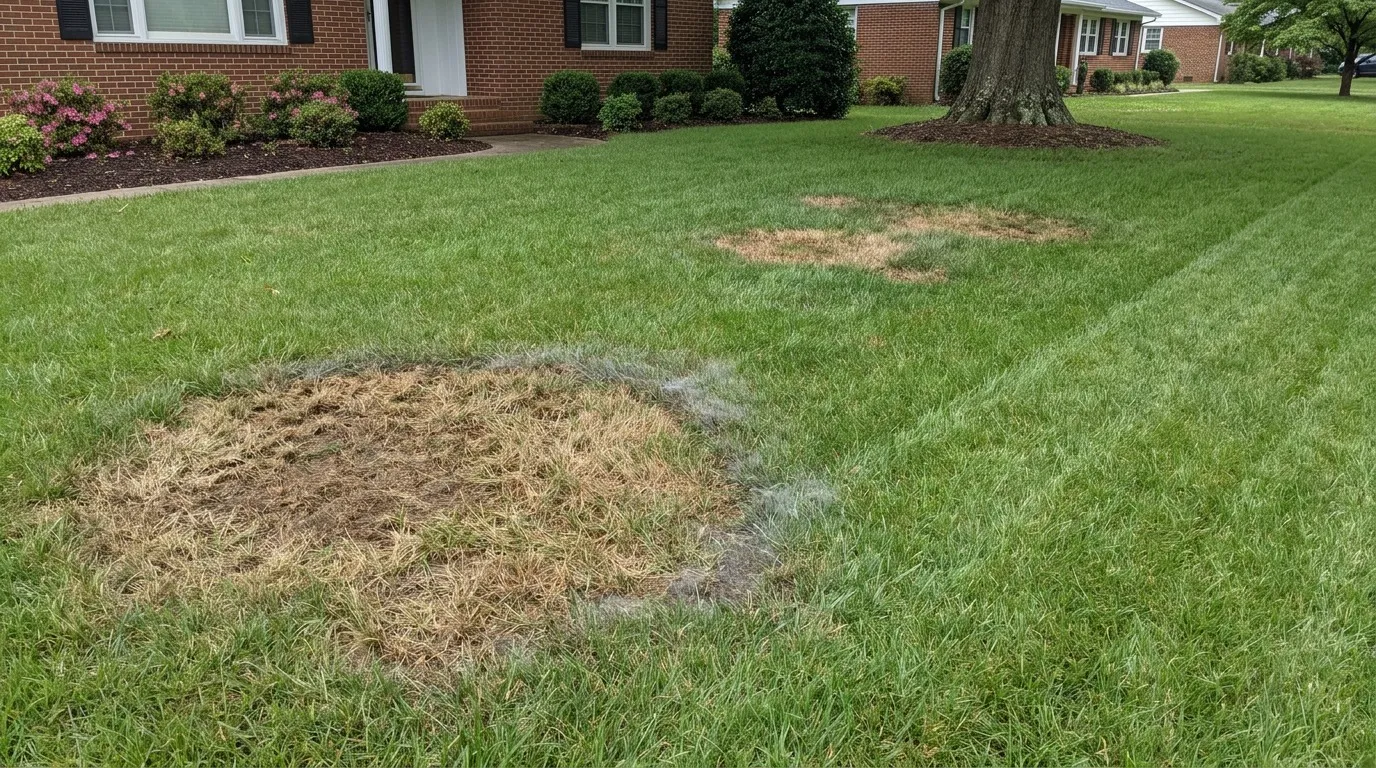
Brown patch on tall fescue in North Carolina is caused by Rhizoctonia solani, a soil-borne fungus that turns active when night temperatures stay above 65°F and leaf wetness lasts more than 10 hours. That is why July feels like an on-switch: the pathogen has been in the soil all along, waiting for a specific combination of humidity, warmth, mowing height, and nitrogen timing to break out. The circular patches are not the beginning of the story. They are the soil telling you the disease triangle just closed.
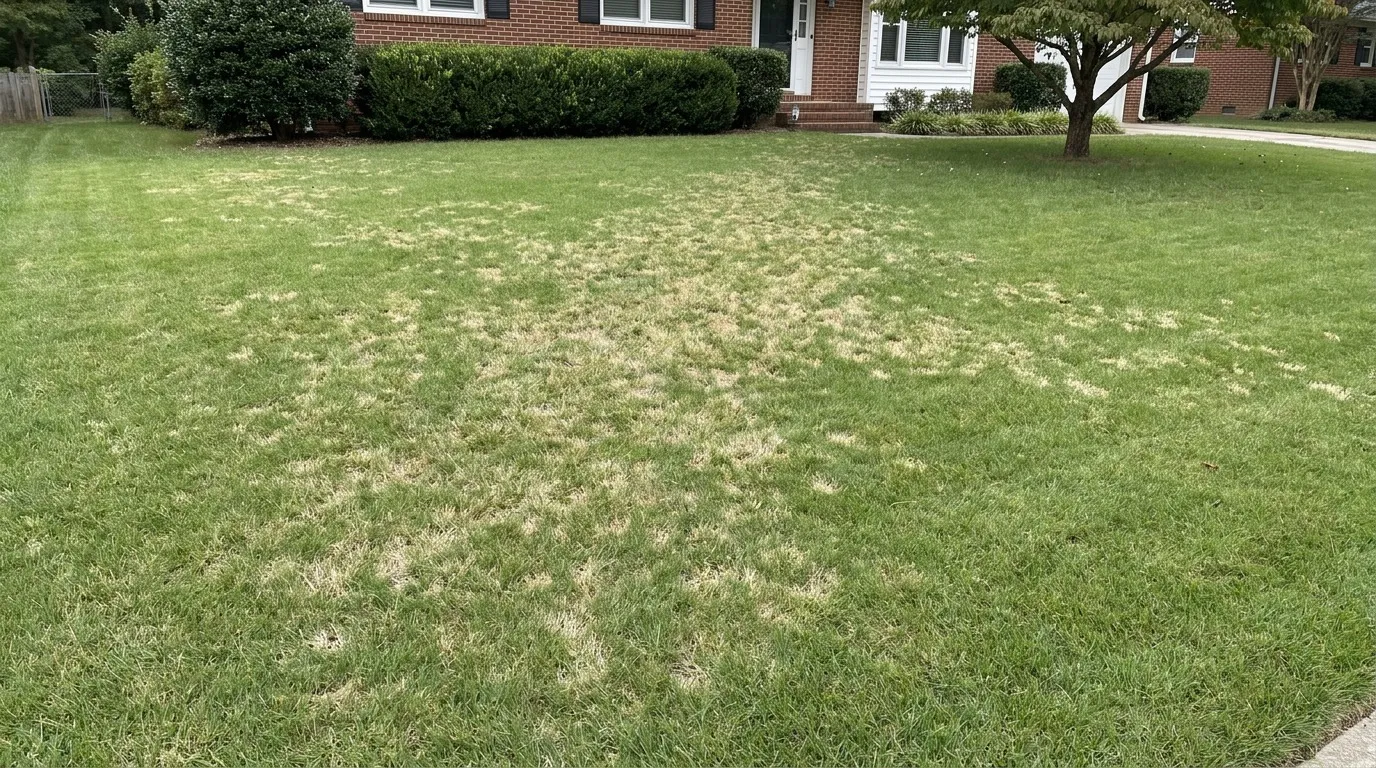
If you walk out to your fescue lawn on a July morning and see rough circular tan patches with a smoke-ring border, you are looking at brown patch fungus. Every North Carolina homeowner with tall fescue meets it sooner or later, and most of them meet it for the first time in July.
The question worth asking is not what brown patch is. The question is why it showed up in your yard this year, in these spots, at this specific moment. The answer involves soil biology, mowing height, irrigation timing, and how a cool-season grass responds to summer humidity. This article explains the pathogen at species level, the disease triangle that lets it activate, the soil signals your lawn is sending, and how a biological program at Nature's Select® reads the same signals before the patches spread.
What Brown Patch Actually Is
Brown patch is a foliar and crown disease caused by the fungus Rhizoctonia solani. Under the microscope, it looks like a network of tan, branching threads called mycelium. In your lawn, that mycelium spreads across the canopy overnight when leaves stay wet and warm, and it feeds by digesting the fescue's leaf tissue at the crown.
The pathogen is already in your soil. Rhizoctonia solani survives year-round in North Carolina turf as resting structures called sclerotia and as thread-like hyphae in thatch and organic debris. It is not something that arrives from a neighbor's yard or blows in on the wind. It is a resident of the soil biology that gets activated when three conditions line up at once. NC State Extension identifies Rhizoctonia solani as the fungus responsible for brown patch outbreaks on cool-season turf across North Carolina (Brown Patch in Turf, NC State Extension).
Tall fescue is the primary host in central North Carolina because it is a cool-season grass forced to survive a subtropical summer. Cool-season grasses reduce root activity when soil temperatures climb above 80°F, which weakens the plant's ability to fight off pathogens that thrive in exactly those conditions. Bermudagrass and zoysia see brown patch pressure too, but the disease presents differently on warm-season turf and is called large patch when it strikes those species in spring and fall.
The Species-Level Detail That Matters
Naming the pathogen is not academic. Rhizoctonia solani has specific weather triggers, a specific class of fungicides it responds to, and a specific soil-biology story that explains why some lawns get it every year and others almost never do. Generic "lawn fungus" content misses all three.
Why July Is the Trigger Month in North Carolina
Brown patch follows what plant pathologists call the disease triangle: pathogen + host + environment. All three sides have to close before the disease breaks out. In North Carolina, the environmental side of that triangle closes in July.
The specific weather conditions that trigger active Rhizoctonia solani growth are:
- Night temperatures above 65°F. The fungus grows optimally between 70°F and 90°F. When July nights stop dropping below that threshold, the pathogen switches from dormant to active.
- Leaf wetness longer than 10 hours. Heavy dew, evening irrigation, humid air overnight, or an afternoon storm followed by a warm night all keep the canopy wet long enough for mycelium to spread from blade to blade.
- Relative humidity above 90%. Central North Carolina summer humidity often lingers overnight, especially near the Triad and Triangle, where rainfall pools in low spots and heavy clay slows drainage.
Look at the calendar this way: May is warm but nights still cool off. June has heat but humidity stretches are shorter. July combines the sustained warm nights and the multi-day humidity stretches that let Rhizoctonia solani run its 5-to-10-day reproductive cycle in tall fescue. NC State TurfFiles documents that brown patch outbreaks intensify when warm, humid conditions push nighttime temperatures above the 65°F threshold and hold leaf wetness on the canopy overnight (TurfFiles Brown Patch, NC State).
That is why brown patch feels sudden. The pathogen was there. The host was there. The environmental switch flipped in July.
What Extended Humidity Actually Does
When the canopy stays wet for 10 or more hours, mycelium can grow from a single infected blade onto every blade it touches. One 6-inch patch on Monday morning becomes a 14-inch patch by Friday if the humidity holds. Most lawn fungi reproduce on a 5-to-10-day cycle in summer humidity, so every cycle the affected area roughly doubles. That is the number to remember. Not "the disease might spread." Doubling.
The Field Signatures That Confirm It Is Brown Patch
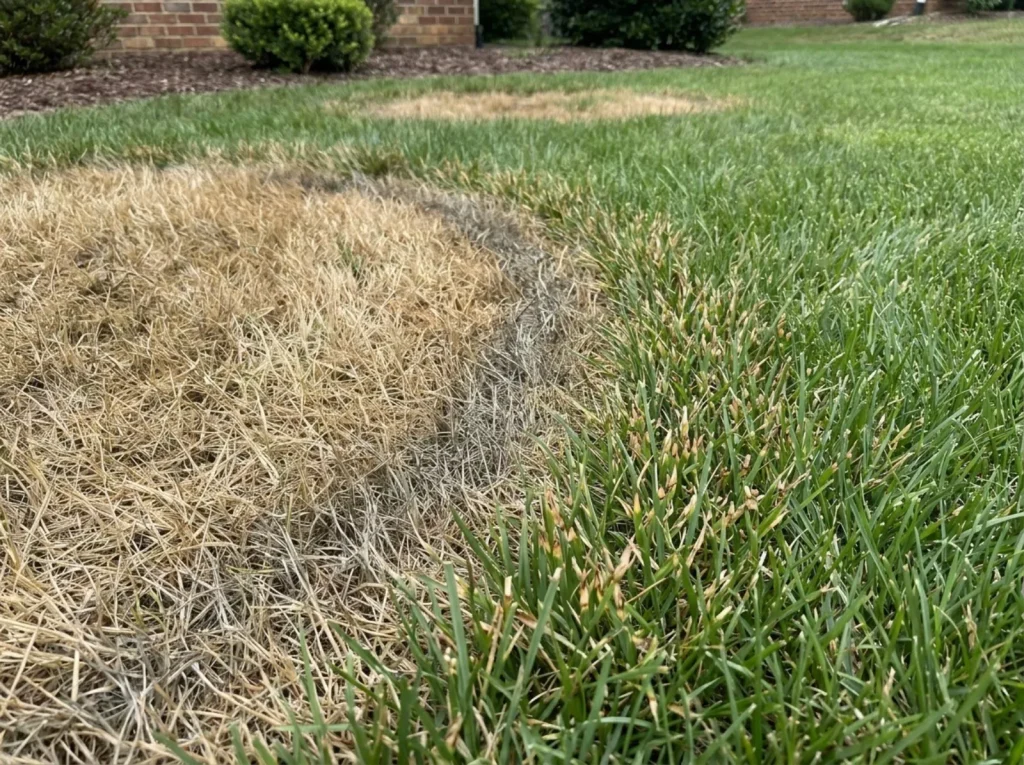
Not every circular brown patch on a fescue lawn is brown patch fungus. Grub damage, dog spots, drought stress, and Pythium blight all produce circular damage. If you are working through a diagnostic walk-through, our guide on is it fungus, grubs, or dog spots? gives you the cross-differential.
Brown patch has four field signatures that confirm the diagnosis:
| Field Signature | What You See | When It Appears |
|---|---|---|
| Circular patch | Rough tan or straw-colored circles ranging from 6 inches to several feet in diameter | Any point during active outbreak |
| Cottony gray mycelium | Fine gray or white webbing across the canopy inside the patch | Early morning dew, before sunrise fully dries the canopy |
| Smoke-ring border | Thin dark brown or purple-brown ring around the edge of the patch | During active spreading, especially after a humid night |
| Foliar lesions | Irregular tan lesions with dark brown borders on individual blades | Present throughout the outbreak; visible with a hand lens |
The mycelium is the confirming detail. If you walk your fescue lawn at sunrise and see a rough circular patch with fine gray webbing across the blades, you are looking at active brown patch. By 10 a.m. the mycelium dries down and disappears, which is why a specialist inspection almost always happens early in the day. The smoke-ring border and the foliar lesions with the dark brown border persist longer and make the diagnosis reliable even at midday.
Damage pattern in tall fescue tends to be irregular rather than perfect circles, because the fungus expands along wet leaf paths rather than in a neat radius. Patches can range in size from a few inches to several feet in diameter, and multiple patches often merge as they grow.
What Your Soil Is Telling You
Here is where the story shifts. The circular patches are the visible symptom. The soil signal underneath them tells you why the disease triangle closed in your yard this year.
There are four soil signals a Nature's Select® specialist reads at the same time the diagnosis happens on site:
Nitrogen timing. Fescue lawns that received a heavy nitrogen application in late May or June entered July with lush, succulent leaf tissue that Rhizoctonia solani digests faster. High nitrogen right before the summer humidity window makes the host side of the disease triangle wide open. The right nitrogen timing for fescue in North Carolina puts the bulk of the nitrogen into fall and early winter when the grass can use it for root development, with a lean summer application if any.
Mowing height. Tall fescue mowed shorter than 3.5 inches during summer stresses the plant, reduces root reserves, and produces more leaf wetness per canopy inch because the humid air pools in the shorter, denser canopy. Raising mowing height to 3.5 to 4 inches for the summer is one of the single largest cultural levers for reducing brown patch pressure.
Drainage and irrigation timing. Poor soil drainage is the single most consistent factor in repeat brown patch outbreaks. Compacted clay soil, low spots, or a heavy thatch layer all keep the canopy wetter longer. Irrigation applied late in the day or in the evening keeps leaf wetness above the 10-hour threshold overnight. Watering deeply and infrequently in the early morning, so the canopy dries by 10 a.m., is the discipline that shortens the wet window.
Soil microbial diversity. Healthy soil hosts beneficial fungi and bacteria that compete with Rhizoctonia solani at the root and crown level. This is the biological science behind soil-first disease control. A biological program rebuilds Trichoderma harzianum, Bacillus subtilis, and mycorrhizal populations through seasonal applications, so the pathogenic fungus is outcompeted before it gains a foothold. When broad-spectrum fungicide gets applied without addressing the soil, it often suppresses the beneficial fungi too, which is why some lawns get worse the year after a chemical program.
Read those four signals together and the outbreak stops looking random. It looks like feedback.
Cultural Management That Actually Reduces Pressure
Before any fungicide decision, there is a set of cultural adjustments that reduce brown patch severity across the entire growing season. These are the levers most competitor content leaves out.
- Raise mowing height to 3.5 to 4 inches for the summer. Mow more often to remove no more than one-third of the leaf blade in a single cutting. Sharp mower blades reduce leaf wounding that gives the fungus an entry point.
- Water deeply and infrequently in the early morning. One inch of water per week, applied between 4 a.m. and 8 a.m., lets the canopy dry by mid-morning. Never water in the evening during summer humidity stretches.
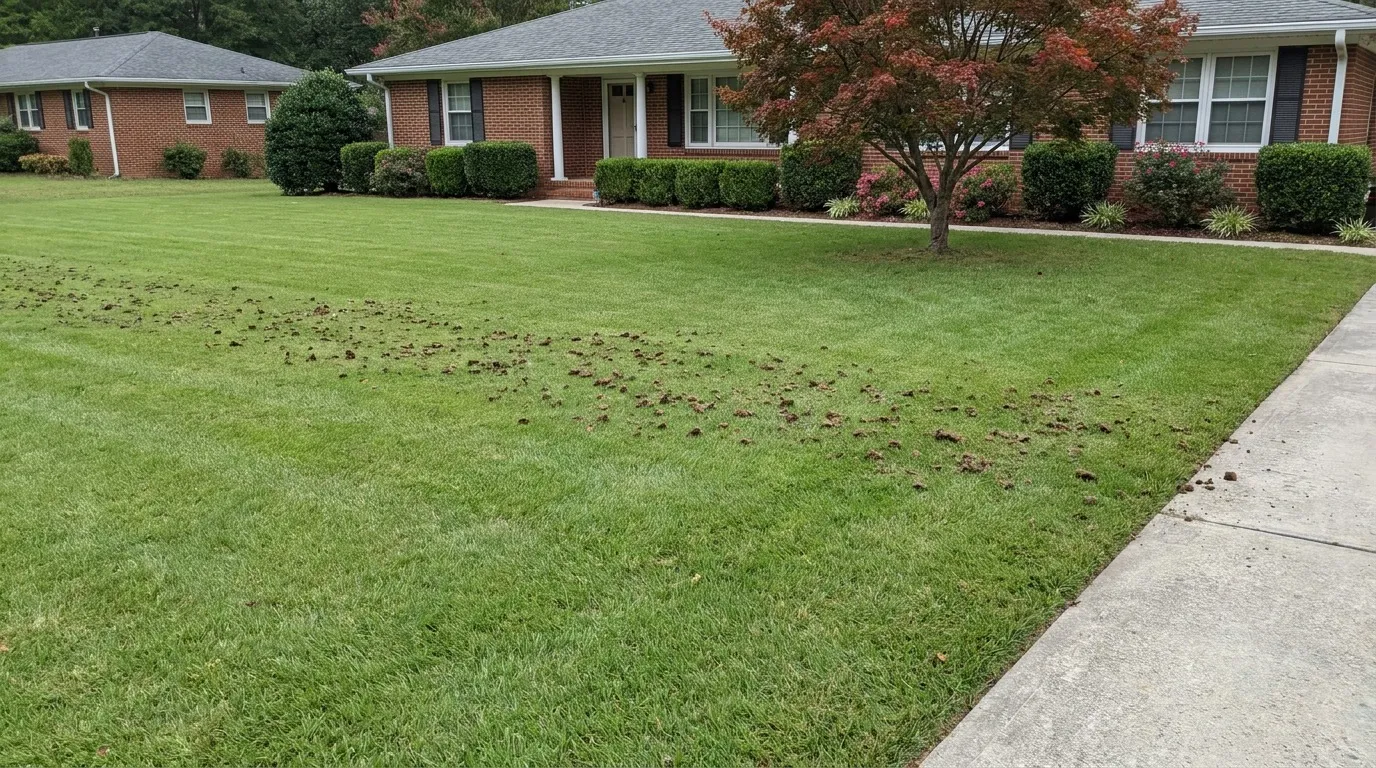
- Improve soil drainage through core aeration. Fall core aeration relieves compaction, improves water movement through the profile, and helps rebuild soil biology. Drainage problems that show up as summer brown patch are addressed by fall renovation, not summer treatment.
- Reduce thatch above one-half inch. Excess thatch holds moisture at the crown and provides habitat for Rhizoctonia solani sclerotia between seasons. Fall aeration and biological topdressing rebuild the thatch decomposition cycle.
- Feed the soil biology. Seasonal applications of the proprietary Nature's Select® Solutions blend and other biological inputs rebuild microbial diversity throughout the growing year, which is the mechanism that begins to close the pathogen side of the disease triangle.
- Time nitrogen for fall, not spring. Fescue does its root work in the cool months. A heavy spring or early-summer nitrogen application produces the succulent leaf tissue that brown patch attacks. Shift the bulk of nitrogen into September through November.
- Match summer irrigation to actual rainfall. During humid stretches with regular thunderstorms, cut back on supplemental irrigation. The disease triangle closes on leaf wetness, not on soil moisture.
Doing four or five of these consistently drops brown patch pressure in a fescue lawn dramatically, often to the point where fungicide is not required at all in a normal summer. USGA agronomists reach the same conclusion for turf-type tall fescue, noting that mowing height, morning irrigation, and balanced nitrogen timing are the primary cultural levers that reduce disease severity (USGA guide to managing brown patch in turf-type tall fescue).
When Fungicide Is Actually the Right Call
Broad-spectrum fungicide is not the first tool at Nature's Select®. It is the tool for outbreaks above the treatment threshold, applied at the lowest effective rate, and matched to the pathogen the technician identifies on site.
For Rhizoctonia solani on tall fescue, the fungicide classes with reliable activity include azoxystrobin, flutolanil, and triadimefon. Rotating between chemical classes with different modes of action prevents fungicide resistance in the pathogen population. Following label directions on application rate and interval matters more than the specific product name.
The treatment threshold is a judgment call a state-licensed pesticide applicator makes on site. It depends on how much of the lawn is affected, how fast the patches are spreading, the weather window over the next 7 to 10 days, and how much healthy fescue is left to defend. Below the threshold, cultural adjustments and biological inputs are the right intervention. Above the threshold, a targeted fungicide application stops the active outbreak for 3 to 4 weeks while the biological program keeps rebuilding soil defenses.
Preventative applications are sometimes appropriate on lawns with a documented history of severe outbreaks and specific risk factors, but they are not the default. The default is monitor, adjust, and treat when the threshold is crossed.
The one important guardrail: broad-spectrum fungicides suppress the beneficial soil fungi that would otherwise be competing with Rhizoctonia solani. Applied without a biological rebuild between visits, that suppression makes the next outbreak more likely, not less. The soil biology that keeps disease pressure down needs to be actively maintained.
How Nature's Select® Handles Brown Patch on North Carolina Fescue
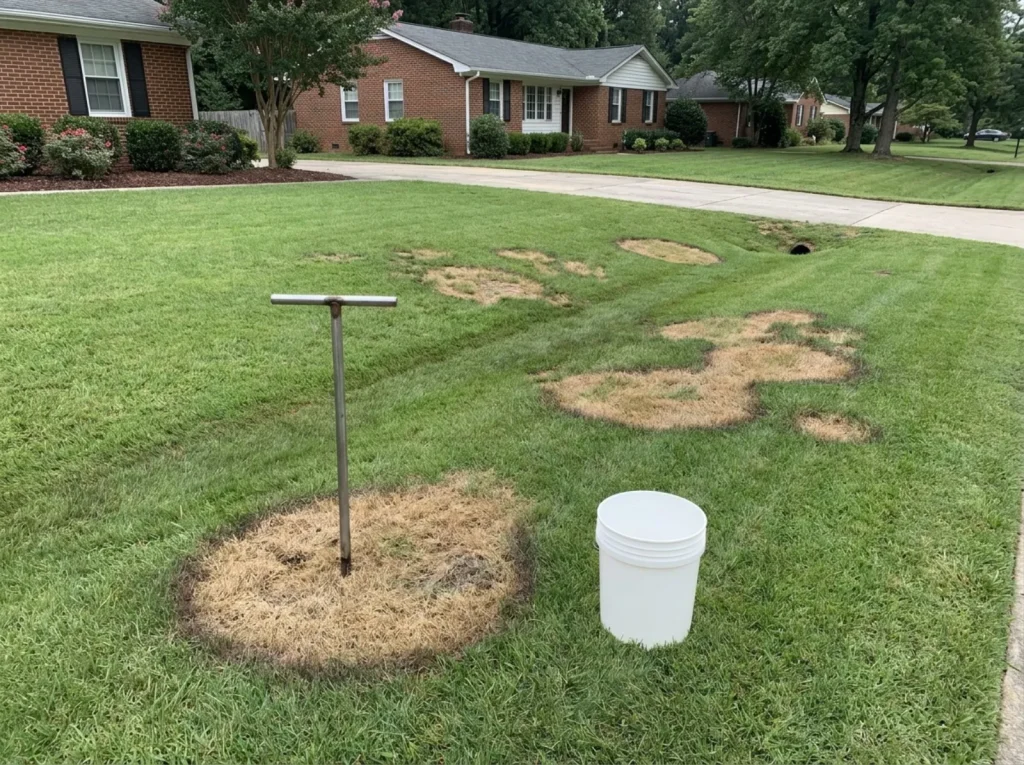
Every disease call at Nature's Select® starts the same way. A state-licensed specialist walks the lawn, identifies Rhizoctonia solani on site (usually within 25 to 40 minutes), and checks the four soil signals against what the outbreak is showing. Nitrogen timing history. Mowing height and irrigation practice. Drainage and thatch condition. Soil biological baseline.
The plan that comes out of that inspection is matched to what the lawn actually needs. Sometimes that means an immediate targeted fungicide because the outbreak is above threshold and the weather window is closing. Sometimes it means adjusting mowing height and irrigation timing and letting the lawn recover on its own. Almost always it means seasonal applications of the biological soil-first program that rebuilds the microbial diversity that suppresses the pathogen between visits.
The four active Nature's Select® offices — Winston-Salem, Greensboro, Chapel Hill, and Pinehurst — have been reading North Carolina fescue lawns since 1994. The weather-window discipline is not theoretical. It is thirty years of field observation on the specific way tall fescue meets summer humidity in the Triad, the Triangle, and the Sandhills.
If you are seeing rough circular tan patches on your fescue lawn this July, request a Nature's Select® lawn disease assessment or call (888) 786-9735. The specialist will identify the disease at species level, read the soil signals, and match the response to what your lawn actually needs.
Recovery: What Happens After the Outbreak
Brown patch damage on tall fescue is recoverable in most cases, provided the crown of the plant survived. Fescue can regrow leaf tissue from an undamaged crown once the humid weather breaks and cultural conditions improve.
The recovery timeline depends on how long the outbreak ran, how much of the lawn was affected, and whether the cultural conditions that let the disease activate have been corrected. Small early-caught patches recover in 2 to 4 weeks once the weather window closes. Larger merged patches where multiple crowns died usually require fall aeration and overseeding to bring the turf back to full density.
The single most important recovery move is fall aeration and overseeding at the right window, typically September for central North Carolina. That is when soil temperatures are cool enough for fescue to establish, root work restarts, and biological topdressing has time to work through the winter.
Key Takeaways
- Brown patch on tall fescue in North Carolina is caused by Rhizoctonia solani, a soil-borne fungus that activates when night temperatures stay above 65°F and leaf wetness lasts more than 10 hours.
- The pathogen is present in the soil year-round. July is not when it arrives. July is when the disease triangle closes and the fungus activates.
- The four field signatures that confirm brown patch are circular patches 6 inches to several feet in diameter, cottony gray mycelium in early morning dew, a thin dark brown smoke-ring border, and irregular foliar lesions with dark brown borders on individual blades.
- The four soil signals a specialist reads are nitrogen timing, mowing height, drainage and irrigation practice, and soil microbial diversity.
- Cultural adjustments (raise mowing height, morning irrigation, correct nitrogen timing, fall aeration, biological soil inputs) reduce brown patch pressure more consistently than any fungicide alone.
- Fungicide is the right tool for outbreaks above the treatment threshold, applied at the lowest effective rate and matched to the pathogen on site, never blanket-applied.
Frequently Asked Questions
How do you treat brown patches on fescue grass?
Treat brown patch on fescue grass by first identifying the pathogen at species level, then matching the response to the outbreak severity. Raise mowing height to 3.5 to 4 inches, switch to early-morning deep irrigation, and delay nitrogen until fall. For outbreaks above the treatment threshold, a targeted fungicide (azoxystrobin, flutolanil, or triadimefon class) applied at the lowest effective rate stops the active spread for 3 to 4 weeks. Seasonal biological soil applications rebuild the microbial diversity that keeps Rhizoctonia solani suppressed between visits.
Will grass regrow after a brown patch?
Yes, tall fescue can regrow from a brown patch outbreak in most cases, provided the crown of the plant survived the infection. The recovery timeline depends on outbreak severity: small early-caught patches recover in 2 to 4 weeks once humid weather breaks, while larger merged patches usually need fall aeration and overseeding to bring turf back to full density. The single most important recovery move is fall aeration and overseeding at the right window, typically September for central North Carolina.
Will fescue come back after it turns brown?
Fescue that turns brown from brown patch fungus typically comes back if the crown survives. The green tissue you see is leaf material that got digested by the mycelium, but the crown of the plant lives underground and regrows leaves when conditions improve. Fescue that turns brown from summer dormancy (without the circular patches or mycelium) also comes back. Fescue that turns brown from Pythium blight or from crown rot may not recover, which is why identifying the pathogen at species level matters.
Will brown patch go away on its own?
Brown patch will stop spreading on its own once the environmental conditions that activated it change: night temperatures drop below 65°F, humidity breaks, and leaf wetness stays under 10 hours overnight. In North Carolina, that usually means late September or the first cool front. However, the damage already done does not repair itself. Cultural adjustments and often overseeding are needed to bring the lawn back. Waiting for the weather to break also lets the outbreak keep expanding at its 5-to-10-day doubling cycle in the meantime.
What causes brown patch fungus in fescue?
Brown patch fungus in fescue is caused by Rhizoctonia solani, a soil-borne fungus that lives in the soil year-round and activates when three conditions line up: night temperatures above 65°F, leaf wetness longer than 10 hours, and susceptible tall fescue host tissue. Contributing factors include heavy spring or early-summer nitrogen, mowing shorter than 3.5 inches, evening irrigation, poor drainage, and low soil microbial diversity. The pathogen was already present. The conditions that let it activate were caused by weather plus cultural practice.
How can you tell brown patch apart from drought stress or grub damage?
Brown patch shows cottony gray mycelium in the canopy at early morning dew, a distinctive smoke-ring border, and irregular foliar lesions on individual blades. Drought stress shows uniform browning without circular patches, no mycelium, and often reveals dry soil underneath. Grub damage shows sunken circular areas where turf lifts easily off the soil because the roots have been chewed off, with no mycelium and often visible C-shaped grubs in the soil below. When the symptoms overlap, our guide on brown circles diagnosis walks through the full cross-differential.
Stop Guessing What Is Killing Your Fescue. Let a Specialist Read the Soil Signal.
If you are seeing rough circular tan patches with a smoke-ring border on your tall fescue this July, you are almost certainly looking at active brown patch. The good news: outbreaks caught early respond faster, treat smaller, and cost less. The specialist identifies Rhizoctonia solani on site, reads the four soil signals, and matches the plan to what your lawn actually needs.
Same-day estimate. Species-level diagnosis. Biological program with targeted fungicide only when the threshold is crossed. Book a Nature's Select® biological disease program assessment or call (888) 786-9735 to reach the office that covers your address.