The 14 Days After Aeration That Decide If It Worked
Lawn care after aeration comes down to fourteen days. Water lightly two or three times a day for the first week to keep the top inch of soil damp, and leave the soil plugs in place to break down. Stay off the turf, hold off on mowing until new fescue reaches 3.5 inches, and skip weed control until after the second mowing.
Aeration is the appointment. The two weeks that follow are the actual outcome.
That is not a clever way to sell a service. It is what shows up in the lawn the following June. Two North Carolina properties can get identical work on the same street, with the same seed, and look completely different by spring. The difference traces back to day one through day fourteen: watering frequency, when the mower came out, how much foot traffic crossed the yard, and whether somebody applied a weed product too early.
This article walks post-aeration care one range at a time. You will get watering frequency and depth, the mowing trigger and height, a traffic plan, a hold list of products, and the reason behind each rule. How much of it applies depends on your grass type, so it covers both cool-season tall fescue and warm-season bermuda and zoysia. Guidance is grounded in NC State Cooperative Extension research and the program Nature's Select® has run statewide since 1994.
Why the Two Weeks After Aeration Decide the Outcome
Core aeration is a controlled injury. Hollow tines pull cylindrical plugs of soil out of the ground, usually on two passes, and leave several thousand open holes across a typical yard. Those holes are the point. They relieve compaction, they let oxygen and water reach the root zone, and if you are overseeding, they give grass seed a protected pocket of bare mineral soil.
An open hole is also a temporary vulnerability. The soil around it dries faster than sealed ground, and root hairs on either side of the core have been severed. If you seeded, thousands of ungerminated seeds sit in the top half inch of soil with no root system and no ability to buffer a dry afternoon.
For roughly fourteen days, small inputs produce large swings. A missed watering on day three does more damage than a missed watering in July. A mower pass on day six shears seedlings that have not anchored. A pre-emergent herbicide on day two can shut down germination across the whole property. After day fourteen, the turf has enough root structure to absorb ordinary mistakes again.
Aeration buys a two-week window in which your lawn is unusually responsive to both good care and bad care. The rest of this article is about spending it well.
What Is Happening Under the Surface After Aeration
Understanding what happens immediately after aeration makes the rules easier to follow, because you stop treating them as arbitrary.
The Soil Plugs Are Doing Work, So Leave Them There
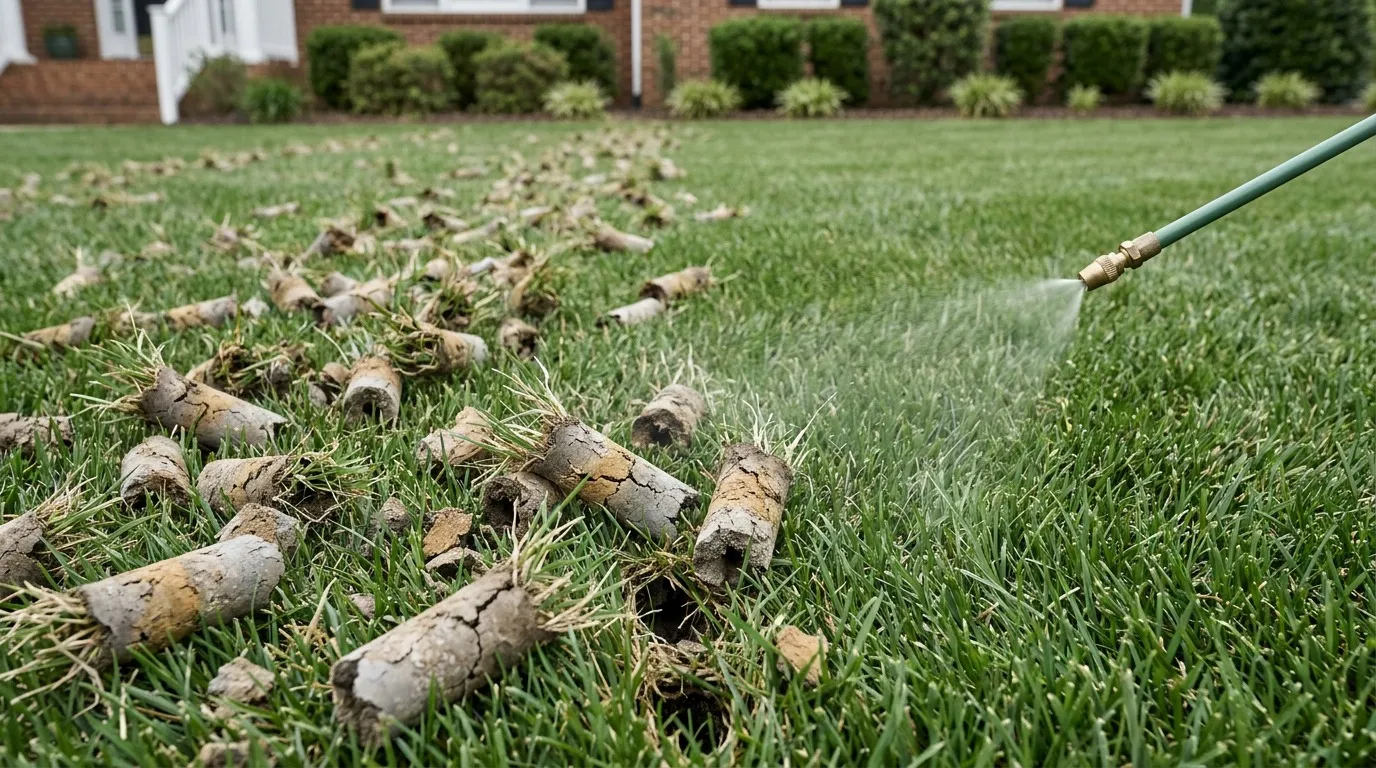
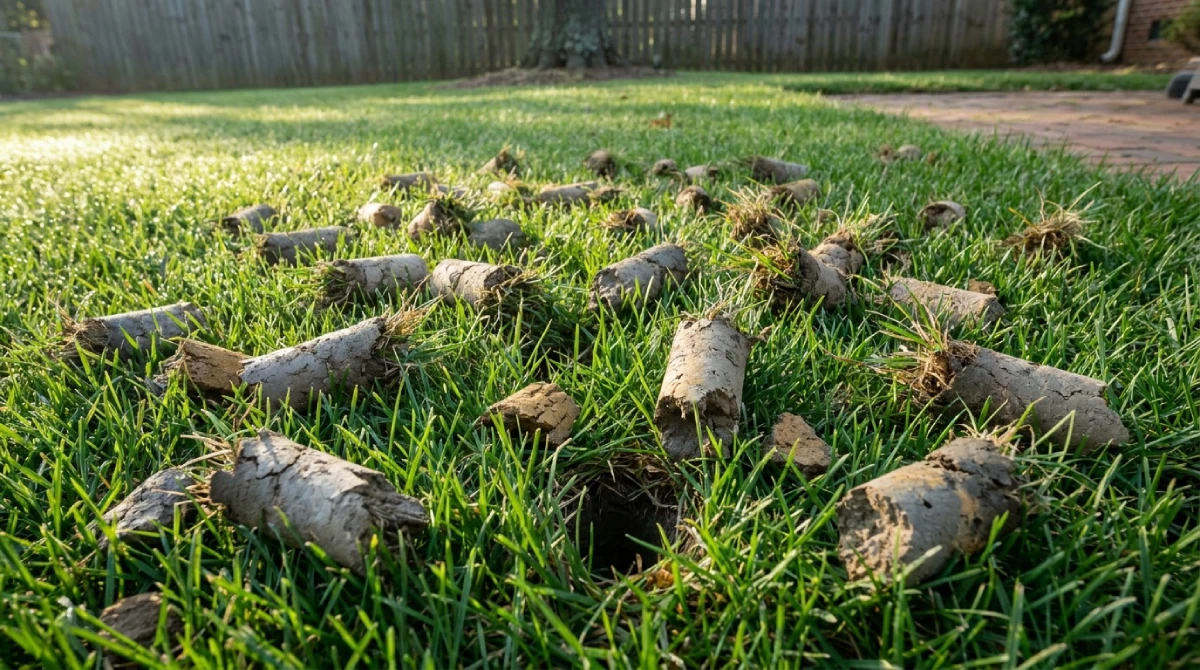
The first thing most homeowners want to do is rake up the cores. Do not. Those plugs are the cheapest soil amendment on the property.
Each plug carries topsoil, root fragments, thatch, and a dense population of soil microbes from the root zone. Left on the surface, rain and irrigation break them down over roughly two to three weeks. The material redistributes as a thin natural topdressing that feeds the microbial population, helps decompose the thatch layer, and settles fine soil back into the open holes.
Raking the plugs off removes organic matter and living biology from a lawn that needs both. It also compacts the surface you just opened, because raking means walking. If the plugs bother you visually, run the mower over them once the lawn is ready for its first cut.
Oxygen Reaches the Root Zone and the Microbes Wake Up
North Carolina clay holds nutrients well and holds air badly. Compacted clay has almost no pore space, and without pore space there is no oxygen. Soil microbes that cycle nutrients and break down organic matter are aerobic. Starve them of oxygen and they go dormant or die back.
Opening the profile changes that within days. Oxygen moves into the holes in the soil, moisture follows, and microbial activity climbs around each core. Those microbes are what return nutrients to the soil in a form roots can use. That burst of biological activity is why aeration anchors a soil-first program rather than being a mechanical chore, and why Nature's Select® applies its soil amendment at the same visit rather than weeks later.
The catch is that microbial activity depends on moisture. Dry soil shuts it down as fast as compaction does. Your watering plan is not only about the seed. It keeps the biology running while the window is open.
Seed-to-Soil Contact Is the Whole Point of the Aeration Holes
If you overseeded, the reason it happened in the same visit is contact. Grass seed broadcast onto a mature canopy mostly lands on blades and thatch. It dries out, it feeds birds, and germination collapses. Seed that falls into an aeration hole lands on fresh mineral soil, sits below the wind line, holds moisture longer, and gets shade from the hole walls. Those are the ideal conditions for overseeding.
That is why the overseeding rate you started with only works if the holes are there to catch it. It is also why nothing should disturb the surface for two weeks. Dragging a rake, running a leaf blower, or letting a dog dig moves seed out of the holes it needs to stay in.
The 14-Day Post-Aeration Care Roadmap
Here is the whole window in one place. The table below assumes core aeration and overseeding on a cool-season tall fescue lawn in the fall window. Aeration-only lawns follow a simpler version covered later in this article. Best results come from treating every row as a job rather than a suggestion.
| Day Range | Watering | Mowing | Traffic | What Is Happening in the Lawn |
|---|---|---|---|---|
| Day 0 (day of service) | Water thoroughly once, 20 to 30 minutes per zone, to settle seed and soil | None | Off the lawn entirely | Cores on the surface, holes open, seed in place |
| Days 1 to 3 | Water lightly 2 to 3 times daily, 5 to 10 minutes per zone, keep top inch of soil moist | None | Off the lawn entirely | Seed imbibing water, plugs beginning to soften |
| Days 4 to 7 | Continue 2 to 3 light waterings daily | None | Essential access only, walk the perimeter | Seed germination begins, first green haze appears |
| Days 8 to 10 | Reduce to 2 light waterings daily | None unless existing turf exceeds 4.5 inches | Light foot traffic acceptable | New seedlings 0.5 to 1.5 inches, first roots anchoring |
| Days 11 to 14 | Reduce to 1 longer watering daily, begin lengthening intervals | First mow when new grass reaches 3.5 inches, cut to 3 inches | Normal light use, no sports or heavy play | Canopy starting to knit, plugs mostly broken down |
| Day 15 onward | Transition to deep and infrequent, 1 inch per week total | Weekly at 3 to 3.5 inches, sharp blade | Normal use returns | Root growth deepening, weed pressure dropping |
Two notes. These are ranges, not laws: a cool overcast week needs less water than a dry, breezy one. And the trigger for the first mow is grass height, not the calendar.
Days 1 to 3: Moisture Is the Only Job
For the first seventy-two hours, you have exactly one responsibility: do not let the top inch of soil dry out.
Tall fescue seed has to absorb water and hold it continuously to germinate. If a seed takes up moisture, begins to swell, then dries out completely before the root emerges, it usually dies. It does not pause and resume. This is the most common way North Carolina homeowners lose an overseed, and it happens on a warm, breezy afternoon when nobody was home to run the hose.
The answer is frequency, not volume. Two to three short cycles per day, roughly five to ten minutes per irrigation zone, keeps the surface damp without saturating the profile. Early morning, late morning, and mid-afternoon works for most properties. Skip evening watering. Blades that stay wet overnight raise disease pressure on a stand of seedlings with no defenses.
Check the work with your finger rather than the clock. Push into the soil next to a core. Damp and cool means you are on schedule. Dry and crumbly means add a cycle.
Days 4 to 7: Germination and the First Green Haze
Tall fescue germinates in roughly seven to fourteen days under proper soil moisture and temperature. In the fall window it often shows on the early end. Somewhere in this stretch you should see the first faint green fuzz, easiest to spot at a low angle in morning light.
Keep the same watering rhythm. This is not the moment to back off, because germination is uneven. Seed that fell deepest into a core hole comes up first. Seed in a shallower pocket may be three or four days behind. Cutting water at the first sign of green strands the second wave.
Traffic matters more here than at any other point. An emerged seedling is a single blade with a root perhaps a quarter inch long. A footstep does not bend it. It tears it out.
Days 8 to 14: Rooting, the First Mow, and Canopy Knit
By day eight the new fescue has enough root to survive brief dry spells, and you can start stretching the intervals between waterings. Move from three cycles to two, then toward one longer cycle by the end of the second week. You are training roots downward. Constant surface moisture past this point produces shallow-rooted turf that fails in summer heat.
This is also when the first mow becomes possible. The trigger is height: new fescue at 3.5 inches.
Meanwhile the plugs are disappearing. By day ten to fourteen most have broken down naturally into a thin, dark scatter, and the aeration holes have partially closed.
Watering After Aeration and Overseeding: Frequency Beats Volume
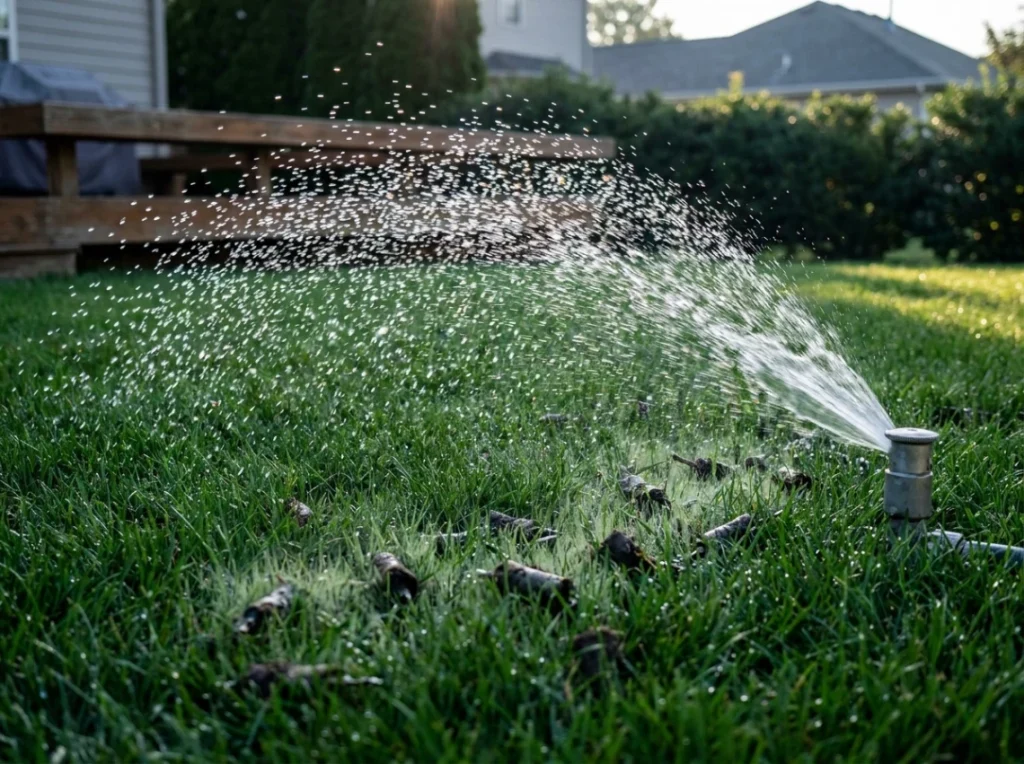
Watering is where most aftercare plans succeed or fail, so it deserves its own numbers.
One rule governs the whole schedule: before germination, water the seed. After germination, water the roots. Those are two different jobs, and the transition happens gradually across the second week.
NC State Extension research on water requirements for North Carolina turfgrasses puts established cool-season lawns at roughly one inch per week from rainfall and irrigation combined. That is the destination, not the starting point. A newly seeded lawn needs the same total spread across many smaller applications.
| Stage | Frequency | Duration Per Zone | Goal | Common Mistake |
|---|---|---|---|---|
| Day 0 | Once | 20 to 30 minutes | Settle seed and soil, saturate the profile | Skipping it because rain is forecast |
| Days 1 to 7 | 2 to 3 times daily | 5 to 10 minutes | Keep top inch continuously damp | One long soak each morning |
| Days 8 to 14 | 1 to 2 times daily | 10 to 15 minutes | Encourage roots to follow moisture down | Cutting back too fast on a hot week |
| Days 15 to 30 | Every 2 to 3 days | 20 to 30 minutes | Build depth, dry the surface between cycles | Staying on the seedling schedule |
| Day 30 onward | 1 to 2 times weekly | 30 to 40 minutes | About 1 inch per week total | Watering by calendar instead of by weather |
A few practical points that do not fit in a table.
- Measure once. Set straight-sided cups around a zone, run it fifteen minutes, and measure the depth. Now you know your system's output.
- Shallow rain does not count for much. A tenth of an inch on day three wets the blades and evaporates. Run your cycle anyway.
- Slopes need split cycles. North Carolina clay on a grade sheds water fast. Two five-minute passes twenty minutes apart soak in better and carry less seed downhill.
- Shade zones and sun zones are different lawns. A north-facing strip under a mature oak may need half the water of the open front yard.
Overwatering is the other failure mode, and it is less obvious because the lawn looks fine right up until it does not. Saturated clay drives out the oxygen aeration just delivered, and standing moisture on a thin canopy is what brown patch wants. Puddling, a spongy feel underfoot, or a faint sour smell means back the schedule off immediately.
When to Mow After Aeration, and How High
The most common question about lawn care after aeration is when to mow. Height decides it, not the calendar.
On an overseeded lawn, wait until the new fescue reaches 3.5 inches, then cut to 3 inches. That usually lands between day twelve and day twenty-one depending on soil temperature and how fast the seed came up. Cutting sooner shears seedlings that have not anchored, and the drive wheels lift them out entirely.
On an aeration-only lawn, mow as soon as the grass needs it, typically within five to seven days. There is no seedling to protect. Give the plugs a few days of moisture first so the mower breaks them apart instead of throwing them.
Four rules for that first cut, whichever category you are in.
- Sharpen the mower blade. A dull blade tears rather than slices, and torn tissue on a young stand invites disease.
- Never remove more than one-third of the grass blade in one pass. If the lawn got away from you, take it down over two mowings.
- Mow when the surface is dry. Wet soil plus mower weight means new compaction, and wet clippings mat over seedlings.
- Bag nothing this time. Return the clippings. They are nitrogen, and the new stand can use it.
Keep the mower at 3 to 3.5 inches through the rest of the season. Taller fescue shades the soil, keeps root-zone temperature down, and out-competes weed seed for light. Scalping a recovering lawn undoes much of what aeration bought you.
Warm-season lawns are different. Bermuda and zoysia get cut lower, generally 1 to 2 inches, and they recover by spreading rather than by germinating. Resume your normal height once the cores have softened.
Foot Traffic, Pets, and Everything Else That Presses on Open Soil
Compaction is the problem aeration exists to solve, so the first two weeks are a strange time to walk all over the lawn.
The soil around each core hole has been loosened and holds more moisture than usual. Moist, loosened clay compacts more easily than dry, settled clay, not less. Every pass across the yard in week one presses that structure back down and closes holes you paid to open. Add seedlings with quarter-inch roots and the math gets worse.
A realistic traffic plan for a family that actually uses its yard:
- Days 0 to 7: Stay off the lawn for at least a week. Use the driveway and walkways. If you must cross, take one consistent path near the edge.
- Days 8 to 14: Light, occasional foot traffic is acceptable. No sports, no wheelbarrows, no parking a trailer on the grass.
- Day 15 onward: Normal use returns. Heavy repeated traffic still deserves a rotation plan year round.
Pets are the hard part. A dog that runs the same fence line every afternoon wears a compacted, seed-free stripe within a week. Keep pets off for the first week where you can, and confine them to a smaller area through day fourteen.
Equipment is the traffic nobody thinks about. Leaf blowers move seed, pressure washers move seed and soil, and ladders leave ruts in soft ground. If any of that is scheduled, delay it.
What Not to Apply During the First 14 Days
The hold list is short, and every item on it is a mistake homeowners make with good intentions.
| Product | Hold Until | Why It Waits |
|---|---|---|
| Pre-emergent herbicide | After the new stand is fully established, generally the following season | Pre-emergents suppress germinating seed indiscriminately, including your fescue |
| Post-emergent broadleaf weed control | After the second mowing, roughly 4 to 6 weeks | Young seedlings lack the tissue maturity to tolerate selective herbicides |
| Heavy nitrogen fertilizer | Day 14 or later, and only at a starter rate | Pushes top growth ahead of root growth and raises disease pressure |
| Lime | After a soil test, any time outside the seedling window | Not urgent, and spreader traffic on open soil is not worth it |
| Thick topdressing or compost layer | Not on freshly seeded turf | Burying seed deeper than about a quarter inch prevents emergence |
| Dethatching or power raking | Not this season | Tears out seedlings and undoes the aeration pass |
The pre-emergent conflict deserves emphasis because it catches careful homeowners. Fall is when North Carolina lawns want a pre-emergent for winter annual weeds. It is also when fescue is being seeded. Those two calendars collide, and you generally cannot do both on the same turf in the same season without one canceling the other.
Sequencing has to be planned rather than improvised. That is why weed control and fertilization is scheduled around the aeration visit rather than alongside it.
Fertilizer needs a nuance. A starter product is not the same as a summer nitrogen application. If a biological soil amendment or starter nutrition went down at the time of service, as it does on a Nature's Select® visit, the seedlings already have what they need. If nothing was applied, a light starter formulation around day fourteen is reasonable.
What is not reasonable is heavy quick-release nitrogen on a two-week-old stand of fescue. It produces soft, fast top growth on plants with almost no roots, and soft growth in warm humid weather is what turf disease feeds on.
Aeration Without Overseeding: A Shorter, Simpler 14 Days
Not every lawn gets seed, and the aftercare changes considerably when it does not.
Warm-season lawns are the main case. Bermuda and zoysia spread by rhizomes and stolons rather than by seed, so they close their own cores and reject broadcast fescue. In the Sandhills, where nearly all turf is warm-season, aeration is performed alone in the late-spring window of May through June while the grass is actively growing.
Aeration-only aftercare looks like this:
- Water normally, not on a seedling schedule. Deep and infrequent from day one. There is no seed to keep damp, only recovering roots.
- Mow on your regular schedule once the plugs have softened, usually within about a week.
- Traffic restrictions relax after three to five days rather than fourteen.
- Fertilizer and weed control can resume much sooner, because the herbicide restrictions that protect seedlings do not apply.
- Leave the cores anyway. The topdressing and microbial benefits of aerating are identical either way.
Actively growing warm-season turf closes visible aeration holes in roughly two to three weeks. Aerate a bermuda or zoysia lawn near dormancy and the wound sits open through the dormant period while recovery drags. That is why the best time to aerate warm-season turf sits where it does.
Cool-season grasses aerated without seed follow a middle path: normal watering, normal mowing, a shorter traffic hold. Hold pre-emergent products anyway if you plan on overseeding your lawn later in the same season.
The Aftercare Mistakes That Undo the Work
Five patterns account for most disappointing results.
Watering deep and infrequent from day one. Correct advice for an established lawn, wrong advice for a seedbed. One thirty-minute soak each morning leaves the top inch bone dry by afternoon. Seed germinates or dies at the surface, not at six inches.
Mowing on a schedule instead of on a trigger. Saturday is when people mow. Seedlings do not know that. If the new fescue is at two inches on Saturday, skip the week.
Applying weed control early. The lawn looks thin, weeds show in the gaps, and the instinct is to spray. On a two-week-old stand that trades a temporary weed problem for a permanent thin spot.
Raking or blowing the cores off. It feels tidy and productive. It removes organic matter, disturbs seed placement, and compacts the surface.
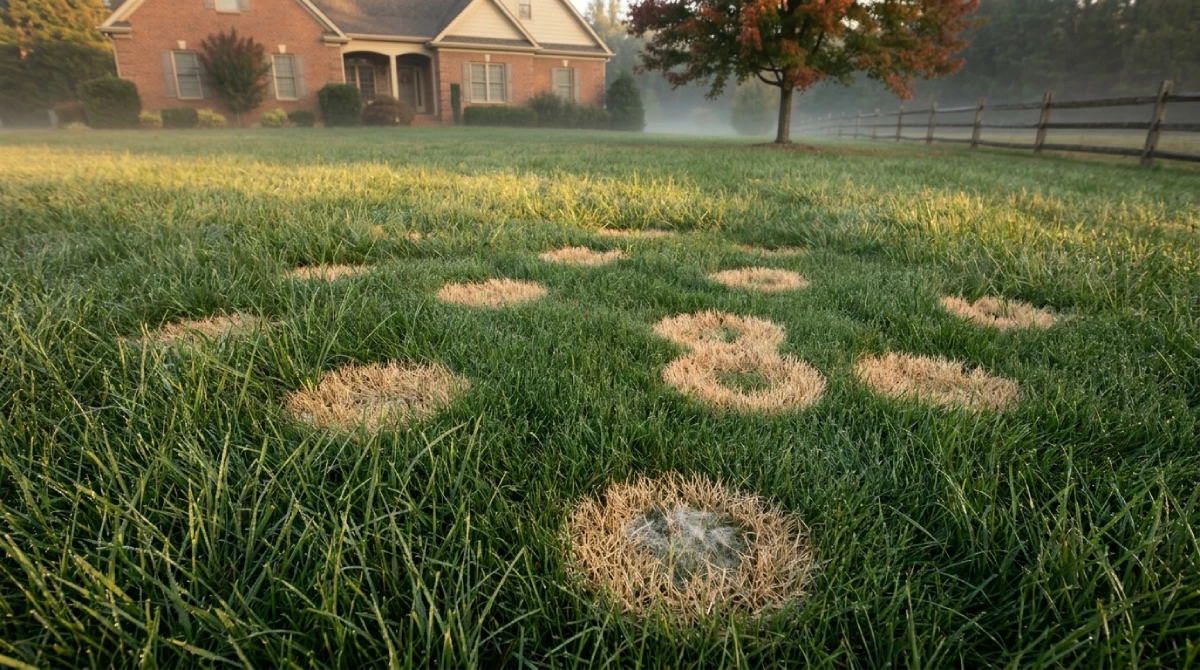
Overwatering into disease. This failure mode usually follows a very conscientious homeowner. Warm days, humid nights, a thin canopy, and constant moisture are the conditions for brown patch, which NC State Extension identifies as a major warm-weather disease of tall fescue. Circular tan patches with a darker margin mean cut evening irrigation immediately. Established stands recover; two-week-old seedlings often do not. That is why lawn disease control and aeration aftercare are more connected than they look.
There is a sixth, upstream of all of these: aerating outside the window in the first place. Perfect aftercare cannot rescue fescue seeded in late October, because the seedlings will not have the growing weather to root before winter.
The best time to overseed a cool-season lawn in North Carolina is early fall. The right time to aerate warm-season turf is late spring. If you are planning next year, start with the window you seeded into rather than the aftercare.
Day 15 Through Day 45: What Good Recovery Looks Like
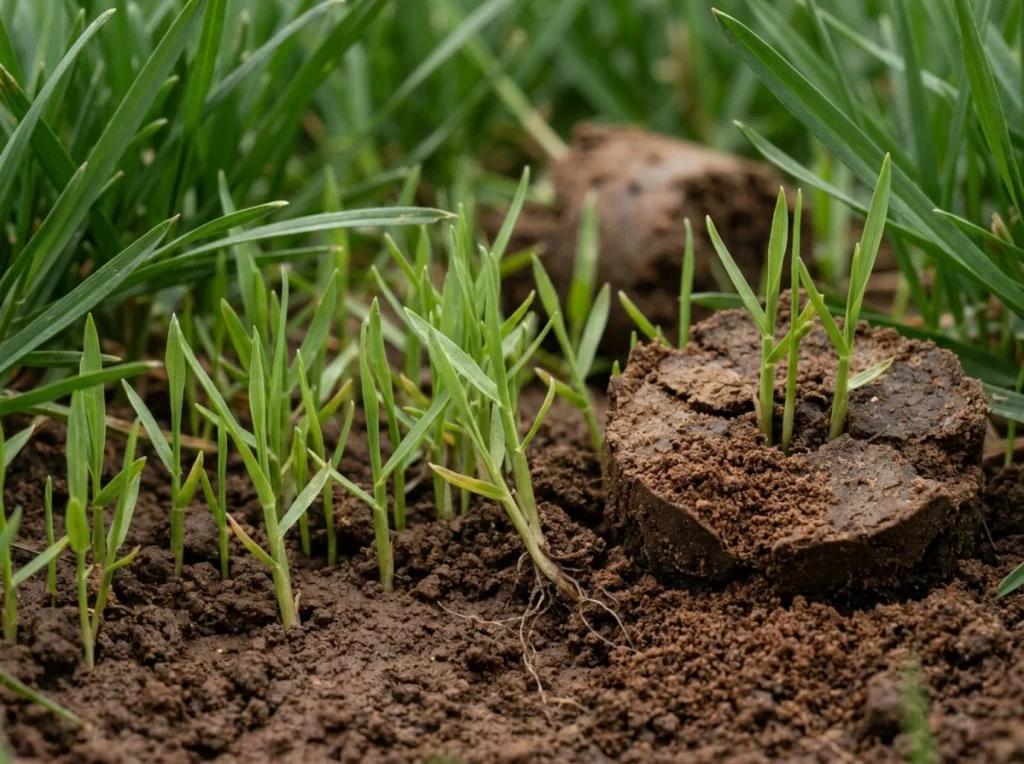
The fourteen-day window ends, but the outcome is not finished.
- Weeks three and four. New fescue reaches mowing height across most of the lawn, roughly 2 to 4 weeks after seeding. Newly seeded areas look lighter green than established turf, which is normal and closes on its own. Watering moves to every two or three days, and after the second mowing, selective broadleaf weed control becomes an option.
- Weeks five and six. The canopy knits and bare spots fill in. Root systems reach a depth where the lawn can go several days without irrigation. A starter nutrition application, if one was not made earlier, pays off here.
- The following spring. The real verdict. A lawn aerated in the correct window and cared for through the first fourteen days comes out of winter denser and holds color deeper into summer heat than the year before. It also greens up more evenly at spring green-up.
A lawn aerated correctly and neglected afterward looks about the same as it did before, which is why homeowners sometimes conclude aeration did not work.
Two seasons out, the benefits of aerating compound. Denser turf shades out weed seed, deeper roots reach water the shallow-rooted lawn cannot, and better soil structure means the next core aeration pass starts from a better baseline. That is the argument for treating aeration as an annual practice inside a year-round lawn care program rather than a one-time repair.
If your lawn did not respond, the checklist is short: wrong window, wrong seed rate, or wrong aftercare. Compare against the signs of compaction you spotted before booking. If the screwdriver still will not go in, the aeration pass may not have been deep enough.
When a Written Aftercare Plan Earns Its Keep
Everything above is doable by a homeowner with an irrigation timer and two weeks of attention. Plenty of people do.
It gets harder when the variables stack. A property with sun, deep shade, a slope, and a dog is really four aftercare plans at once. A homeowner traveling during week one has a problem no schedule solves. A lawn that is half fescue and half bermuda needs two plans on one parcel.
That is where a lawn care company changes the arithmetic. Nature's Select® was founded in 1994 by Dr. William Hildebolt, a food scientist trained at Ohio State University, on the premise that healthy soils create healthy lawns. Every aeration and seeding visit ends with written seed-care instructions matched to the grass type, the seed blend, and the conditions on the property. The biological soil amendment goes down at the time of service.
Core aeration services run across North Carolina from the Winston-Salem, Greensboro, Chapel Hill, and Pinehurst offices, and the year-round lawn care program cares for roughly 8,086 acres of lawn statewide. Book professional aeration with a written aftercare plan, or start with a free on-property assessment to get the grass type confirmed. For a shorter version of this ground, our earlier aftercare guide covers the fundamentals.
Key Takeaways
- Water light and frequent for seven days, two to three short cycles daily to keep the top inch damp, then stretch intervals to build deep roots.
- Leave the soil plugs where they fall. They break down into free topdressing and feed the microbial population over two to three weeks.
- Hold the mower until new fescue reaches 3.5 inches, then cut to 3 inches with a sharp blade. Height is the trigger, not the calendar.
- Keep everyone off the lawn for the first week. Moist, loosened clay compacts more easily than settled clay, and seedlings tear out rather than bend.
- Skip pre-emergent entirely on a newly seeded lawn and hold post-emergent weed control until after the second mowing.
- Aeration-only lawns, including most warm-season turf in the Sandhills, follow a shorter recovery plan with normal watering and mowing.
Frequently Asked Questions
How long does it take for a lawn to recover after aeration?
Visible recovery takes about two to three weeks. Soil plugs break down and disappear in that time, and core holes close as roots and shoots fill them. On an overseeded fescue lawn, new seedlings emerge in seven to fourteen days and reach mowing height around week three. Full canopy knit takes four to six weeks. The real payoff shows the following spring.
How soon after aeration can I mow my lawn?
If you overseeded, wait until the new fescue reaches 3.5 inches, usually somewhere between day twelve and day twenty-one, then cut to 3 inches with a sharp blade. Height is the trigger, not the date. If you aerated without seeding, you can mow within about five to seven days once the plugs have softened enough to break apart under the deck.
How much should I water my lawn after aeration and overseeding?
For the first week, run two to three short cycles daily, roughly five to ten minutes per zone, to keep the top inch of soil continuously damp. Do not switch to one long soak. From day eight, reduce frequency and increase duration so roots follow moisture downward. By about day thirty you are back to roughly one inch per week total, delivered in one or two sessions.
Should I remove the soil plugs after aerating?
No. Leave them. Each plug carries topsoil, root fragments, and soil microbes from the root zone, and rain plus irrigation breaks them down into a thin natural topdressing over two to three weeks. Raking removes organic matter, disturbs seed placement, and compacts the surface you just opened. If the look bothers you, your first mow will break them apart in one pass.
Should I fertilize my lawn right after aeration?
Not with a heavy nitrogen product. If a starter nutrition or biological soil amendment went down at the time of service, the seedlings already have what they need. If nothing was applied, a light starter formulation around day fourteen is reasonable. Heavy quick-release nitrogen on a two-week-old stand pushes soft top growth ahead of root growth and raises disease pressure sharply.
Can I walk on my lawn after aeration?
Stay off the lawn for at least a week. The soil around each aeration hole is loosened and holding moisture, which makes it compact more easily than settled ground, and new seedlings have roots roughly a quarter inch long that tear out under a footstep. From day eight, light occasional foot traffic is fine. Normal use returns around day fifteen.
Should I overseed right after aeration?
Yes, on cool-season lawns, and ideally in the same visit. Open aeration holes give grass seed direct contact with fresh mineral soil, shade from the hole walls, and better moisture retention than seed broadcast onto an intact canopy. Warm-season lawns are the exception. Bermuda and zoysia spread by rhizomes and stolons and reject overseeded fescue, so they get aeration alone.
When can I apply weed control after aeration and overseeding?
Hold selective post-emergent broadleaf products until after the second mowing, roughly four to six weeks out, when seedlings have enough tissue maturity to tolerate them. Skip pre-emergent herbicide entirely on newly seeded turf, because it suppresses germinating seed without distinguishing weeds from your fescue. On aeration-only lawns with no seed down, normal weed control timing applies.
How long does it take to see results after aerating a lawn?
You will see germination in seven to fourteen days on an overseeded fescue lawn and a knitted canopy in four to six weeks. The meaningful result arrives the following spring, when the lawn greens up denser and holds color further into summer. On aeration-only turf, the benefit shows as better water infiltration within weeks and improved drought tolerance over the following season.
What should I avoid doing after lawn aeration?
Avoid raking off the plugs, mowing before the new grass reaches 3.5 inches, applying pre-emergent herbicide, spreading heavy nitrogen fertilizer, dethatching, topdressing thickly enough to bury seed, and walking on the lawn during the first week. Also avoid evening watering, which leaves grass blades wet overnight and raises disease pressure on a thin canopy.
Conclusion
Aeration opens the soil. The fourteen days that follow decide whether anything grows into the opening.
The plan is not complicated. Keep the top inch damp with short, frequent watering for the first week. Leave the cores alone. Stay off the grass. Wait for 3.5 inches before the mower comes out, then cut to 3. Keep herbicides and heavy fertilizer off the property until the new stand can handle them. Then stretch the watering intervals and let the roots go find the moisture themselves.
That is proper lawn care for the two weeks that matter most. Do it, and the following spring you will have the thing you actually paid for: denser turf, deeper roots, fewer weed gaps, and a healthier lawn that holds up through a North Carolina July.
Would you rather have the window picked, the seed blend matched, and a written aftercare plan handed to you at the end of the visit? Nature's Select® handles core aeration and overseeding across North Carolina from the Winston-Salem, Greensboro, Chapel Hill, and Pinehurst offices. Book professional aeration with a written aftercare plan or call (888) 786-9735 for a free on-property assessment and a same-day written estimate.