Aeration Windows for NC: The 3-Week Window That Actually Matters
The best time to aerate a lawn in North Carolina is when soil temperature at four inches sits between 65 and 75 degrees Fahrenheit. For tall fescue in the Triad and Triangle, the ideal time to aerate and overseed falls between mid-September and early October and lasts roughly three weeks. For bermuda and zoysia in the Sandhills, the window to aerate opens from late May through June while the grass is actively growing. Aerating your lawn outside these windows creates small holes that recover poorly, so missing the window means waiting a full year.
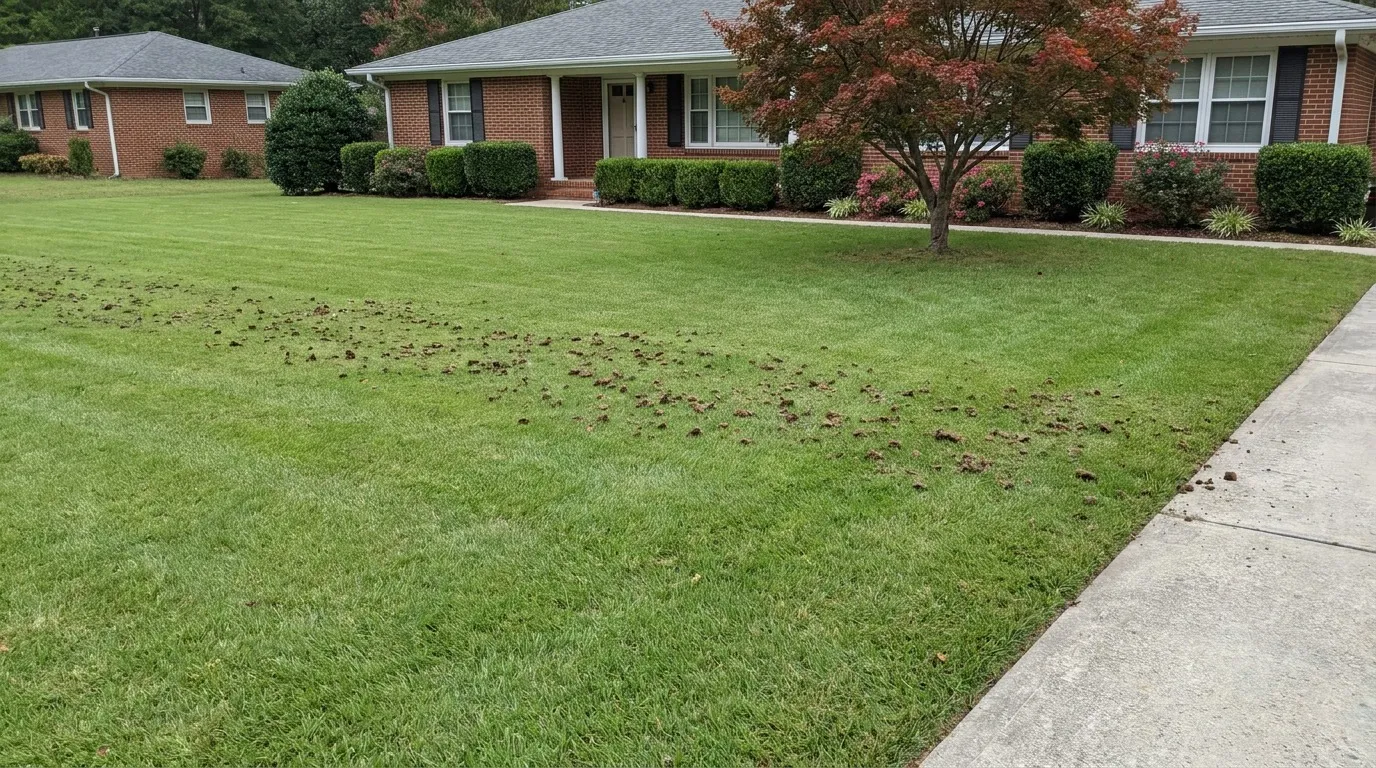
Every fall lawn guide tells North Carolina homeowners the same thing: aerate somewhere between September and November. That range is technically correct and practically useless. Inside those ten weeks sits a much narrower window when soil temperature, moisture, and grass physiology all line up for a successful aerate-and-overseed pass. If the work lands outside that window, the aerator still punches small holes, the grass seed still hits the soil, and the results still disappoint. The lawn does not look meaningfully better the following spring, and the homeowner blames aerating your lawn when the calendar was the real problem.
This article gives you a soil-temperature calendar for both grass types across North Carolina, explains why the actionable window is usually three weeks wide rather than three months, and shows you how to check the ground yourself before you rent a machine or book lawn aeration services. Every recommendation is grounded in NC State Cooperative Extension research and the year-round lawn care program Nature's Select® has run across North Carolina since 1994.
Why the Aeration Window Is Narrower Than the Calendar Says
Aeration works because it opens compacted soil exactly when the grass is ready to use the opening. For cool-season grasses like tall fescue, that moment is the shoulder between summer heat and winter dormancy: soil cool enough for grass seed germination, air warm enough for root growth, and enough weeks of active growing weather ahead for the seedlings to root before frost. For warm-season grasses like bermuda and zoysia, the moment is exactly the opposite: active summer growth that can close the cores, extend rhizomes deeper into the soil, and knit the wound back into the canopy within days. Cool-season grasses grow best in the fall shoulder; warm-season grasses grow best in the summer heat. Timing aeration to when each grass type grows best is one of the best things a homeowner can do for overall lawn health.
Both windows are defined by soil temperature, not by the calendar. Air temperature swings twenty degrees between morning and afternoon; soil at four inches barely moves in a day. That thermal stability is why turfgrass researchers measure soil temperature to time seeding, aeration, and pre-emergent applications. Air temperature is what you feel. Soil temperature is what the grass roots feel, and grass roots are what a healthy lawn is really built on.
The window is narrow because three conditions must be met simultaneously.
- Soil temperature has to be in the germination or active-growth band for the grass type on the property.
- Soil moisture has to be moderate. Aeration on bone-dry clay produces shallow, cone-shaped plugs; aeration on saturated soil pushes clay sideways and reseals the small holes in your lawn.
- The forecast has to give the seed or the recovering turf enough active growing weather before the next dormancy trigger arrives.
In central North Carolina, those three conditions overlap for roughly three weeks in the fall and roughly six weeks in the spring. The rest of the fall aeration season either sits above the seed germination ceiling or below the root-growth floor. The rest of the spring warm-season season either sits before green-up or after the first heat wave that stresses new cores.
The Fall Fescue Window: Mid-September Through Early October
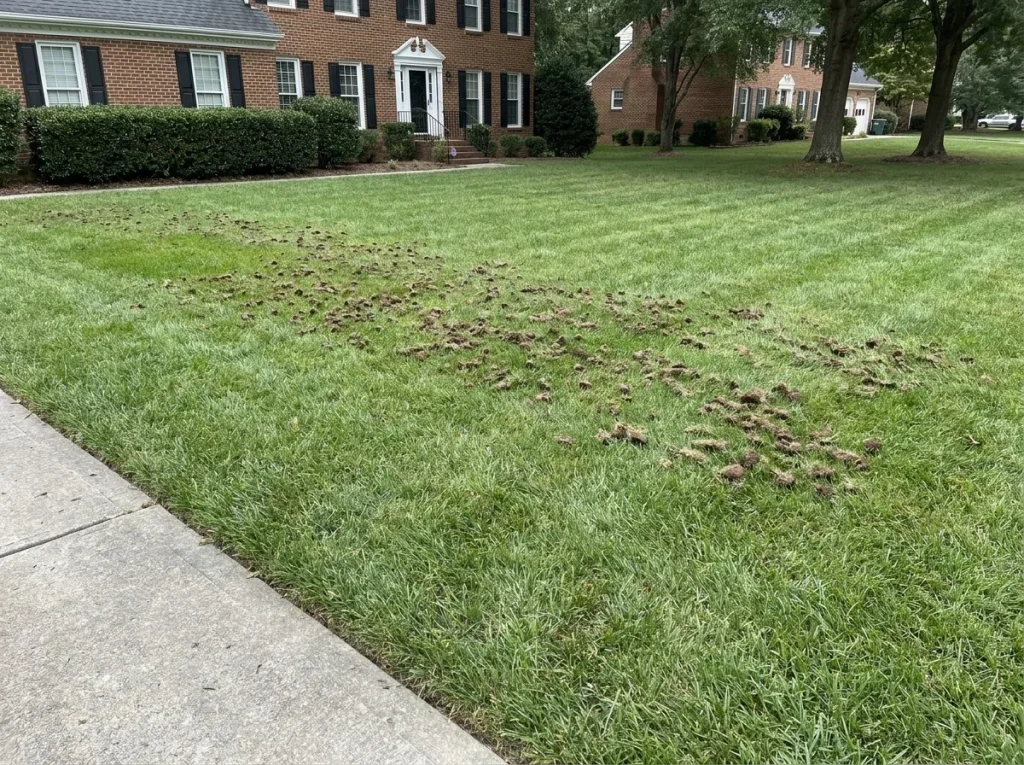
Tall fescue is the dominant grass across the Triad and much of the Triangle. Winston-Salem, Greensboro, and Chapel Hill lawns are roughly ninety-five, ninety-five, and forty percent fescue respectively. For a fescue lawn, the fall window is the entire annual chance to rebuild the canopy. Miss it and you wait a year for the next one. Overseeding on cool-season grasses like tall fescue is only effective inside this soil-temperature window.
The Soil-Temperature Signal for Fescue
NC State TurfFiles guidance and cooperative-extension research converge on a narrow range for tall fescue overseeding: four-inch soil temperature between roughly 65 and 75 degrees Fahrenheit, trending downward. Below 60 degrees, germination slows to a crawl and seedlings struggle to establish roots before the first hard frost. Above 78 degrees, seedlings emerge into leftover summer heat, blade tips scorch, and disease pressure climbs. Grass seed germination is one of the best things a homeowner can time correctly on a fescue lawn.
The window that meets those thresholds across most of central North Carolina opens in the second or third week of September and closes in the first week or two of October. That is the three-week window the title refers to. Aeration and overseed done inside it produce dense, deep-rooted fescue by the following June. The same work done in late October produces seedlings that never fully rooted before winter and fail under the first stretch of summer heat.
A Week-by-Week Look at the Fall Window
The exact dates shift by year and by microclimate, but the pattern holds across the Triad and Triangle.
| Weekly Window | Typical 4-Inch Soil Temp | What the Lawn Is Ready For |
|---|---|---|
| Late August | 78 to 82 F | Too warm. Book the assessment, prep the soil, do not aerate yet. |
| First two weeks of September | 74 to 78 F | Approaching the top of the window. Watch the forecast and the probe. |
| Third week of September to first week of October | 65 to 74 F | The three-week window. Aerate, overseed, and apply the biological amendment now. |
| Second week of October | 60 to 65 F | Late window. Germination slows; skip overseed if soil is dropping fast. |
| Mid-October onward | Below 60 F | Aeration alone is fine for compaction relief. New seed rarely establishes before frost. |
The three-week window is exactly why fall slots for aeration services across the Triad and Triangle fill quickly. A dozen good aeration days in a season is not much room for a full customer base, which is why booking before the window opens matters more than the exact date the work lands. Homeowners who know their lawn needs aeration but wait until October to call often end up watching the window close without help.
Why the Window Closes So Sharply
Fescue seed germinates in seven to fourteen days under favorable conditions, and the seedling needs roughly six weeks of active shoot and root growth before the first frost to survive winter. In central North Carolina, first frost typically arrives in the first half of November. Working backward, seed that hits the soil after the first week of October rarely gets the growing weather it needs. That is the physiology behind the sharp close of the window, not a marketing calendar.
If you would rather have the timing decided for you against a live probe reading, you can book fall aeration before slots fill and get a written window recommendation matched to your grass type at the free on-property assessment.
The Warm-Season Window: May Through June
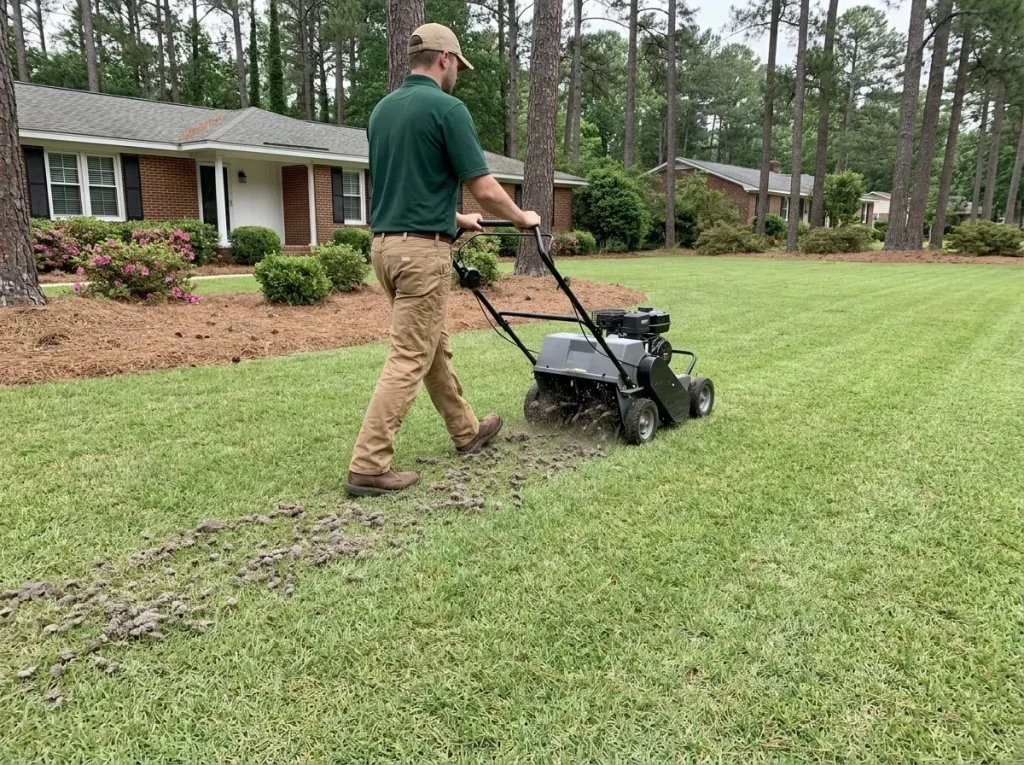
Bermuda and zoysia dominate the Sandhills and cover the majority of Chapel Hill lawns. Pinehurst is roughly ninety-seven percent warm-season turf. For these warm-season grasses, the aeration calendar runs opposite to fescue: aerate during active summer growth, not during the fall cool-down. Aeration relieves soil compaction on a bermuda lawn best when the grass is actively growing and can knit the cores closed on its own.
The Soil-Temperature Signal for Bermuda and Zoysia
Warm-season grasses green up when soil temperature at four inches climbs into the mid-60s, then hit active shoot and rhizome growth once soil holds steady at 70 degrees Fahrenheit and above. That threshold is the physiological trigger for the plant to close aeration cores, extend rhizomes into the loosened soil, and knit the canopy back together. Aeration on dormant or barely-active warm-season turf leaves open cores that stress the plant and slow recovery.
The window that meets the threshold in the Sandhills opens in mid-May in warm springs and late May in cool ones, and closes in late June or early July when heat stress starts to work against recovery. A six-week usable window is more forgiving than the fall fescue window, but the same principle applies: the temperature signal, not the month, determines the day.
A Week-by-Week Look at the Spring and Early Summer Window
| Weekly Window | Typical 4-Inch Soil Temp | What the Lawn Is Ready For |
|---|---|---|
| Early May | 55 to 65 F | Green-up in progress. Wait for consistent 70 F soil. |
| Mid to late May | 65 to 72 F | Window opens. Aerate as soon as growth is visibly active. |
| June | 72 to 80 F | Peak recovery window. Cores close in days; no overseed on warm-season turf. |
| Early July | 80 F and rising | Late window. Aeration still works if irrigation is reliable. |
| Mid-July onward | Above 82 F | Heat stress. Skip aeration until the next spring cycle. |
Warm-season lawns are not overseeded. Bermuda and zoysia spread by rhizomes and stolons rather than seed, and introduced seed rarely competes with the established mat. Aeration alone does the work, opening channels so water and nutrients move deeper into the soil where roots actually use them. That is what makes bermuda and zoysia so responsive to properly timed aeration services: the plant closes its own cores, produces a healthier lawn canopy, and allows the lawn to recover before summer heat peaks.
How to Check the Window Yourself
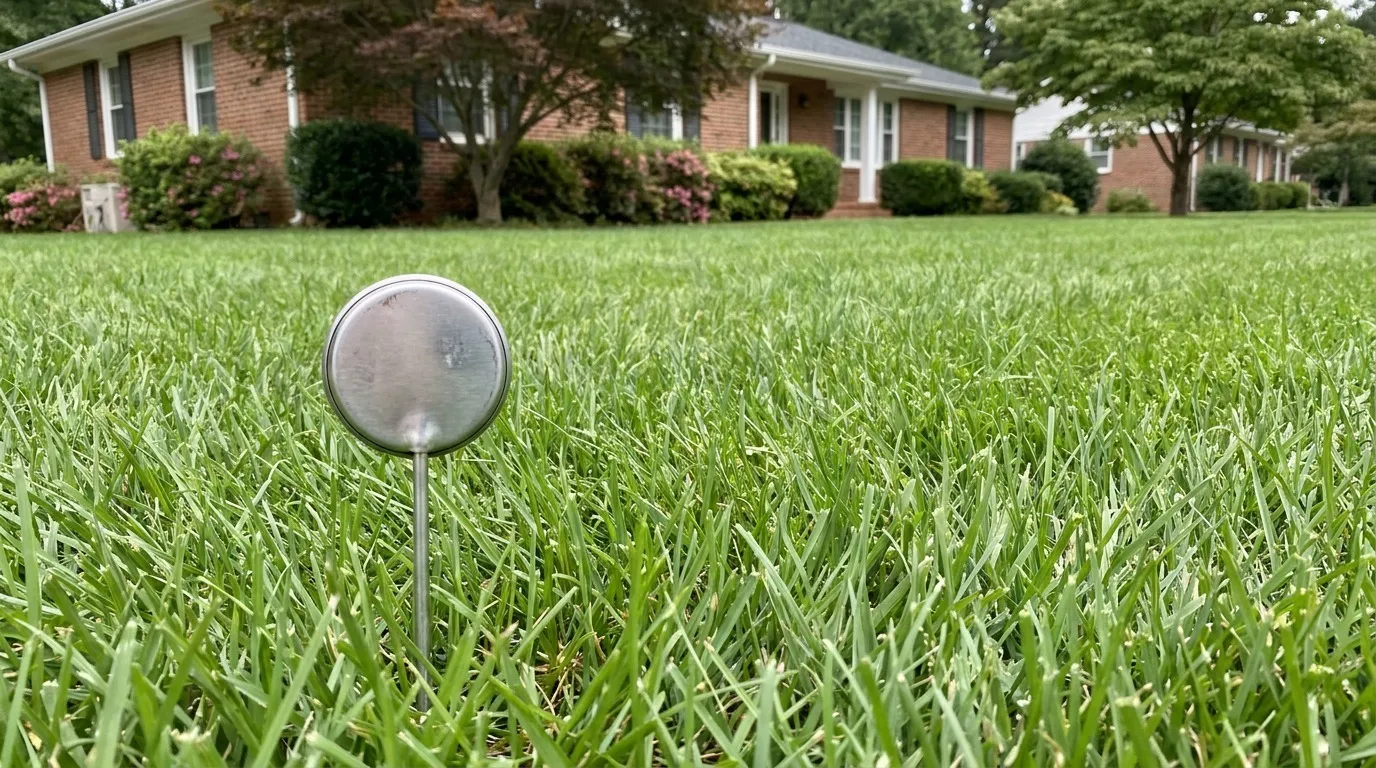
You do not need a laboratory to time the aeration of your lawn correctly. A twelve-dollar soil thermometer with a four-inch stem, sold at most hardware stores and garden centers, tells you exactly how the grass feels. If you plan to rent a core aerator for a Saturday, this two-minute check tells you whether the machine is worth the trip.
The Two-Reading Protocol
Take two readings, four to five days apart, at the same time of day and in the same location on the lawn. Mid-morning is the most consistent time because overnight cooling has stabilized. Push the probe to four inches and wait thirty seconds for the reading to settle.
- If both readings sit above 78 degrees Fahrenheit, the fall fescue window is not open yet. Wait.
- If both readings sit between 65 and 75 degrees and are trending downward, the window is open now. Move fast.
- If both readings sit below 62 degrees and dropping, the window has closed for overseed. Aeration alone still helps compaction; save the seed for next fall.
For warm-season turf, invert the reading. Consistent 70-degree soil that is trending upward opens the window. A drop into the low 60s means dormancy is starting; skip aeration until spring.
Where to Take the Reading
Sunny, mid-slope lawn is the reference reading. North-facing shade runs three to five degrees cooler; south-facing full sun runs three to five degrees warmer. If your yard has significant shade, take a reading in each condition and treat the shaded area as the pace car. Aerate when the shady part reaches the window, not when the sunny strip did three weeks ago. Consistent readings across the lawn are one of the best signs your lawn needs aeration is being answered on your own schedule rather than the retailer's rental calendar.
What Happens When the Work Lands Outside the Window
Every lawn service season has stories that boil down to the same problem: the aeration was executed correctly, but the calendar was wrong. Here is what actually happens in each miss.
Too Early (Fescue Aerated in Late August)
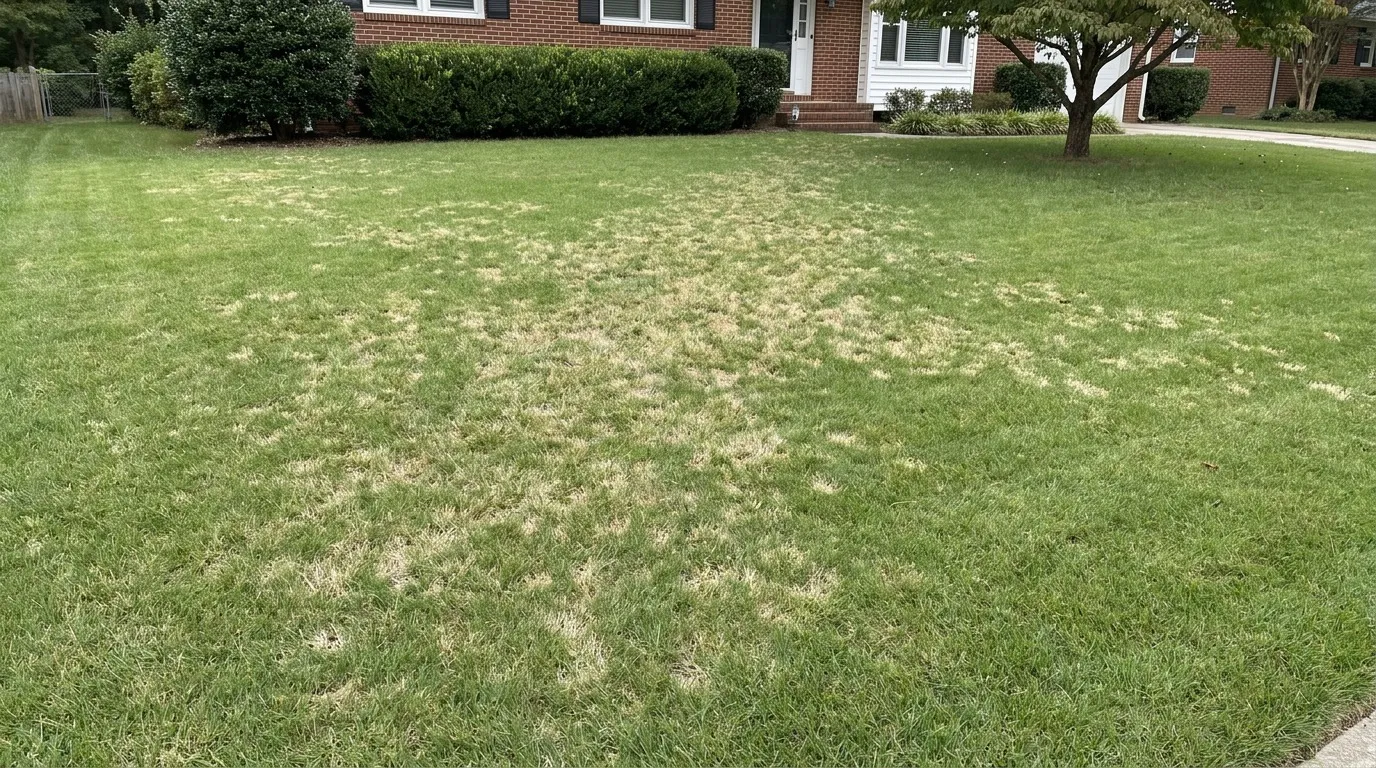
New grass seed hits soil holding above 78 degrees. Some germinates within four days, then blade tips scorch under lingering heat. Brown patch and pythium find the wounded seedlings. The homeowner ends up with a mixed canopy of scorched new grass and older fescue that never got the benefit of the aeration timed to a cooler root zone. Aerating at the wrong time on a compacted soil profile can set overall lawn health back a full season.
Too Late (Fescue Aerated Mid-October or Later)
Soil drops below 60 degrees within two weeks of the work. Germination stalls. Seedlings that do emerge do not put down enough root mass before frost. Winter kill is heavy, and the following spring shows thin, patchy establishment that looks worse than the pre-aeration lawn.
Too Early on Warm-Season Turf
Aeration before consistent 70-degree soil creates open cores that the plant cannot close through active growth. Cores dry out, edges brown, and the lawn takes weeks to recover. In a dry spring, the wound never fully heals.
Too Late on Warm-Season Turf
Aeration during peak summer heat stresses turf that is fighting drought and temperature. Recovery slows, and irrigation demand climbs to keep cores from drying out.
None of these outcomes is a critique of the work itself. Each one is the wrong week on the calendar. Nailing the week matters more than nailing the machine, because reaching the grass roots at the moment they can respond is what turns aeration into a healthier lawn rather than a punched surface.
Where Grass Type and Region Change the Window
Central North Carolina crosses two turfgrass zones, and the window shifts as you move across the state. A single household with a mixed lawn may need two different aeration dates for two different parts of the yard, depending on the type of grass in each zone.
Triad Fescue Lawns
Winston-Salem, Greensboro, Kernersville, Clemmons, Lewisville, King, High Point, Burlington, Summerfield, and Oak Ridge sit squarely inside the fall-fescue pattern. The three-week window typically falls mid-September to first week of October in cooler years and shifts a week later in warm years. Compare the current soil probe reading with the seasonal lawn care program schedule to lock the date.
Research Triangle Mixed Lawns
Chapel Hill, Carrboro, Hillsborough, Durham, and Pittsboro carry both cool-season and warm-season turf, sometimes in the same yard. A trained technician walks the property and identifies which zones receive fall aeration and overseeding, and which zones receive late-spring aeration. If you are DIY, mark the yard by grass type on a printed lot map and time each zone against its own probe reading.
Sandhills Warm-Season Lawns
Pinehurst, Aberdeen, Southern Pines, and Seven Lakes run almost entirely on bermuda and zoysia. The late-spring window is the annual aeration date, and there is no overseed. Fall aeration on Sandhills turf leaves open cores through dormancy and works against the plant.
Coordinating the Window with Everything Else
The aeration window sits inside a busier fall schedule than most homeowners realize. Two other decisions fall in the same week, and both affect the aeration date. Both also shape overall lawn care practices for the rest of the year.
Before the machine ever hits the yard, mow your lawn to the recommended pre-overseed height so the seed reaches the soil surface and the aerator plugs sit on a clean canopy. If there is a heavy layer of dead grass at the base of the turf, dethatch it first: aeration is not a thatch treatment, and a thick layer of dead grass stems can intercept seed before it reaches the soil.
The Overseeding Rate Matches the Window
If you are overseeding fescue during the fall window, the seed rate has to match the window's germination potential. Rates are typically higher for thin lawns and lower for moderate lawns, and the rate you choose affects how many seeds actually reach the soil after the mower closes over the cores. Nature's Select® explains how much seed you need for the window in its overseeding rate article; the short version is that a rate that would be right in mid-September is often too low in the second week of October because the shorter growing season causes over-seeded plants to fail.
The Pre-Emergent Trap Sits Inside the Window
Fall pre-emergent for annual bluegrass, chickweed, and henbit typically breaks down when soil temperature drops into the low 70s at 4 inches, which is the same week the fescue overseed window opens. Standard pre-emergent products inhibit germinating seed indiscriminately, so laying pre-emergent and overseeding in the same week destroys the seed you just paid for. There are viable strategies for handling both, including seedling-safe active ingredients and split scheduling, but the choice has to be made before the machine hits the yard. Nature's Select® works through the pre-emergent conflict during that window in the AO-1.7 companion article; understanding it before booking pre-emergent lawn weed control saves the fall.
Key Takeaways
- The best time to aerate lawn areas in North Carolina is when four-inch soil temperature sits in the grass type's target band, not when the calendar reads a specific month.
- For tall fescue in the Triad and Triangle, the actionable window is roughly three weeks: soil 65 to 75 degrees, trending down, typically mid-September to first week of October.
- For bermuda and zoysia in the Sandhills, the window is roughly six weeks: soil consistently 70 degrees and rising, typically mid-May to end of June.
- A twelve-dollar soil thermometer with a four-inch stem and two readings four days apart is enough to time the window without guessing.
- Missing the window by three weeks does not just delay results; it produces a materially worse lawn than skipping the year and waiting.
- Fall pre-emergent decisions have to be made at the same time as the overseed decision because both land in the same soil-temperature week.
When Nature's Select® Times Aeration for North Carolina Homeowners
Nature's Select® runs lawn aeration services and a full seasonal lawn care program across the Triad, the Triangle, and the Sandhills. A trained technician reads soil temperature at four inches, identifies the type of grass on the property, and matches the aeration and overseed date to the window that fits both. On cool-season fescue lawns in the Triad, the crew aerates and overseeds during the fall three-week window. On warm-season lawns in the Sandhills, the crew aerates in late spring while bermuda and zoysia are actively growing. The plan is written down so you know exactly when your lawn is scheduled and why. If overall lawn care throughout the season is the goal, correctly timing aeration is one of the most impactful decisions of the year.
Frequently Asked Questions
When is the best time to aerate a lawn in North Carolina?
The best time to aerate depends on the type of grass on the property. For tall fescue, aim for four-inch soil temperature between 65 and 75 degrees Fahrenheit and dropping, which typically falls between mid-September and the first week of October across most of central North Carolina. For bermuda and zoysia, aim for four-inch soil temperature consistently at or above 70 degrees Fahrenheit and rising, typically between mid-May and the end of June. A twelve-dollar soil thermometer removes the guesswork.
Is it too late to aerate my lawn in NC in late October?
Late October is too late for overseeding a tall fescue lawn in most of North Carolina. Soil temperature has usually dropped below 60 degrees at that point, and new seedlings will not root deeply enough before the first hard frost to survive winter. Aeration alone is still useful in late October for compaction relief on both cool-season and warm-season lawns, but plan the overseed for the next fall window.
Is October too late to aerate a lawn?
The first week or two of October is typically still inside the fall fescue window across the Triad and Triangle, but the window closes quickly after that. If a soil thermometer at four inches reads above 62 degrees and the seven-day forecast holds mild, October aeration and overseed still works. Below 62 degrees or with a cold front in the forecast, the window has functionally closed for that year.
What are the downsides of aerating your lawn at the wrong time?
Aerating at the wrong time creates open cores that the grass cannot close and that expose the root zone to heat, cold, or drought stress. On fescue, too-early aeration under lingering summer heat scorches seedlings and invites brown patch. Too-late aeration produces seedlings that never root before frost and die in winter. On bermuda and zoysia, too-early aeration on dormant turf leaves open cores that dry out, and too-late aeration during peak summer heat stresses turf already fighting drought.
How do I know if my lawn needs aeration?
Push a screwdriver into the soil after a dry stretch. If it stops in the first three or four inches with hard resistance, the lawn needs aeration. Pooling water after rain, thin turf despite regular fertilization, worn wear paths along walking routes, and a lawn that hardens like a driveway in summer are all consistent signals. The full six-signal diagnostic is covered in the companion article on signs your soil is compacted.
Should you put topsoil down after aerating?
No. Topsoil layered on top of an aerated lawn suffocates the existing turf and does not reach the soil profile you actually want to improve. The correct amendment is a thin top-dressing of composted material worked into the open cores by rainfall or irrigation. Composted leaves, aged wood bark, or finished yard-waste compost enter the soil ready to work; fresh topsoil settles as it decomposes and pulls nitrogen from the root zone while microbes break it down.
How often should you aerate your lawn in North Carolina?
For fescue lawns under a full seasonal lawn care program, an annual fall aeration and overseed cycle is typically enough to maintain gains once the first two or three years have opened the soil profile. For warm-season lawns in the Sandhills, an annual late-spring aeration is the standard. New-construction lawns or lawns with heavier compaction sometimes benefit from a second annual aeration in the first year or two of rebuild.
Conclusion
The three-week fall window for tall fescue and the six-week late-spring window for bermuda and zoysia are not marketing simplifications. They are the physical windows where soil temperature, moisture, and grass physiology overlap enough for aeration and overseed to actually improve the lawn. Every calendar-driven "September through November" range hides the truth that the real window inside it is a fraction of the length. A soil thermometer costs less than a bag of seed and prevents the most common reason aeration disappoints homeowners: the right work at the wrong time.
If you would rather have the window watched for you and the aeration timed against a live soil-temperature reading on your specific property, request a free on-property assessment or call Nature's Select® at (888) 786-9735 for a same-day written estimate.
Lauren Whitfield is Turf Science Editor at Nature's Select®.