THE LIVING SOIL, PART 3: ORGANIC MATTER & HUMUS
The founding theory of the Select Program is that “Healthy Soil creates a Healthy Lawn”. But what is “healthy soil”? Let's look at the factors that go into producing a healthy soil that benefits your grass and lets nature feed and protect your lawn.
Note: The science of soil chemistry and makeup is complex. This is a very simple overview of the process.
ORGANIC MATTER: THE RAW MATERIAL
A compost pile shows the transformation of raw organic material into dark rich soil.
Organic matter is the raw material of good soil structure: grass clippings, leaf clippings, twigs, things that have died (plant or animal); essentially whatever is laying on top of the soil that isn’t alive but once was. It’s also anything that’s died below ground: plant roots, microorganisms, animals and insects. When you consider that there is as much plant material below the ground (roots etc.) as there is visible above the ground, plus the incredible, invisible mass of microorganisms and soil-dwelling animals and insects, that is a lot of organic raw material.
The raw organic material is broken down through several processes into its component mineral compounds and humus. (We looked at how mircoorganisms and earthworms contribute to this breakdown in part 1 and part 2) These byproducts of organic matter feed your grass and other plants and organisms. Organic material and humus also perform the following functions in the soil:
- Increases the water-holding capacity of the soil, increasing drought resistance
- Keeps soil nutrients from being dissolved or washed away by rainfall or irrigation
- Slows changes (up or down) in soil pH and helps maintain a fairly neutral pH
- Provides a constant source of nutrients to feed soil microorganisms
Obviously, adding and keeping organic material in the soil has many important benefits to soil health (and therefore plant health). But how do you build up organic material in your soil, especially if it has a high clay content like the soils in the Triad?
Leaving grass clippings and fallen leaves (finely chopped so as not to smother grass) on your lawn returns a great deal of organic matter to the soil. Additionally, supplanting organic compounds during lawn care applications (as we do with the Select Program’s proprietary ingredients) will also increase the organic matter in the soil and also provides needed components to turn existing raw organic matter into humus.
HUMUS: THE SUSTAINABLE GOAL
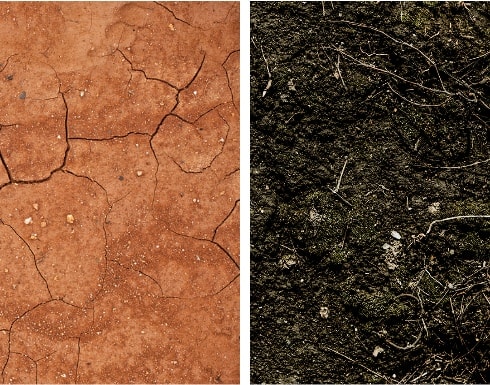
Left, red soil with heavy clay content is common in the Piedmont. While it's fertile, it has low organic content. Right, a dark, humusy soil heavy in organic content. Slower-decomposing raw organic material (twigs and leaf petioles) is still recognizable. Left, red soil with heavy clay content is common in the Piedmont. While it's fertile, it has low organic content.

Right, a dark, humusy soil heavy in organic content. Slower-decomposing raw organic material (twigs and leaf petioles) is still recognizable.
Right, a dark, humusy soil heavy in organic content. Slower-decomposing raw organic material (twigs and leaf petioles) is still recognizable.
The transition of organic material to humus takes time and the help of many different parts of the “living soil”. As organic material decomposes, some of it becomes broken down into minerals that feed your grass including nitrogen, phosphorus, potassium (the “N-P-K” macronutrients), and other equally important micronutrients.
The remainder doesn’t break down so much as become recombined into complex organic polymers known collectively as humus. Some of these polymers are very stable and resist further breakdown by soil microorganisms, becoming a long-term component of the soil. Humus improves soil texture and helps lock moisture & nutrients in the soil—all very desireable traits for growing anything from grass to landscape plants to food crops. Humus also holds CO2 in the soil and away from the atmosphere where it contributes to the greenhouse effect.
The goal of the Select Program is to promote and sustain the formation of a sustainable, healthy soil environment that benefits your grass, your landscape, and the living things both below and above the surface. The end product is the “black gold” we know as humus. Your healthy, humus-y soil will create a healthy and sustainable lawn, naturally.