6 Signs Your Soil Is Compacted (Before You Spend a Dollar on Aeration)
The clearest signs of soil compaction are water pooling after normal rain, a screwdriver that will not slide six inches into moist ground, thinning turf even after fertilization, worn traffic paths and matted moss, weed pressure in the bare spots, and mower rutting on level ground. Three or more signs mean the soil structure has failed and aeration is the right next step. Fewer than three means the fix is likely somewhere else.
Your lawn looks tired. You have watered it, mowed it at the right height, and put money into treatments. Something below the surface is still not right, and every article you find tells you to aerate before it tells you why. This guide flips that. You will walk your own lawn against six specific signs of soil compaction, count how many show up on your property, and know whether aeration is the intervention that actually fits your problem or whether the answer is something else entirely.
Nature's Select® has run hollow-tine core aeration on North Carolina lawns since 1994, which means we have watched a lot of homeowners spend money on aeration when the real issue was thatch, disease, or a nutrient gap. The six-signal checklist below is the same rough diagnostic our technicians use on the on-property assessment. Work through it before you rent a machine or book a service, and you will spend the next dollar on the right fix.
Sign 1: Water Pools or Runs Off After Normal Rain
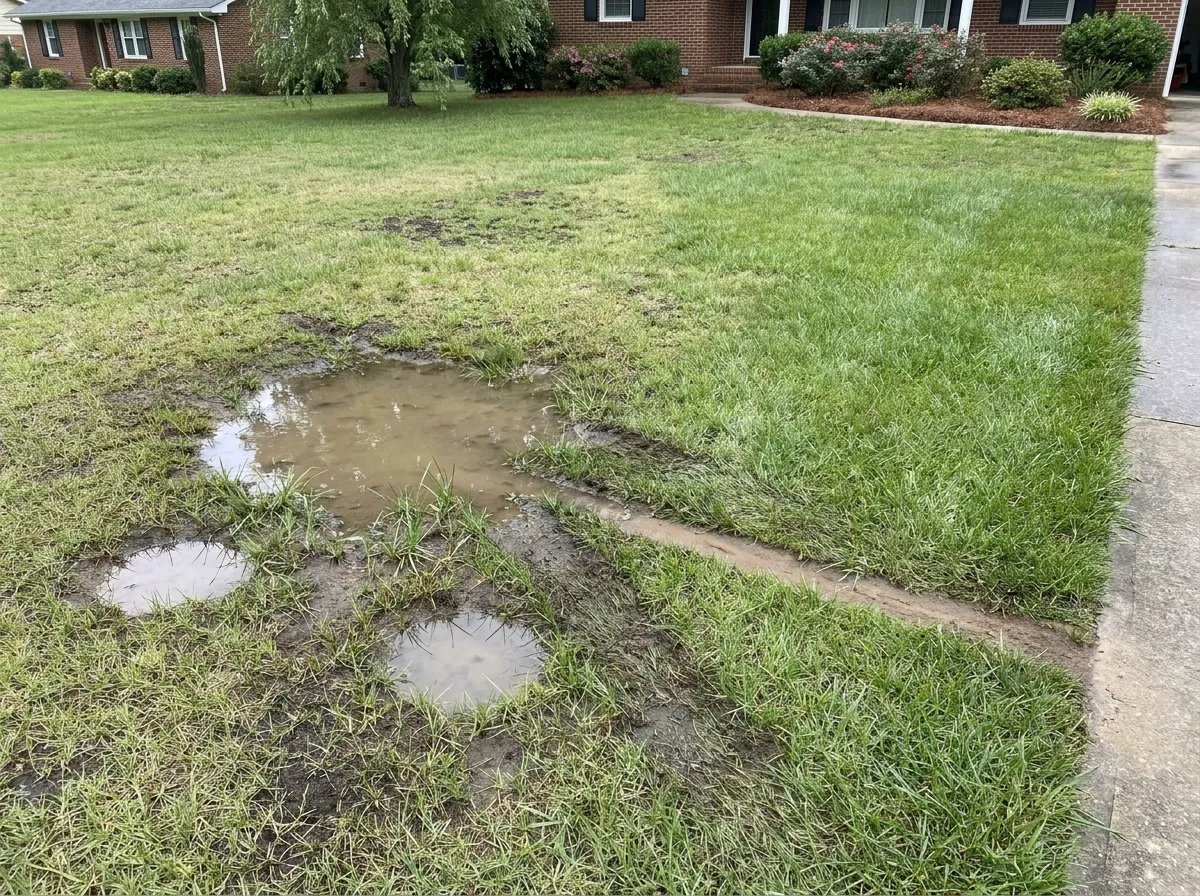
Healthy soil is roughly half solid particle and half pore space. Those pores are the channels water follows on its way down to the root zone. When soil compacts, the pores collapse. Water hits the surface, finds no path in, and either sits there or sheets off toward the driveway.
Two or three hours after a normal soaking rain, walk the yard. You are looking for puddles that persist in flat areas, sheet flow across sections of turf that should be absorbing, and darker mud lines where water traveled instead of infiltrated. Rutgers Cooperative Extension flags this as one of the earliest structural warnings a homeowner can spot, because the pooling is compaction rendered visible on the surface. Standing water for more than an hour after rain that soaked in elsewhere in the yard is the strongest single indicator on this list.
The pooling matters for more than aesthetics. Water that will not soak in is carrying dissolved nitrogen, sulfur, and any pre-emergent you applied off the property. Compacted lawns lose fertilizer efficacy at a measurable rate. That is one of the reasons you may feel like the granular you spread last month never showed up in the canopy.
Sign 2: The Screwdriver Test Stops Short of Six Inches
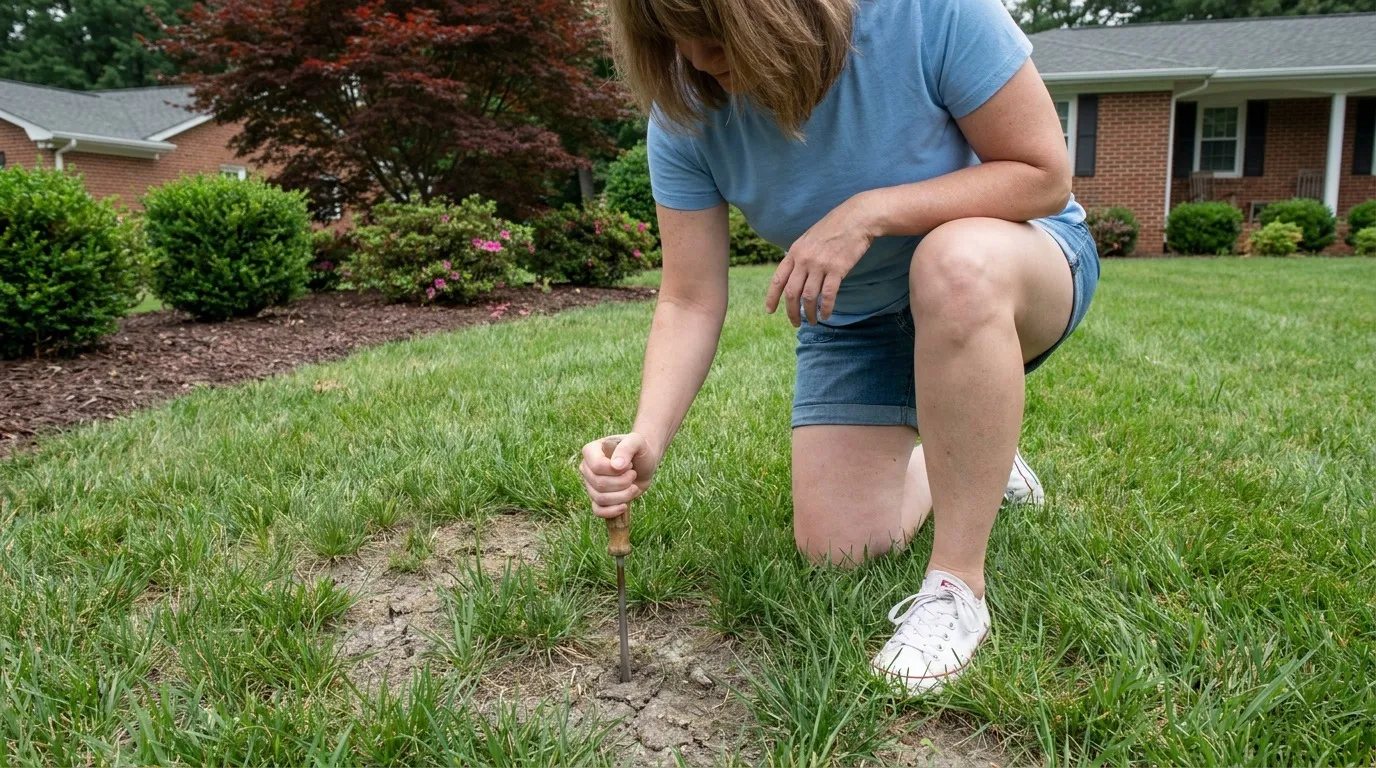
The screwdriver test is the closest thing to a universal DIY compaction check, and other cooperative extensions across the transition zone. It costs nothing, takes five minutes, and gives you a rough bulk-density reading you can act on.
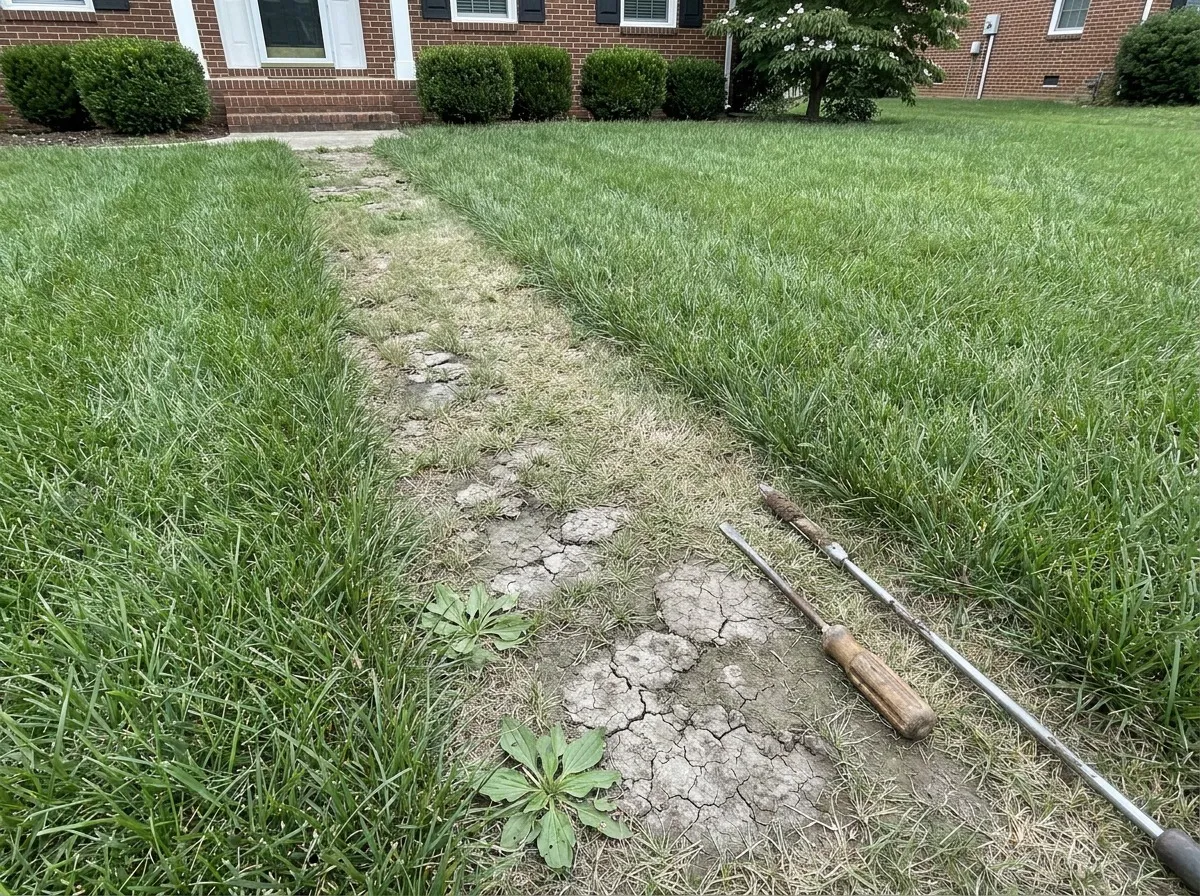
Wait two to three days after rain or irrigation. The soil should be moist, not muddy, and not dry. Take a six-inch flathead or Phillips screwdriver and push it straight down into the turf. In healthy soil, it will slide most of the way in with hand pressure. If it stops abruptly at two or three inches, if you have to lean your body weight to get it past the surface layer, or if it will not pass through the top inch at all, the soil is compacted.
Test at least five spots across the lawn. Focus on the areas people walk, where the dog runs, the mower path, and one control spot in a flower bed if you have one nearby. If the driveway edge and the walkway margin resist while an untraveled corner behaves normally, you are looking at traffic-driven compaction, which is exactly what hollow-tine core aeration is designed to correct. If the screwdriver hits resistance everywhere, the issue is deeper and structural, and a professional soil probe reading is the right next step. If you want the full three-test protocol including the soil probe and the infiltration jar, walk through the screwdriver test protocol next weekend.
| Screwdriver Reading | What It Means | Recommended Action |
|---|---|---|
| Slides in six inches with hand pressure | Soil structure is intact | Aeration not indicated; look at other causes |
| Resistance below three inches, some progress with pressure | Moderate compaction in traffic zones | Annual core aeration matched to grass type |
| Stops at one to two inches, requires body weight | Severe compaction across the lawn | Book a professional soil assessment |
| Cannot pass a surface crust at all | Surface sealing plus deeper compaction | Core aeration plus biological amendment |
Sign 3: The Canopy Thins Despite Fertilization and Water
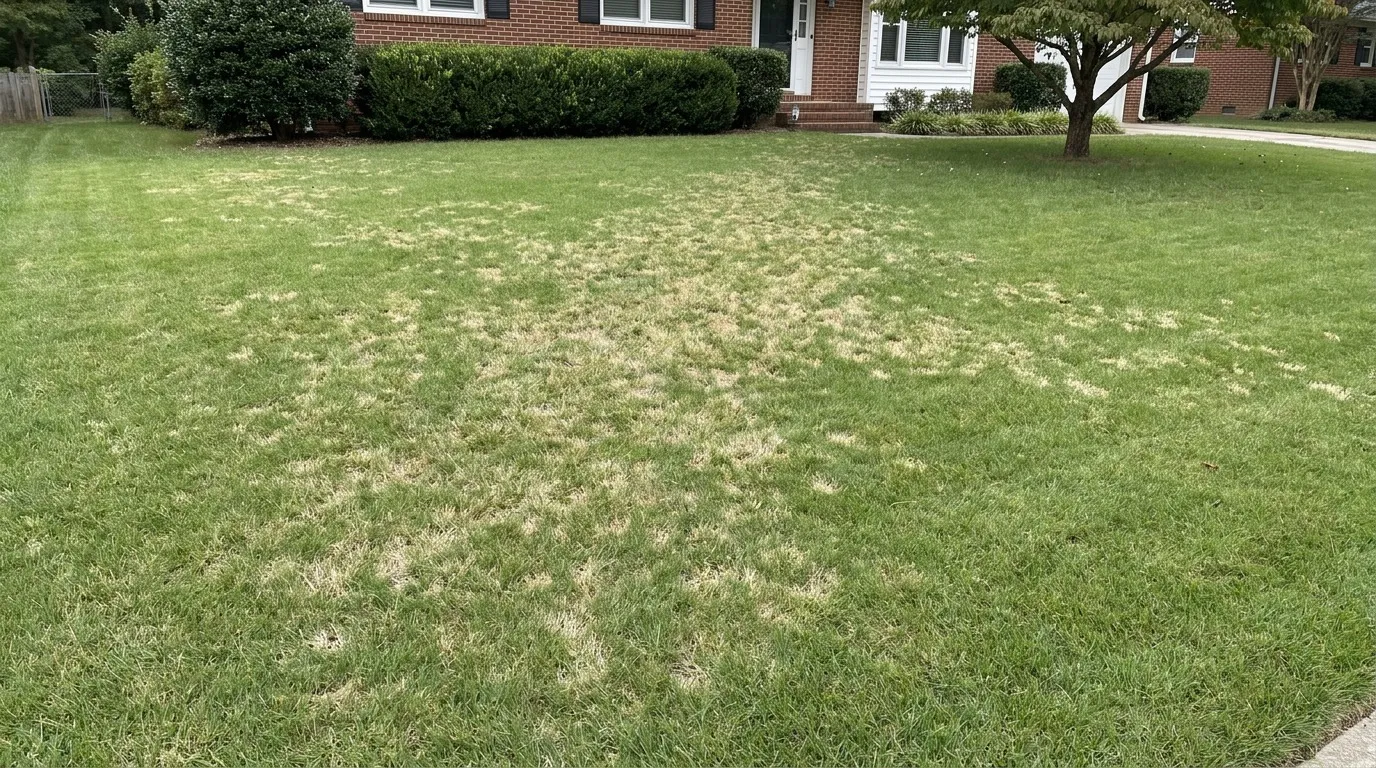
You have watered on schedule and put down the right amount of nitrogen. The lawn should be thickening. It is not. The canopy stays thin, colors run pale to yellow-green through the growing season, and blades pull up more easily than they should. This is compaction expressing itself in the tissue, not in the soil surface.
The mechanism is straightforward. Compacted soil restricts root growth to the top two or three inches. Shallow-rooted turf cannot access soil moisture during a summer stretch and cannot pull nutrients up faster than they leach past. Research summarized by the University of Massachusetts turf program shows compacted soil can cut nutrient uptake by ten to thirty percent. You are effectively getting seventy to ninety cents of value out of every dollar of fertilizer.
Central North Carolina tall fescue is especially vulnerable here. Fescue is a bunch grass that recovers density through crown tillering and, on cool-season lawns, through overseeding. Neither mechanism can produce a thicker canopy over shallow roots. Signs three, four, and five almost always show up together. If you notice thinning alongside decent watering practice, count this signal and move on.
Sign 4: Worn Traffic Paths, Matted Moss, or Mower Rutting on Level Ground
Compaction concentrates where the load concentrates. That means the shortcut across the front yard, the strip between the driveway and the porch, the arc where the mower turns, and the shady margin under the tree line where moisture lingers.
The visual signals cluster in three patterns:
- Traffic paths. A bare or thinning stripe that follows the way the family actually walks the yard. The turf on either side is denser and greener.
- Moss and algae. Green or brown moss taking hold in shady, wet, compacted zones. Moss thrives where turf cannot root; it is telling you the compaction pushed grass out.
- Mower rutting on level ground. If your tires are leaving tracks on a flat pass at normal moisture, the soil is being displaced instead of supporting the load.
None of these signs alone means the whole lawn is compacted. Two or three of them in the same area is a strong local indicator. Note where they are on the property. When we run a professional soil assessment, we test those spots first because they will give us the fastest read.
Sign 5: Weeds Take the Bare Spots the Turf Cannot Hold
Weeds tell you about the soil. Turf density is the primary defense against weed germination, and when compaction thins the canopy, opportunistic species move in. The pattern is not random. Certain weeds are strong signal species for compacted soil, particularly on the clay-heavy soils that dominate central North Carolina.
Watch for:
- Broadleaf plantain and buckhorn plantain. Rosettes with heavy taproots that penetrate compacted soil. Plantain in an otherwise-treated lawn is a compaction indicator.
- Prostrate knotweed. Wiry mats that spread flat along walkways and driveway edges, exactly where foot traffic compacts hardest.
- Prostrate spurge and spotted spurge. Summer annuals that colonize open, compacted, hot ground.
- Annual bluegrass (Poa annua). Fills thin fall and winter canopies on compacted fescue lawns; a common indicator across the Triad and Triangle.
- Crabgrass. Not a pure compaction indicator on its own, but a canopy-density indicator, and canopy density often traces back to compaction.
If you see these species clustered in the same spots you flagged for signs one through four, count the signal. If your weed pressure is spread evenly across a dense, thick lawn, compaction is not the primary driver.
Sign 6: The Ground Feels Different Underfoot
The last signal is the least technical and the one professionals often notice first when they walk a property. The soil surface feels wrong. There are three sub-patterns:
Spongy. You step across the lawn and it gives half an inch under your foot. That is usually a thick thatch layer sitting above compacted soil. The turf feels soft; the ground beneath it is rock hard. Sponginess without hardness is a thatch issue. Sponginess with hardness underneath is compaction plus thatch, which is a compound problem that seasonal lawn care alone cannot solve.
Bouncy or hollow. The lawn feels like a drum. Air pockets are trapped between a hydrophobic surface and a compacted layer below. Water beads on top instead of soaking in. This shows up on Sandhills bermuda and zoysia lawns as often as on Triad fescue.
Crusted and cracked. Dry weeks leave a fine crust on the surface that cracks in a pattern like alligator skin. Clay soils, especially the weathered Cecil-series soils under a lot of central North Carolina neighborhoods, crust readily when compacted. Once the crust forms, water sheets off instead of penetrating.
You already know what healthy turf feels like under your feet from the yard next door or the park. If your ground does not feel like that, count the signal.
What to Do With Your Score
Add up how many of the six signs you saw. Use the count to decide what happens next.
| Signs Present | Interpretation | Recommended Next Step |
|---|---|---|
| 0-2 | Compaction is unlikely to be the primary issue | Look at watering, mowing height, disease pressure, thatch, or nutrition first |
| 3-4 | Compaction is a real contributor | Book aeration timed to your grass type; overseed on cool-season lawns |
| 5-6 | Compaction is the structural problem holding the lawn back | Professional core aeration plus a biological amendment to restore soil biology |
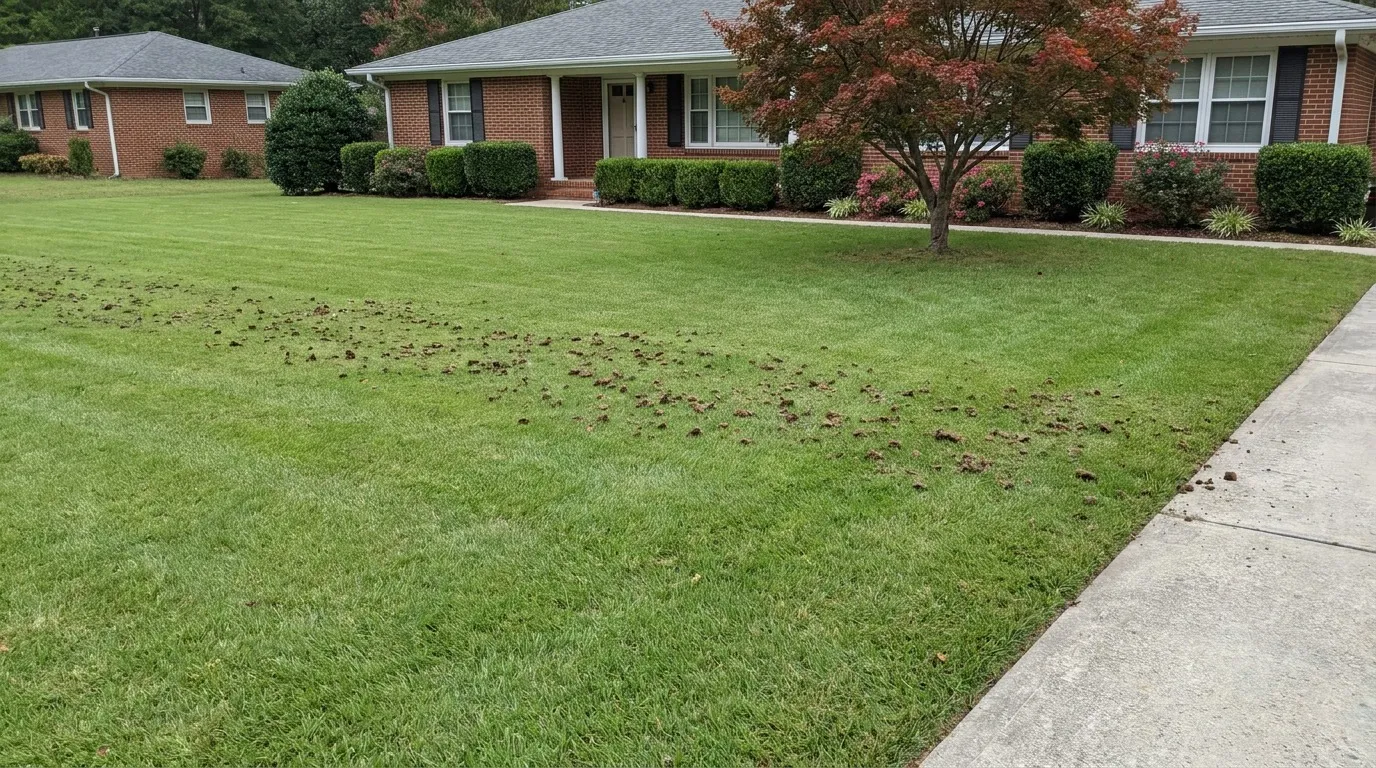
Timing matters as much as the count. Tall fescue lawns across central North Carolina hit their aeration and overseeding window from mid-September through mid-November, when soil temperatures cool enough for germination and warm enough for root establishment. Warm-season bermuda and zoysia lawns aerate in late spring, typically May through June, during active growth. A hollow-tine core aerator is the only tool that actually pulls plugs out and relieves compaction; spike aerators push soil sideways and seal the hole back. If the signs point to aeration, use the right tool at the right time.
If you are landing between three and six signs and want the work done during the correct soil-temperature window with a written aftercare plan, book a compaction assessment with Nature's Select® and we will pull a real bulk-density reading before we recommend the plan.
Key Takeaways
- Water pooling or running off after normal rain is the earliest visible sign of failed soil pore structure.
- The screwdriver test is a five-minute DIY check endorsed by NC State turfgrass specialists; six inches easy is healthy, one to two inches with body weight is severe.
- Thinning canopy alongside on-schedule watering and fertilization points to shallow roots and reduced nutrient uptake.
- Traffic paths, moss in shady margins, and mower rutting on level ground localize compaction to specific zones you can treat.
- Broadleaf plantain, prostrate knotweed, prostrate spurge, annual bluegrass, and crabgrass are signal weeds where turf density has failed.
- Three or more signs justifies aeration; fewer than three means the primary problem is somewhere else, and aeration will disappoint.
Frequently Asked Questions
How many of the six signs mean my lawn needs aeration?
Three or more signs across the same area of the lawn is a reliable threshold for aeration. Fewer than three usually points to a different problem, most often thatch, watering practice, mowing height, or a nutrient gap. The screwdriver test carries the most diagnostic weight of any single signal, so if it fails on its own, treat that as equivalent to two signs and consider aeration on that basis alone.
Can I test for soil compaction myself, or do I need a professional?
You can. The screwdriver test costs nothing and reliably identifies compaction in the top six inches, which is the zone hollow-tine core aeration addresses. Test at least five spots, wait two to three days after rain, and use moist not dry soil. A professional soil assessment adds a bulk-density reading and a soil-temperature check, which you cannot easily do with home tools, and it will tell you whether compaction is the whole story or whether disease, thatch, or nutrient imbalance is compounding it.
Is compacted soil the same as clay soil in North Carolina?
No. Clay soil is a texture; compacted soil is a structure. Central North Carolina clay is naturally denser than loam because clay particles are smaller and pack closer, but a healthy clay soil still has adequate pore space and infiltration. Compaction is what happens when foot traffic, mower weight, and dry-wet cycles collapse those pores. Clay soils compact faster than loam or sand, which is why NC clay compacts faster and why annual aeration matters more here than in a lot of other regions.
Will my lawn recover on its own if I stop walking on it?
Partially, over years. Freeze-thaw cycles and earthworm activity slowly rebuild pore space when the load is removed. On central North Carolina clay, that natural recovery is measured in growing seasons, not weeks. Aeration compresses the timeline from years to one visit, and pairing aeration with overseeding on cool-season lawns closes the canopy gap that let weeds in during the compaction period.
Does thatch cause the same symptoms as soil compaction?
The symptoms overlap and homeowners frequently confuse the two. Thatch is a layer of dead and living stem material above the soil; compaction is a structural failure below the soil surface. Dethatching addresses thatch. Aeration addresses compaction. The screwdriver test tells you which one you have. If the surface feels spongy but the screwdriver slides in six inches easily, thatch is your problem. If the surface feels hard and the screwdriver stops short, it is compaction.
If I only have one or two signs, should I still aerate?
Not necessarily. Aeration is a real intervention with a real cost, and it works on a real problem. If you are seeing only pooling after rain, check whether the yard grades away from the house before you assume the soil is at fault. If the screwdriver slides in but the canopy is thinning, check your watering depth and your mowing height. Save the aeration for the year the count crosses three.
Conclusion
Six signs, one score, one honest decision. Central North Carolina soil compacts every growing season it goes untreated, and the recovery compounds when you catch it early. Walk the yard, run the screwdriver test, count what you see, and decide whether aeration is the fix that fits your problem this year or whether the money belongs somewhere else. If the count lands at three or higher and you want the work done inside the correct soil-temperature window with a written aftercare plan, book a compaction assessment with Nature's Select® or call (888) 786-9735 for a free on-property assessment across our North Carolina service area.