
Insect pressure on a lawn is rarely cosmetic. White grubs hollow out the root zone from below, chinch bugs collapse the canopy in sunny strips, army worms can defoliate a yard in a weekend, and sod webworms cut blades at the thatch line overnight. Nature's Select® provides lawn insect control services or applications for North Carolina homeowners: the technician identifies the species on-site, then matches the treatment to what is actually there, with timing that protects bees and other beneficial insects.
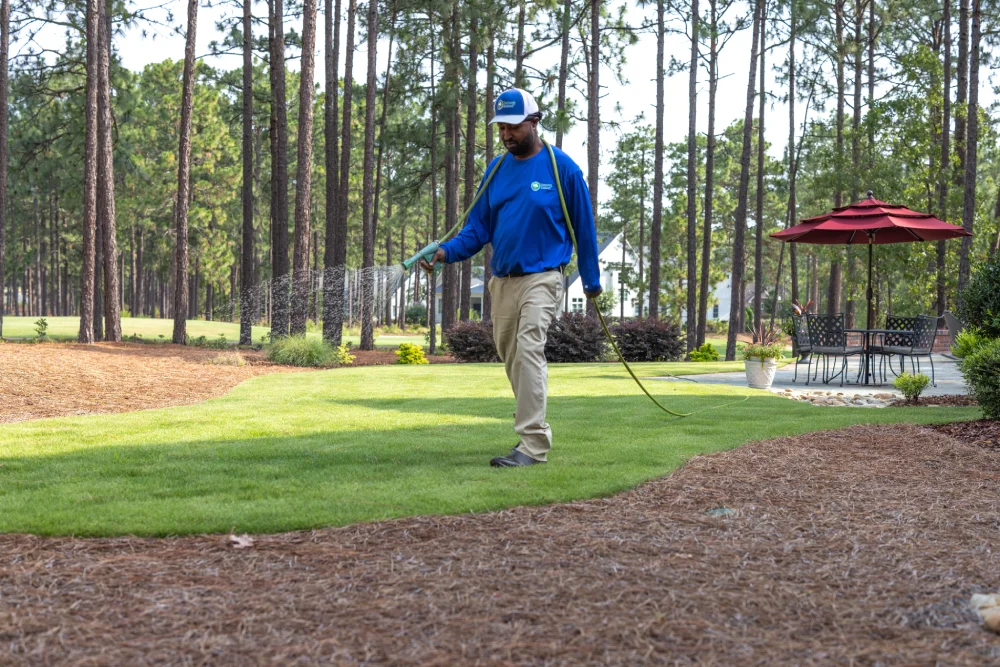

Stop guessing what is killing your lawn: The technician identifies the exact species on-site before any treatment

Recovery starts with quick diagnosis: Catching the species early keeps the treatment area small, and the ongoing lawn care program feeds recovery from healthy soil underneath.

Beneficial insects stay protected: Targeted spot treatment at the lowest effective rate keeps your pollinators and predator beetles working for you.

We treat the cycle, not just the outbreak: Insects run multiple generations in a season, so the technician tracks the population through its life cycle rather than treating once and walking away.
Nature's Select® lawn insect control covers the four insect pressures that North Carolina turf actually sees: armyworms, chinch bugs, white grubs, and sod webworms. Identification occurs at the species level on-site, and treatment is matched to what is present.
Coverage: ARMY WORMS · CHINCH BUGS · WHITE GRUBS · SOD WEBWORMS
The program starts with the soil. A healthy biological soil environment supports the beneficial insects that feed on these pests at the egg and larva stage, which is the lowest-cost intervention possible. When monitoring identifies an active population above the action threshold, a targeted insecticide is applied only to the affected area at the lowest effective rate, timed to protect pollinators through our affiliation with the NC State Beekeepers Association. The technician tracks each species within its window: chinch bugs in mid-summer heat, white grubs after late-summer egg lay, army worms in late summer for both cool- and warm-season turf, and sod webworms in July and August.
Insect pressure on a turf system can move from invisible to visible damage in a matter of days. By the time the lawn looks marked, the underlying population is often several generations ahead. The right program detects the pressure early, treats it within the right window, and restores soil conditions that make repeat infestations less likely.

A targeted insect treatment that costs $80 to $200 in July only stays that small if the population is caught early. Insects reproduce on a 2- to 3-week cycle in summer heat, and the affected area roughly doubles with each cycle, so a 10x10 ft patch can spread across the lawn by fall and turn a spot job into a whole-property application. North Carolina fescue gets overseeded every year as a matter of course, but insect damage stacks on top of that routine recovery rather than being covered by it, leaving thin areas your annual aeration and overseeding then has to fight to fill.

White grubs and chinch bugs hit the lawn from opposite directions. Grubs feed on roots from below, leaving turf that looks dry no matter how much you water; chinch bugs feed on stems and inject a toxin from above, leaving discolored patches in sunny areas. Treatment that works for one species does not work for another, which is why on-site species identification matters.

A healthy soil environment attracts predatory beetles, parasitic wasps, and other beneficial insects that feed on pests at the egg and larval stages. Blanket spray suppresses these allies along with the target. Nature's Select® is affiliated with the NC State Beekeepers Association, avoids broad spray during bloom on flowering trees, shrubs, and lawn weeds, and applies treatments only to the species causing pressure at the lowest effective rate.
No long phone call, no obligation. From your first call to a written plan matched to what the technician finds.
A trained technician walks the lawn, looks for the field signs each insect leaves (silk webbing, irregular brown patches, sod that lifts like a rug, sunken canopy in sunny strips), checks soil and thatch conditions, and confirms which species is active. The assessment is free, and there is no obligation.
Itemized pricing, recommended treatment timing, the species the technician identified, and the threshold above which treatment makes sense. The plan reflects the unique needs of your lawn and the actual pressure on it.
Treatment is matched to the species and applied at the lowest effective rate on the affected area. Broad spray during bloom is avoided.
Most homeowners considering professional insect control have first tried a bag from the box store. The honest comparison spans four dimensions that actually matter, and the gap between a worn shelf product and a species-matched professional treatment is wider than most homeowners expect.
| Dimension | Nature's Select® | DIY Store-Bought |
|---|---|---|
| Species identification | On-site identification at the species level. Soap-flush is performed when necessary to identify target pests and density before any product is applied. | Guesswork from package pictures. Most homeowners cannot distinguish chinch bugs from sod webworms, or army worms from beetle larvae, and the damage patterns overlap. |
| Treatment timing | Soil-temperature and life-cycle driven. Treatment lands during the small-larva window when products work best and application rates are lowest. | Calendar-driven (whatever is on the shelf), regardless of the actual pest cycle. Often too early or too late for the species causing damage. |
| Pollinator safety | NC State Beekeepers Association affiliation. Broad spray during bloom avoided. | Broad-spectrum granules or spray the entire lawn; suppress beneficial insects along with the target. No bloom-avoidance protocol. |
| Treatment precision | Treats the full area the insects have spread into, not just the visible damage, and applies only while the insects are in the active feeding stage, so the product actually reaches and controls the population. | Applied too early or too late in the life cycle, so the insecticide never contacts the active feeding stage and does not mitigate the problem. |
Skip the trial-and-error. call (888) 786-9735 or
The technician identifies insect pressure at the species level on every visit. The reference below covers the four pressures our turf actually sees, grouped by where they damage the lawn.
Caterpillar-stage moths that move across turf in large groups, defoliating cool-season and warm-season turf in late summer through fall. Fall armyworms grow up to 1.5" long and range in color from light green to nearly black. They have a distinguishing inverted "Y" shape on their head. Damage often resembles drought-stressed turf because the leaf material is gone, but the root system is intact.
Active
Late July through October on all turf
Damage pattern
Rapid defoliation, brown patches that spread outward as the worms move; visible chewing on grass blades
Field detection
Technician inspects soil-level thatch in the early morning for caterpillars; soap-flush test confirms population density
Small black bugs with shiny white wings marked by a black triangle, the southern chinch bug feeds on stems and injects a secretion that blocks water and nutrient movement. Populations build in sunny, hot, dry areas with thick thatch, producing 7 to 10 overlapping generations in a Piedmont summer. Peak infestation usually arrives in early July.
Active
May through September; peak pressure in July
Damage pattern
Discolored yellow-to-brown patches in sunny, open areas; turf wilts even with adequate irrigation; damage spreads outward
Field detection
Parting the canopy at the edge of a discolored patch reveals adults and nymphs at the soil line; flotation test confirms density
The larval stage of the Japanese beetle is the most damaging grub in Piedmont turf. White grubs have cream-colored bodies, brown heads, six legs, and a characteristic C-shape; they range from ¼ inch to 1½ inches long depending on the instar. They feed on turfgrass roots from below, hollowing out the root system until the canopy lifts away from the soil like a rug. According to the USDA, financial losses attributed to Japanese beetle larvae in the United States are estimated at $234 million per year.
Active
July through October (most damaging late August through September after egg lay)
Damage pattern
Turf wilts and stays brown despite irrigation; sections of sod lift away with little resistance; raccoons, skunks, and crows dig up affected areas hunting the grubs
Field detection
Cut a 12-inch square of sod 2-3 inches deep and count grubs; treatment threshold is roughly 5-10 grubs per square foot depending on turf vigor
The larval stage of small pink, yellow, or light-brown moths. Adult moths fly in zig-zag patterns just above the canopy at dusk and live only a few days, feeding on dew. Larvae overwinter underground in silk-lined tubes, then feed in early spring on root systems and grass blades, cutting blades at the thatch line and pulling them into the tunnel to eat. Peak damage hits Piedmont lawns in July and August.
Active
April through September (peak damage July through August)
Damage pattern
Small brown patches of closely cropped grass with visible bite marks on remaining blades; larger irregular brown patches with heavy infestations; silk webbing visible in the canopy at dawn before dew evaporates
Field detection
Parting the canopy in a brown patch reveals silk-lined tunnels at the soil line; soap-flush test brings larvae to the surface; moth flight at dusk indicates an active population
Walk your yard and check for these patterns. If one of them describes what you see, the lawn is telling you a specific insect is active.
When you can pull up a section of turf with little resistance and the root system underneath looks chewed or missing, you almost certainly have white grubs. The grub feeds on the roots from below, hollowing out the anchoring system until the canopy floats free of the soil. Often paired with raccoon, skunk, or crow digging in the affected area.
Patches that show up first in the sunniest, hottest parts of the lawn and spread outward, with turf that wilts even after watering, often signal chinch bugs. Chinch bugs prefer thick thatch, dry conditions, and full sun. The secretion they inject blocks the movement of water and nutrients, which is why irrigation does not help.
Brown patches that appear within days, with visible chewing on grass blades and caterpillars in the soil-level thatch in the early morning, signal armyworms. Damage often resembles drought stress because the leaf material is gone, but the root system is intact. True army worms hit fescue in spring; fall army worms hit warm-season turf in late summer.
Closely cropped grass with visible bite marks on the blades, paired with silk webbing in the canopy that is most visible at dawn before the dew evaporates, signals sod webworms. The larvae cut blades at the thatch line and pull them into silk-lined tunnels to eat. Peak pressure July through August during heat and drought stress.
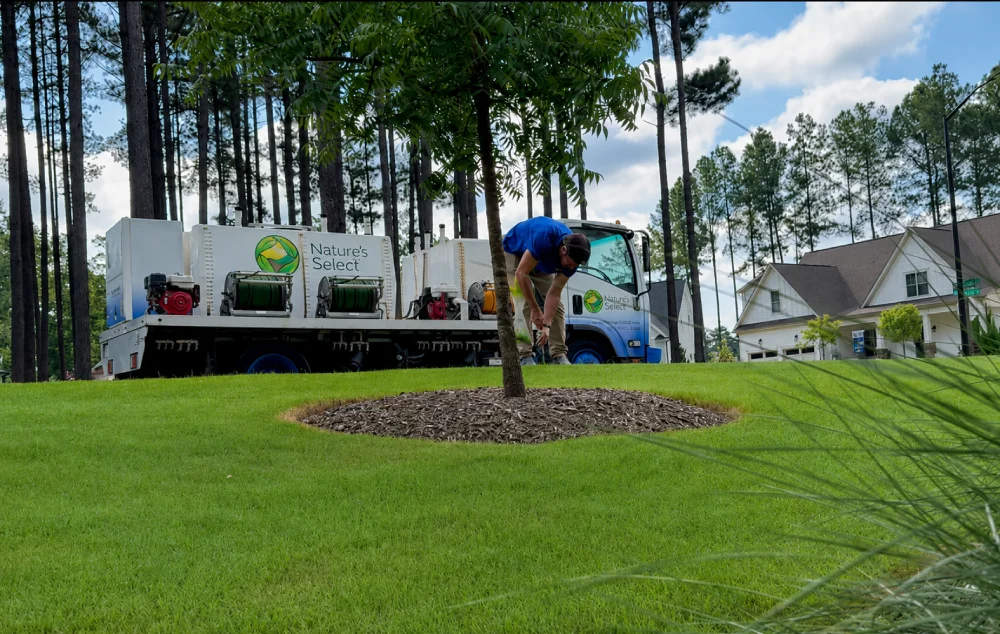
If any of these describe your lawn, the population is already several generations in. The earlier we catch it, the smaller the treatment area, the lower the cost, and the faster your lawn recovers. call (888) 786-9735 or
Founded in Winston-Salem in 1994, Nature's Select® has expanded across North Carolina into the Triad, the Triangle, and the Sandhills, and continues to add franchises across the region. Call the toll-free number and you'll be routed to the office that covers your address.

Serving the Research Triangle (Chapel Hill, Carrboro, Hillsborough, Durham, Pittsboro)
Serving the Piedmont Triad (Greensboro, High Point, Burlington, Summerfield, Oak Ridge)
Serving the Sandhills (Pinehurst, Aberdeen, Southern Pines, Seven Lakes)
Serving the Piedmont Triad (Winston-Salem, Clemmons, Kernersville, Lewisville, King)
Not sure which office covers your address? Call (888) 786-9735 and we will point you to the right local team.
Conventional services spray the whole property on a fixed calendar, often before anyone confirms which insect is active. Nature's Select® works the other way around. The technician identifies the species on-site, and treatment only happens when monitoring shows a population above the action threshold. When treatment is warranted, the product is a targeted, EPA-approved insecticide applied at the lowest effective rate, to the affected area, and timed to the active feeding stage so it actually works and protects pollinators. Underneath all of it is a soil-first lawn care program that supports beneficial insects and keeps pest pressure low, which is what reduces how often any spraying is needed. Nature's Select® has run this approach across North Carolina since 1994.
No. Biological lawn insect control is a soil-first approach built around living soil microbes and the proprietary Nature's Select® Solutions blend, a science-backed approach designed to use less synthetic and chemical input rather than none. "Organic" and "natural" are not regulated terms in lawn insect control: there is no USDA standard or certification behind either label, so both are used inconsistently and can mean almost anything. An "organic" label also does not guarantee a gentle product, since some organic-labeled inputs carry toxicity comparable to conventional ones. Nature's Select® uses EPA-approved inputs and does not market itself as organic; the biological label describes what the program does at the soil level.
These are the four most common insect pressures on North Carolina lawns, but they are not the only pests the program handles: army worms (true army worms on fescue in spring, fall army worms on warm-season lawns in late summer), chinch bugs (southern chinch bug, peak in early July), white grubs (Japanese beetle larvae and related species, peak in late August), and sod webworms (peak July through August). The technician identifies the species on site at every visit and treats whatever turf-damaging insect is present, not just these four.
The decision is based on species and density. For each pest, there is an action threshold above which treatment makes sense and below which monitoring continues. White grubs, for example, are typically treated when density reaches roughly 5 to 10 per square foot, depending on turf vigor. Chinch bugs and army worms are confirmed at the canopy or thatch line using a flotation or soap flush test. Treatment is applied at the lowest effective rate during the window when the pest is most vulnerable.
The Nature's Select® program uses biological inputs, the proprietary Nature's Select® Solutions blend, and targeted insecticides applied at lower rates of synthetic input than a typical lawn insect program. The technician can answer property-specific questions before treatment
Nature's Select® is affiliated with the NC State Beekeepers Association. The program avoids broad spraying during bloom on flowering trees, shrubs, and lawn weeds, restricts treatments to the species the technician identifies on-site, and applies treatments at the lowest effective rate. Protecting bees and beneficial insects is built into how the program is scheduled, not added on afterward.
Pricing depends on the size of your lawn, the insect in question, the control method it calls for, and whether treatment is paired with the broader year-round lawn care program. Because every property and infestation is different, final pricing is delivered during the free on-property assessment so the quote matches your actual lawn, and monitoring visits are included in the year-round subscription. If targeted treatment does not perform as expected, the technician returns and re-treats at no additional cost under the Nature's Select® Guarantee. Free estimate: (888) 786-9735.
Nature's Select® serves North Carolina from four locations. The Winston-Salem office (336-729-3122) is the original 1994 company and serves Winston-Salem and the surrounding Forsyth County communities across the Piedmont Triad. The Greensboro office (336-221-7680) serves the rest of the Piedmont Triad around Guilford County. The Chapel Hill office (919-335-4656) covers the Research Triangle. The Pinehurst office (910-634-3886) covers the Sandhills
Free on-property assessment within 48 hours, customized estimate the same day. Species-level identification. Nature's Select® Guarantee. Local franchises, one team.