Deep Root Feeding: Why It Matters More for NC Trees Than Almost Anywhere Else
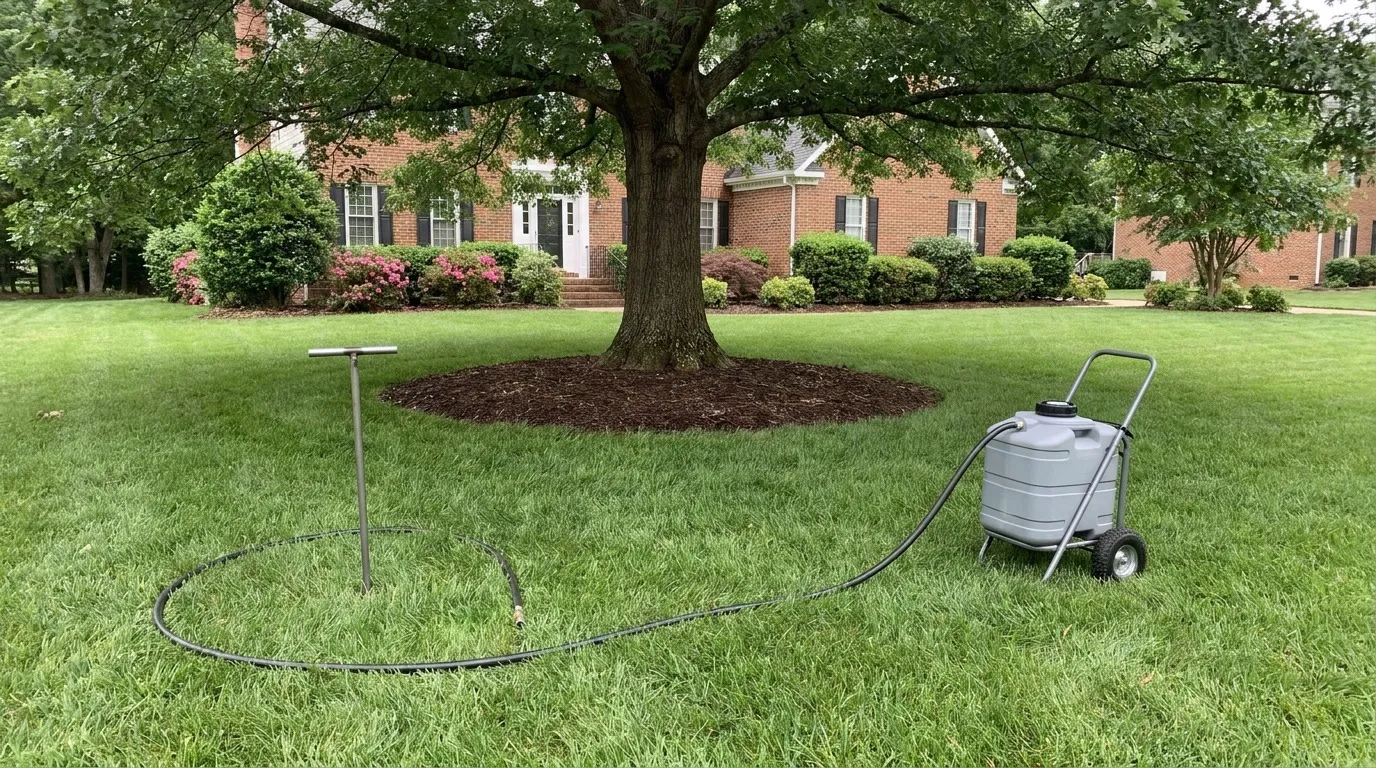
Deep root tree fertilization delivers biological nutrients directly to the feeder root zone 6 to 18 inches below the surface, where a tree actually absorbs them. In North Carolina, dense clay soil compacts the top few inches so tightly that surface fertilizer rarely reaches those feeder roots. That soil reality is why deep root feeding is not a luxury upsell here. It is the mechanism that lets a mature dogwood, oak, or crepe myrtle stay fed.
If you have watched a landscape company inject fertilizer into the ground around your neighbor's oaks and wondered whether it is real science or a pricey upsell, you are asking the right question. Deep root tree fertilization sits in an awkward middle ground online. Tree service company pages describe it in clinical terms. Reddit threads dismiss it as marketing. Neither answer helps you decide whether your own dogwood or magnolia needs it.
This guide walks through what deep root feeding actually is, where a tree's feeder roots live, why North Carolina soil makes the delivery method matter more than it does in loose loamy soil elsewhere, and how a biological program uses the mechanism to build long-term tree health rather than mask a symptom. You will finish reading with a clear picture of when the mechanism is worth doing, when it is not, and what to ask the person you hire.
What Deep Root Fertilization Actually Is
Deep-root fertilization is a soil-injection method. A trained technician uses a probe connected to a pressurized tank to inject liquid fertilizer into the soil 6 to 18 inches below the surface, in a grid pattern across the tree's root zone out to the drip line. The pressure fractures compacted soil around the probe tip, and the liquid disperses through those fractures into the surrounding soil.
The mechanism is not new. Arborists have used pressurized subsurface liquid injection systems for decades. NC State Cooperative Extension notes that split applications and pressurized subsurface liquid injection are the recommended fertilization approaches for trees growing in clay soil, precisely because clay impedes surface infiltration.
What is delivered varies by program. Conventional providers inject standard NPK liquid fertilizer. Nature's Select® uses a biological blend that combines slow-release biological nutrients with the proprietary Nature's Select® Solutions blend, which includes microbial inoculants and humic acid. The delivery method is the same. The material inside the tank is not.
Where Tree Feeder Roots Actually Live
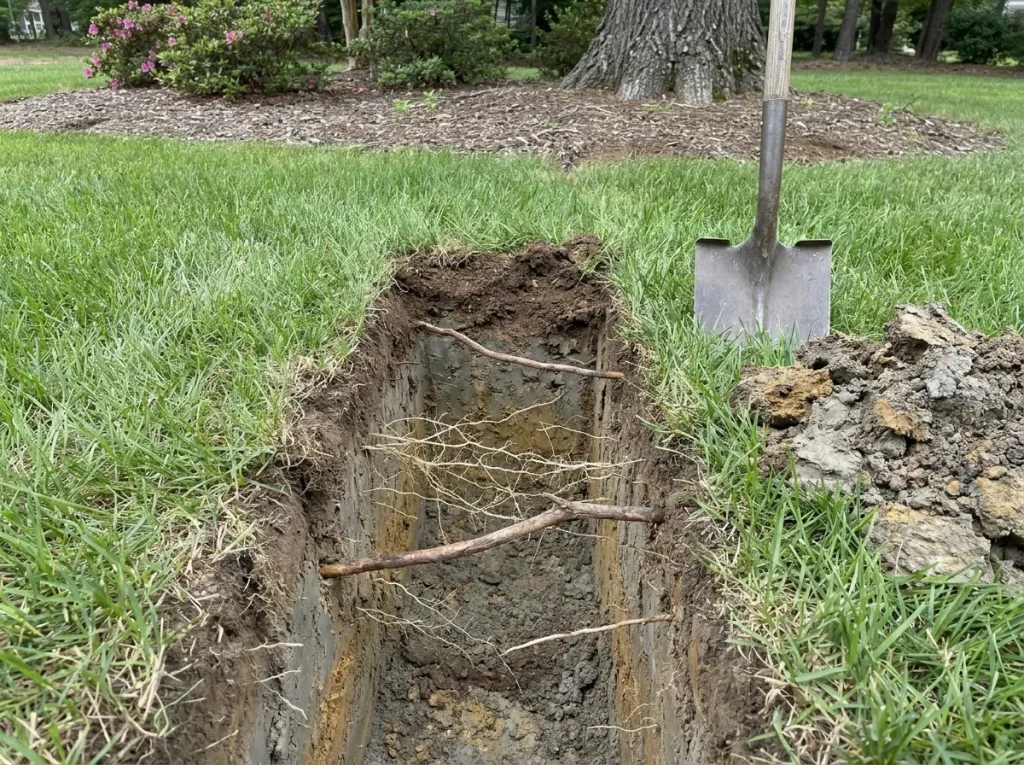
The most important thing to know about tree fertilization is where a tree gets its nutrients. Homeowners often picture a tree's root system as a mirror image of the canopy, with deep vertical taproots reaching for water. That picture is mostly wrong.
Most active feeder roots on a mature landscape tree live in a shallow horizontal mat in the top 6 to 18 inches of soil. They extend well past the visible drip line, often twice as far as the canopy reaches. Feeder roots are the fine, threadlike roots that absorb water and nutrients. The thick structural roots you see at the trunk exist to anchor the tree and transport materials, not to feed it. Root architecture research summarized by the US Forest Service confirms that the majority of a mature tree's absorbing roots concentrate in the top 12 to 18 inches of soil and radiate horizontally well beyond the canopy edge.
That geometry has two implications:
- Surface fertilizer usually misses the target. Granular product broadcast on the lawn dissolves into the top inch or two of soil. Turf roots absorb most of it before it reaches tree feeder roots below.
- The root zone is much wider than you think. A 40-foot canopy oak has feeder roots running under lawn, driveway, and neighboring beds well past the branch tips.
The 6-to-18 inch depth is the target for deep root feeding because that is where the tree actually eats.
Why North Carolina Clay Changes the Math
The reason deep root fertilization matters more in North Carolina than in a state with loose, sandy, or loamy soil comes down to one word: compaction.
North Carolina clay soil has three properties that fight surface fertilization:
- Low porosity. Clay particles are microscopic and pack tightly. Water and dissolved nutrients infiltrate slowly.
- Compaction from decades of use. Suburban lots are graded, driven over during construction, and walked across for years. The top 4 to 6 inches often compacts to a density where roots physically cannot expand.
- Nutrient lock-up in acidic clay. North Carolina's clay is naturally acidic. That low pH keeps iron and manganese available (the red color of NC clay is iron oxide), but it also locks up magnesium, calcium, and phosphorus in forms roots cannot pull.
Add those three together and you have soil that resists surface water infiltration, resists root expansion, and holds some nutrients hostage. Broadcast granular fertilizer sits on top, dissolves in the next rain, and either runs off toward the storm drain or feeds the lawn grass before it ever reaches the tree feeder roots below.
Pressurized subsurface injection short-circuits all three problems. The probe punches past the compacted layer. The pressure fractures the surrounding clay, creating temporary channels for roots to expand into. And the biological amendment introduces microbes that keep those channels open long after the injection is done.
In sandy coastal Georgia or loamy Ohio soil, a homeowner can get away with surface fertilization more often than not. In central North Carolina clay, the same practice wastes most of what you paid for. That is the mechanism gap that Nature's Select® has been closing since 1994.
What a Biological Deep Root Feeding Program Delivers
A single deep root feeding visit is not a magic cure. What matters is what is inside the tank and how the program stacks over multiple years. A biological program delivers three things at once.
1. Slow-release nutrition matched to what the tree needs. Not all trees need the same NPK ratio. A magnolia holding chlorotic yellow leaves needs magnesium and micronutrients. A newly planted crepe myrtle needs phosphorus support for root establishment. A mature oak on a compacted lot needs a broader spectrum. The biological blend is calibrated on site, not pulled off a shelf.
2. Microbial inoculants that rebuild the rhizosphere. The rhizosphere is the thin layer of soil that touches root surfaces. Beneficial bacteria, mycorrhizal fungi, and other microbes in the rhizosphere unlock nutrients that pure chemistry cannot. Compacted urban clay is often microbially depleted. The Nature's Select® Solutions blend reintroduces the microbes that mature root systems depend on.
3. Humic acid to condition the clay. Humic acid is a soil-conditioning compound derived from decomposed organic matter. It binds to clay particles, opens pore space, and improves the soil's ability to hold water and cycle nutrients. Over multiple applications, humic acid changes the physical structure of the clay itself.
The compounding effect is why the second and third seasons of a program often look dramatically better than the first. You are not just feeding the tree. You are rebuilding the soil the tree feeds from. This is the same soil-first thinking that drives our biological approach to lawn care across the state.
Deep Root Injection vs. Soil Drench: What the Difference Actually Is
Two similar-sounding delivery methods often get confused: deep root injection and soil drench. Both are subsurface. They are not the same.
| Method | Delivery | Depth | Pressure | Best Use |
|---|---|---|---|---|
| Soil drench | Liquid poured or low-pressure applied to soil surface, allowed to percolate | Top 4 to 8 inches | None or gravity-fed | Shrubs, small ornamentals, biological amendment across broad root zones |
| Deep root injection | Liquid injected via probe under high pressure | 6 to 18 inches | Pressurized (typically 150 to 250 psi) | Mature trees, compacted sites, targeted feeder-root delivery |
Nature's Select® uses soil drench applications as the primary delivery for tree and shrub biological soil amendment across the root zone, and pressure injection selectively for specific mature trees or compaction-heavy sites where the deeper mechanical fracture matters. Most homeowners' properties benefit more from consistent soil drenching than from an aggressive injection program. The technician makes the call on-site based on species, age, and soil conditions.
Signs a Tree Might Actually Need Deep Root Feeding
Not every tree benefits from a fertilization program. A young, vigorous tree planted in reasonable soil usually does not need supplemental feeding. Deep root fertilization earns its place when a tree shows one of the following patterns:
- Interveinal chlorosis (yellow leaves with still-green veins) that persists through the growing season, signaling micronutrient deficiency locked in acidic clay
- Slow or minimal annual growth compared with the same species elsewhere on the property or in the neighborhood
- Thinning canopy over the last one to two seasons that cannot be explained by pest, disease, or storm damage
- Newly transplanted tree working to establish roots in dense, compacted, or nutrient-poor soil
- Mature specimen in a high-traffic zone where compaction has accumulated over decades
- Repeated late-summer stress on species like crepe myrtle that flags feeder-root limitation rather than acute drought
A late-summer wilting crepe myrtle, for example, is often not dying. It is running out of accessible water and nutrients from a feeder-root zone that surface fertilizer never reached. Late-summer stress on ornamentals is one of the clearest use cases for deep root feeding as part of a longer program. NC State Extension guidance also flags persistent interveinal chlorosis on species like magnolia and river birch as a diagnostic sign that a nutrient is present in the soil but locked away from the roots by acidic clay conditions.
When Deep Root Fertilization Is Not the Answer
Being straight with you matters more than selling a service. Deep root feeding is not the right response to every tree problem.
- If the tree has active bark beetle infestation, wood-borer damage, or vascular disease, feeding it will not solve the primary problem. Diagnosis and targeted treatment come first.
- If the tree is planted in the wrong site (a bald cypress in dry compacted clay, a river birch on a south-facing slope with no irrigation), no amount of fertilization compensates for site mismatch.
- If the tree is over-mulched with a volcano mulch pile at the trunk, girdling roots and bark rot will kill it regardless of what is in the root zone.
- If the property has a soil compaction problem so severe that machinery would be needed to fracture the pan, a fertilization visit does not fix the underlying condition.
A good technician will tell you when deep root feeding is not the fix. That honesty is part of what a program earns over three decades.
Timing: The Best Windows for Deep Root Feeding in North Carolina
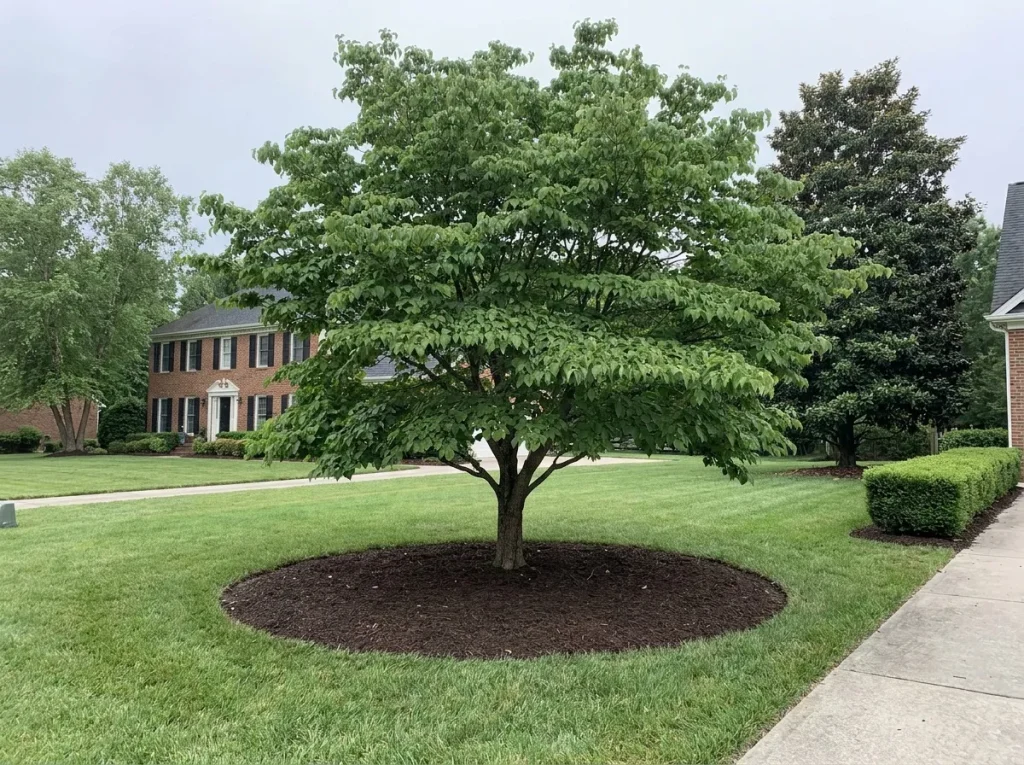
Two windows carry most of the benefit for deep root feeding in North Carolina.
- Fall (August through October). This is the strongest single window. As canopies slow their above-ground growth, root systems shift into a second growth cycle. Nutrients delivered during this window get pulled into root reserves and drive next year's canopy development. Fall application is the reason a program's second growing season often looks so much better than the first.
- Spring (March through April). A spring application supports the flush of new growth and gives newly planted trees a boost through establishment.
Newly planted trees can be fertilized outside these windows for establishment support. Summer applications are avoided when possible because heat and drought stress already push a tree into defensive mode. Pollinator-safety guidance from the North Carolina State Beekeepers Association also shapes the schedule, because subsurface injection keeps material below the bloom zone and morning-only visits protect foraging honeybees on nearby flowering shrubs.
If you are considering a program for your trees, fall is the window worth booking ahead for. Aug-Oct capacity fills fast because it aligns with the physiological window that produces the most visible result.
What to Ask the Company You Hire
Before you agree to a deep root fertilization program, ask three specific questions.
"What is in your tank?" A biological program says biological nutrients, microbial inoculants, humic acid. A conventional program says NPK ratio. There is a legitimate use case for both, but you should know which one you are paying for.
"How do you decide what my tree needs?" If the answer is a calendar-based one-size-fits-all program, you are getting a spray truck with a probe. If the answer starts with a site walk, species identification, and a soil condition check, you are getting a program.
"What happens if the treatment does not work?" A company that stands behind the mechanism will explain their guarantee and what they do if the tree does not respond. Nature's Select® backs every program with the Nature's Select® Guarantee.
The reason to ask these questions is the same reason to be skeptical of any expensive service. A homeowner who understands the mechanism cannot be sold something they do not need, and cannot be talked out of something that would actually help. This is where a well-run lawn fungus treatment or lawn aeration program earns trust the same way: transparency about what is happening below the surface.
Key Takeaways
- Deep root tree fertilization delivers nutrients to the 6 to 18 inch feeder root zone where a mature tree actually absorbs them, bypassing surface soil that clay-heavy North Carolina lots resist infiltrating.
- Feeder roots live in a shallow horizontal mat that extends well past the drip line, not in deep vertical taproots. That is the biology behind the mechanism.
- Central North Carolina clay compacts, holds water poorly at the surface, and locks up magnesium and calcium. Those three properties are why the mechanism matters more here than in loose loamy soil elsewhere.
- A biological program delivers slow-release nutrition, microbial inoculants, and humic acid. The compounding effect over multiple seasons rebuilds soil structure, not just tree health.
- Fall (August through October) is the strongest window; spring (March through April) supports new growth. Both windows fill early for this reason.
- Deep root feeding is not a cure for pest infestation, vascular disease, site mismatch, or over-mulching. A good technician tells you when the mechanism does not apply.
Frequently Asked Questions
What is deep root tree fertilization?
Deep root tree fertilization is a subsurface injection method that delivers liquid fertilizer 6 to 18 inches below the soil surface, where a tree's feeder roots actually absorb nutrients. A technician uses a probe connected to a pressurized tank to inject the material in a grid pattern across the root zone. The pressure fractures compacted soil, which is why the method matters most on North Carolina clay lots where surface fertilization does not reach feeder roots.
Why is deep root feeding more important in North Carolina than in other states?
Central North Carolina soil is dense clay with low porosity, heavy compaction from decades of suburban use, and an acidic pH that locks up magnesium, calcium, and phosphorus. Broadcast granular fertilizer sits on the surface, feeds the lawn, or runs off before it reaches tree feeder roots. Pressurized subsurface injection punches past the compacted layer and delivers nutrients directly to the root zone, which is why NC State Cooperative Extension recommends the method for clay soil types.
How often should deep root fertilization be done?
Most mature landscape trees benefit from one or two applications per year. Fall (August through October) is the strongest single window because it drives root reserves and next year's canopy development. Spring (March through April) supports the flush of new growth. A biological program builds compounding results across multiple seasons, so second and third year outcomes typically exceed first year results.
Is deep root fertilization the same as a soil drench?
No. Soil drench is a low-pressure or gravity-fed liquid application that percolates into the top 4 to 8 inches of soil, best suited for shrubs and small ornamentals or broad biological amendment. Deep root injection uses pressurized delivery to reach the 6 to 18 inch feeder root zone of mature trees. Nature's Select® uses soil drench as the primary delivery method across most tree and shrub applications and reserves pressure injection for specific mature trees or heavily compacted sites.
Does deep root feeding hurt the tree or the pollinators around it?
The injection itself is minimally invasive and the tree heals over the probe holes within days. Biological deep root feeding is safe for pollinators because the material is delivered below the surface and does not contact bees, butterflies, or beneficial insects. Nature's Select® is affiliated with the North Carolina State Beekeepers Association and times all treatments to protect pollinator activity.
When will I see results from deep root fertilization?
Visible response depends on what was treated and what the underlying condition was. Nutrient-deficient chlorosis often improves within one growing season. Canopy density typically responds in the growing season following the fall application. Long-term soil structure changes from humic acid and microbial reintroduction show most strongly in the second and third seasons of a program.
Can I do deep root fertilization myself?
The DIY approach with a garden hose fertilizer attachment or a spike does not reach feeder root depth and does not fracture compacted clay. The mechanism that makes deep root feeding effective (pressurized injection and biological amendment matched to the specific tree) requires professional equipment and trained species identification. That is the honest answer, and it is why the mechanism sits inside a professional program rather than on a Home Depot shelf.
Conclusion
Deep root tree fertilization is not a marketing invention. It is a delivery mechanism grounded in tree root biology and NC State Cooperative Extension recommendations, and it matters more on central North Carolina clay lots than it does in loose loamy soil elsewhere. When the mechanism is applied correctly, with a biological blend and a technician who identifies your tree's actual need on site, it is one of the most impactful things you can do for a mature landscape tree.
If you have a maturing crepe myrtle, oak, dogwood, or magnolia that has looked stressed for a season or two, and you want the soil-first program that has served North Carolina since 1994, Nature's Select® runs a deep root fertilization program as part of our full biological tree and shrub care in North Carolina. A technician walks your property within 48 hours and gives you a same-day written estimate. Fall capacity fills early. Call (888) 786-9735 or request a free on-property assessment to get on the fall schedule.