Why Your NC Lawn Yellows in July (And What It's Telling You)
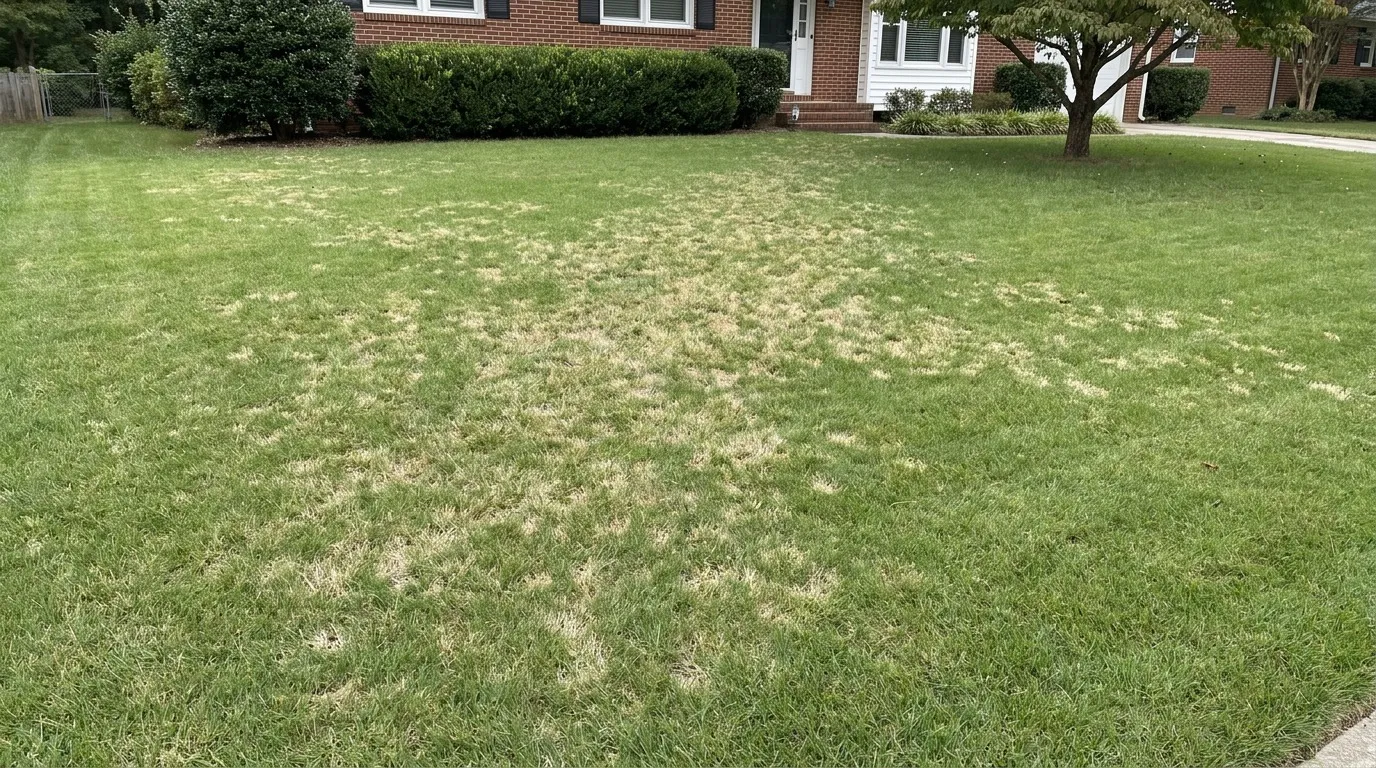
Your North Carolina lawn is yellowing in July because the transition zone breaks the rules cool-season and warm-season grasses were bred for. Tall fescue is signaling heat and root-zone stress; bermuda or zoysia is signaling nutrient, water, or disease pressure inside its peak growth window. The color shift is a diagnostic message about the soil, the water, or the species, not a verdict on your care.
You mowed on Saturday. The lawn was green. Two weeks later, the same patch has faded to the color of dry straw, and the neighbor's yard three doors down still looks like a putting green. If you moved to North Carolina from Ohio, Pennsylvania, or Long Island, this is not the July you remember. If you moved down from New Jersey or up from Florida, none of what worked on your old lawn is landing here.
That is because North Carolina sits inside the Southern transition zone. The homeowner who understands what the yellow is telling them, not just what to spray on it, is the homeowner who fixes the lawn without spending another season guessing. This article walks through the six signals your yellow lawn is sending, how to read each one, and what to do about it before August makes it worse.
What the Yellow Is Actually Telling You
Grass turns yellow when chlorophyll production drops. Chlorophyll is the pigment doing photosynthesis inside every leaf blade, and it needs three things to keep working: adequate water at the root zone, adequate nitrogen and iron in the soil, and a leaf blade that has not been stripped down past its growing point. Take away any one of the three and the color begins to fade before the plant actually dies.
That is the good news. Yellow is a warning, not a funeral. A yellowing lawn is still alive and still trying to communicate. Reading the message correctly is the difference between a lawn that recovers in three weeks and one that needs a full renovation in September.
The four questions that decode the yellow signal:
- What grass type is on the property? (Tall fescue behaves differently from bermuda and zoysia.)
- Is the yellowing all over the lawn, in patches, or in rings?
- When did it start, and was there a weather event just before?
- Is the soil under the yellow area dry, soggy, or somewhere in between?
Your answers to those four questions almost always narrow the diagnosis to one of six causes we see on North Carolina properties every summer.
Signal 1: Fescue Heat Stress and Summer Dormancy
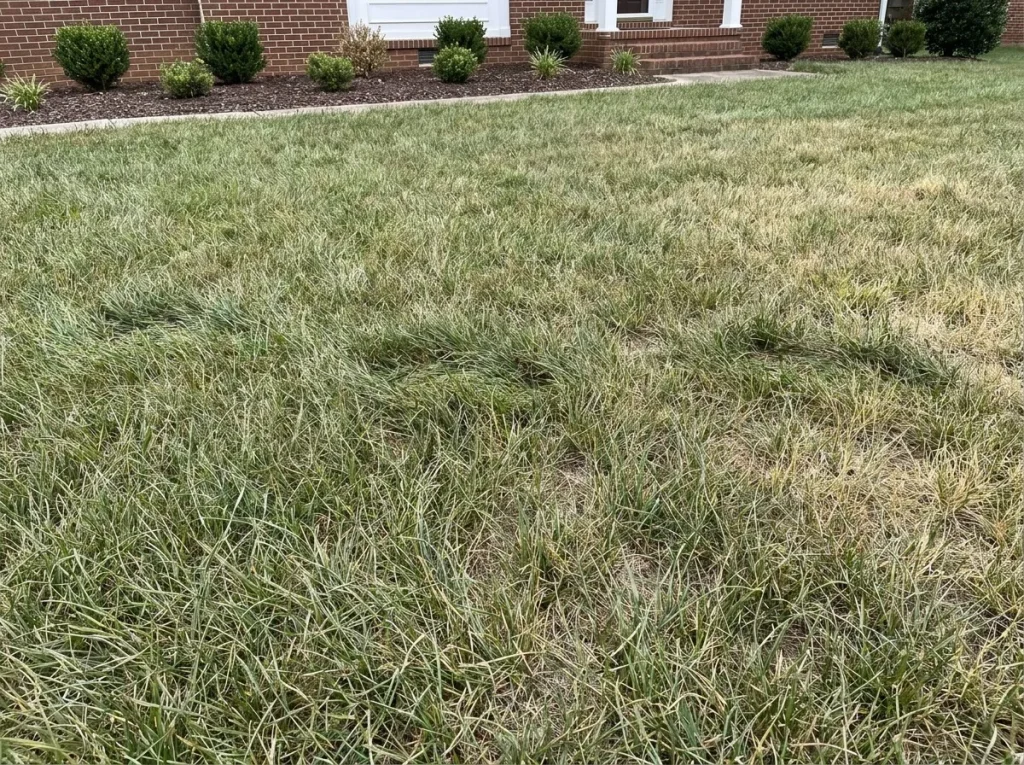
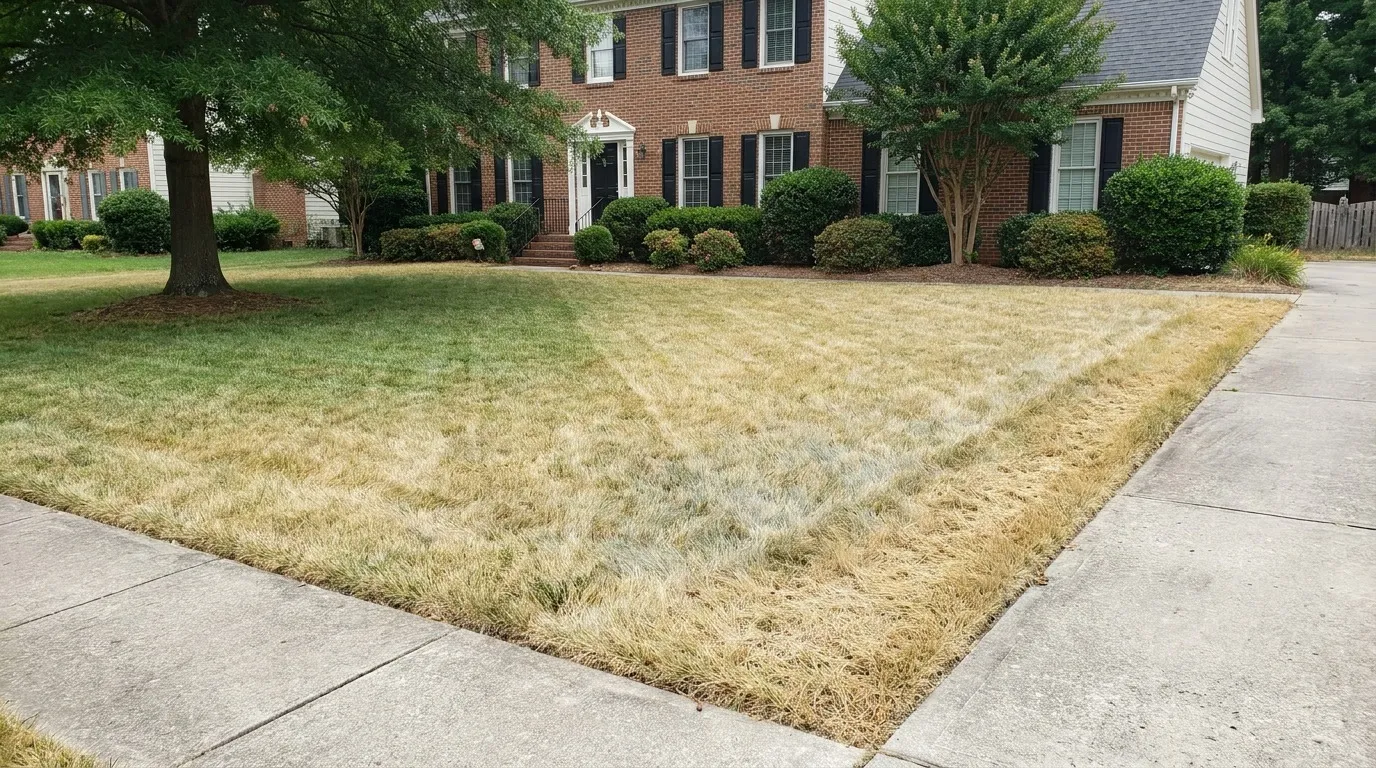
Tall fescue is a cool-season grass. Its optimal growth window is soil temperature between 60 and 75 degrees. When soil temperature climbs into the mid-80s and holds there for a week or more, fescue starts protecting itself by rolling its leaves, shutting down top growth, and pulling resources back to the crown. The visible signal is a blue-gray tint that shifts to straw yellow, most obvious on the southern and western exposures where afternoon sun cooks the root zone first.
This is not a disease. It is a survival response. The fescue is not dying. It is going semi-dormant to ride out heat it was never bred to enjoy.
What tells you this is the cause:
- The yellowing is broad, not patchy, and worse on south and west exposures
- The blades feel dry and roll inward when you look closely
- A footprint stays imprinted on the grass for several minutes after you walk across it
- You have tall fescue (bunching growth pattern, coarse blade, no runners along the ground)
What to do: Raise mowing height to 3.5 inches or more, cut the frequency, water deeply and infrequently to push roots down, and stop feeding nitrogen until soil temperatures drop back into the 70s. Fescue that goes semi-dormant in July almost always greens back up on its own with spring green-up conditions in the following season, and a well-timed fall aeration and overseeding rebuilds the density the summer thinned out.
Signal 2: Bermuda or Zoysia Nutrient Deficiency
If you inherited a bermuda or zoysia lawn when you bought the house, July is the opposite scenario from fescue. Warm-season grasses hit their peak growth window between June and August. When bermuda or zoysia turns yellow in July, the plant is trying to grow fast and cannot find what it needs in the soil.
The most common shortfall in a July warm-season lawn is nitrogen, but iron chlorosis runs a close second. Nitrogen deficiency shows first on the older, lower blades. Iron chlorosis shows on the newest growth at the tips while the older blades stay green underneath. The distinction matters because the fix is different for each.
| Deficiency | Where Yellow Appears First | Fix |
|---|---|---|
| Nitrogen | Older leaves, lower on the plant | Soil test first; targeted fertilization at low input rates |
| Iron chlorosis | New growth, tips of newest leaves | Foliar iron application; soil pH check |
| Potassium | Leaf edges, then interveinal | Soil test; adjust potassium program |
A soil test costs a fraction of one wasted bag of fertilizer and tells you exactly what your soil is short. Blanket fertilization in July heat, without knowing what is missing, will burn a stressed lawn faster than it feeds one.
Signal 3: Watering Wrong (In Either Direction)
The most common July watering mistake in our area is watering every morning for ten minutes. It feels responsible, but the actual result is a lawn with roots that never had to go deeper than the top inch of soil. As soon as a stretch of heat arrives, the top inch dries out, the shallow roots have no reserves, and the whole lawn yellows in a matter of days.
The opposite mistake is real too. A homeowner who runs an irrigation zone for 45 minutes three times a week during a wet summer is drowning the root zone, driving out oxygen, and setting up conditions for fungal disease. Soggy soil breeds problems that also present as yellow patches, but for entirely different reasons.
How to tell watering is the issue:
- Yellow appears all over the lawn, not in defined patches
- Under-watering signs: crunchy blades, blue-gray tint, footprints that stay imprinted
- Over-watering signs: spongy soil, faint mushroom smell, mushrooms actually appearing after warm rain
- Sprinklers running before 6 a.m. or after 10 a.m. lose 30% or more of the water to evaporation
The corrected watering pattern for North Carolina is one inch of water per week, delivered deep and infrequent, early in the morning. Species and soil type shift the exact number, and the correct watering schedule for a fescue lawn on clay soil in the Triad is not the same as a zoysia lawn on sandy soil in the Sandhills. When you set the schedule right, the lawn goes 10 to 14 days between waterings and the yellow color usually resolves within two weeks.
Signal 4: Soil Compaction and Shallow Roots
Root-zone problems present as yellow patches that seem to appear out of nowhere. The reader who is watering correctly, mowing correctly, and feeding the right way still has yellow patches showing up because the soil underneath has compacted into something the roots cannot penetrate.
North Carolina clay soils compact naturally under a decade of foot traffic, mower passes, and the tight construction schedules that come with new-build neighborhoods. Compacted soil blocks water and oxygen from reaching the root zone. The grass above ground reads that as drought and nutrient stress at the same time, even when the soil surface is being watered generously.
The screwdriver test: Push a long-blade screwdriver straight down into the soil in a yellow area. If it stops within three inches, the soil is compacted. If it slides in six inches or more with steady pressure, compaction is not the issue.
Compaction is fixed with fall core aeration, not a summer treatment. Aeration in July heat stresses tall fescue further and is not the right window for cool-season turf. The corrected practice is to schedule fall aeration and overseeding when soil temperatures cool into the mid-70s, which for most North Carolina properties lands in September.
Signal 5: Disease Pressure in Humid Conditions
July in North Carolina brings dew that sits on the leaf until 10 a.m. and thunderstorms that leave the canopy wet overnight. That combination is the exact condition three fungal diseases need to establish. Brown patch, dollar spot, and pythium blight are the three most likely to show on a North Carolina lawn in July, and each one presents differently.
Brown patch shows as circular, tan-to-yellow patches ranging from 6 inches to several feet across. It hits tall fescue hardest. The edges of the patch often have a darker "smoke ring" visible in early morning.
Dollar spot shows as silver-dollar-sized straw-colored patches, often clustered, most obvious in low-nitrogen bermuda and zoysia.
Pythium blight shows as slimy, matted patches that spread along water flow lines, most common after heavy rain and warm nights.
Disease pressure is the reason mowing height and watering timing matter so much in the transition zone. Cutting fescue below 3 inches in July, watering late in the day, and applying nitrogen during a disease flare-up are the three fastest ways to make a small yellow patch into a lawn-wide problem.
Signal 6: Cultural Practice Errors That Compound
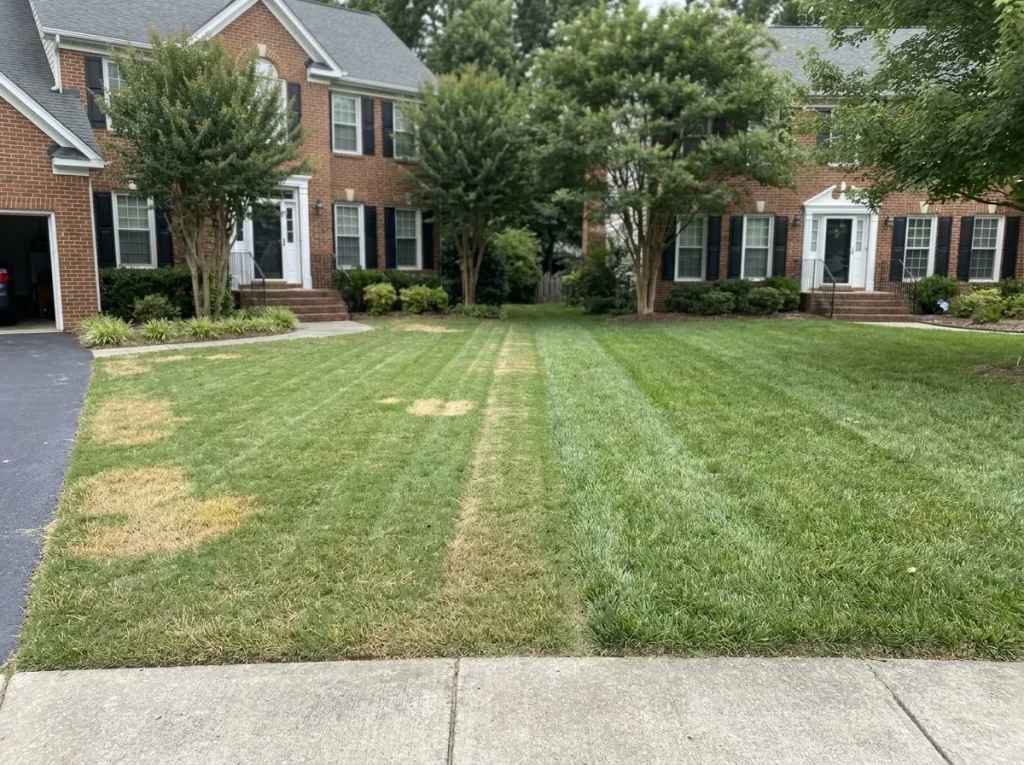
The last category is the one most homeowners resist hearing. Sometimes the lawn is yellow because of the way it has been treated over the last several months, not because of any acute stress this week.
The four most common cultural errors we see on North Carolina properties in July:
- Mowing height too low. Scalping fescue below 3 inches strips the leaf blade the plant needs to photosynthesize, burns the crown, and invites disease.
- Dull mower blades. A dull blade tears grass instead of cutting it, leaving a shredded tip that yellows and browns within 24 hours. If the top inch of your lawn looks tan when you look sideways across it, the blade is dull.
- Bagging clippings in summer. Grass clippings return 20-30% of the nitrogen your lawn needs back to the soil. Bagging every mow removes that free nutrient cycle.
- Wrong pre-emergent timing. A pre-emergent applied on a fixed calendar in early April, rather than at 55-degree soil temperature, either misses the crabgrass germination window or lands during the wrong biological moment for the turf.
Cultural practice, as our approved service page puts it, accounts for about a third of the result. The other two-thirds are soil biology and program timing. A biological lawn care program that pairs soil-first amendments with corrected cultural practice is the compounding fix. Homeowners who invest in a professional biological lawn care program alongside a fescue vs bermuda vs zoysia identification often see the yellow resolve inside the same growing season.
When to Call a Specialist Versus Wait It Out
Not every yellow lawn needs a professional visit. If tall fescue is showing broad summer semi-dormancy and you have a fall aeration and overseeding plan on the calendar, you can ride out July with corrected mowing and watering and expect recovery.
The signals that mean it is time to call a specialist:
- Yellow patches expanding by several inches per week
- Yellow with visible fungal structures, smoke rings, or matting
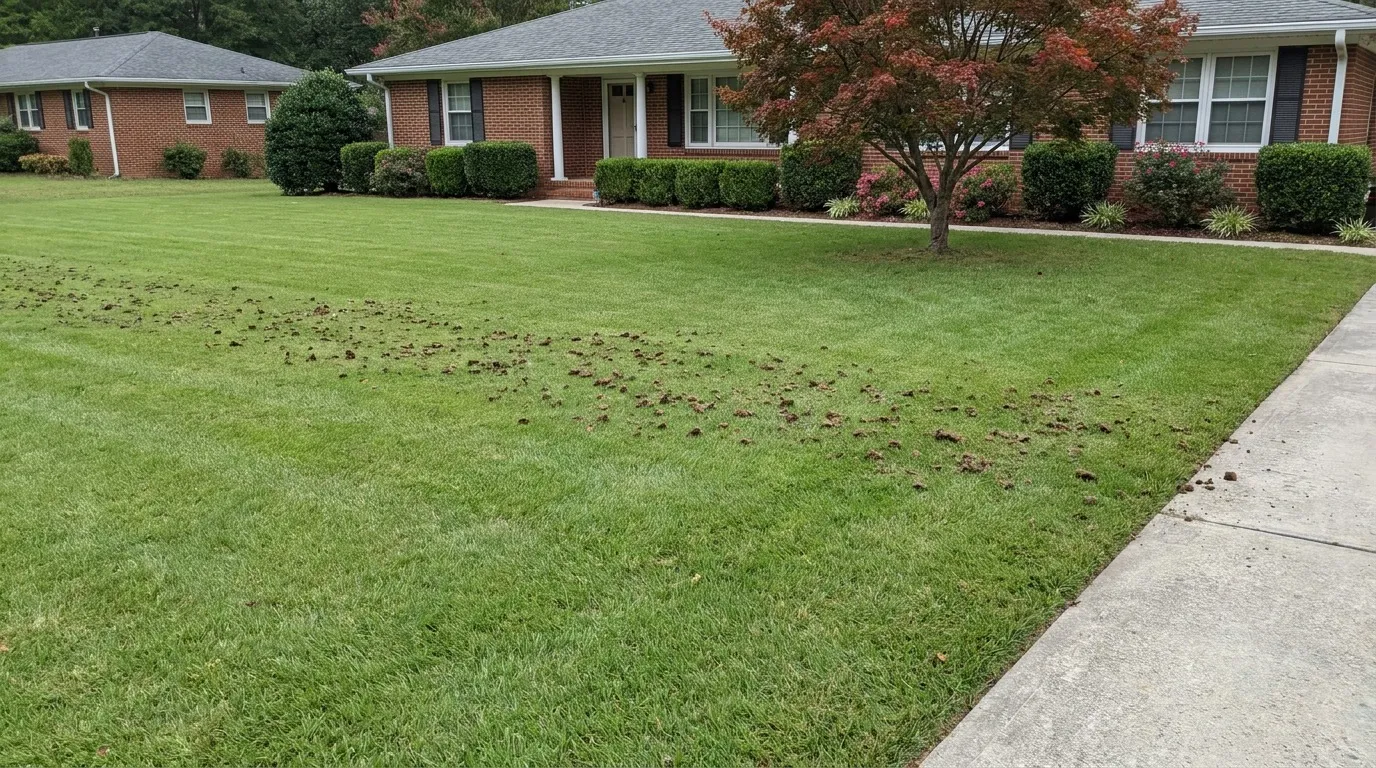
- Yellow accompanied by insect damage (grubs peel the turf back like carpet)
- A third growing season of the same yellow pattern in the same spots
- New-property lawns where you do not know what grass is on the property, what fertilizer history is behind it, or what the soil actually needs
Nature's Select® has served North Carolina homeowners since 1994 with a 7-application year-round program calibrated to soil temperature rather than the calendar. Each property gets one dedicated technician for the year, a written report after every visit, and the Nature's Select® Guarantee. If a treatment does not perform as expected, we return and make it right.
The USDA Plant Hardiness Zone Map places most of North Carolina in Zones 7b and 8a, which is exactly why the transition zone puts cool-season and warm-season grasses on the same street under the same July heat.
Key Takeaways
- Yellow is a diagnostic signal, not a verdict, and North Carolina's transition-zone position makes yellowing common in July across both cool-season and warm-season lawns.
- Tall fescue yellowing in July is almost always heat semi-dormancy; raise mowing height, water deep and infrequent, and let fall aeration and overseeding rebuild density.
- Bermuda and zoysia yellowing in July usually points to nitrogen or iron deficiency, and a soil test through NC State Extension is worth more than a bag of blanket fertilizer.
- Watering every morning for ten minutes is the most common summer stress signs cause we see, and the corrected pattern is one inch per week delivered deep and early.
- Soil compaction produces yellow patches that resist every other fix; the screwdriver test confirms the issue, and fall core aeration is the corrected practice.
- Brown patch, dollar spot, and pythium blight are the three transition-zone diseases most likely to show in July humidity, and cultural practice errors compound each of them.
Frequently Asked Questions
Is my yellow lawn dead or dormant?
Almost always dormant, not dead. The quickest field test is to grab a handful of yellow grass and pull gently. If the roots hold firm to the soil, the lawn is dormant and will recover once conditions correct. If the grass pulls out with no resistance, that patch has lost the root system and needs reseeding. Tall fescue that goes semi-dormant in July heat almost always greens up again with cooler soil temperatures.
Why does my yellow patch return in the same spot every year?
Repeat yellow patches point to a soil-level problem the seasonal weather is exposing. The three most common causes are compacted soil that never gets aerated, a shallow buried construction feature like a rock or a slab, or a recurring disease that overwinters in the thatch layer. A soil test and a core aeration cycle usually reveal which of the three is driving the pattern.
Should I fertilize a yellow lawn in July?
Rarely. Nitrogen applied to a stressed fescue lawn in July heat burns the crown further and can push a semi-dormant lawn into full decline. For bermuda and zoysia in active growth, a low-rate nitrogen or iron application can help if a soil test confirms the deficiency. The corrected practice is to test first, feed with a low-rate biological program, and time the heavier feedings to the shoulder seasons.
Will my North Carolina lawn recover from July yellow on its own?
Cool-season lawns almost always recover with spring green-up conditions in the following season, especially with fall aeration and overseeding. Warm-season lawns recover faster in season if the underlying cause is corrected within a few weeks. The lawns that do not recover are the ones where the underlying cause (compaction, disease, chronic watering error) is left in place through a second and third growing season.
How do I tell if I have tall fescue, bermuda, or zoysia?
Tall fescue grows in bunches, has a wide coarse blade, and does not send runners along the ground. Bermuda spreads aggressively with visible above-ground runners called stolons and green-up starts once soil temperatures reach the mid-60s. Zoysia is dense, feels stiff underfoot, and greens up later than bermuda in the spring. The way you identify what is on your property changes how you should water, mow, and feed it.
Can I just water more and fix the yellow?
Not usually. Over-watering is one of the six causes, and adding water to a soggy or compacted lawn makes yellowing worse by suffocating roots. The corrected practice is to water deep and infrequent, not more often. If yellow patches persist after two weeks of corrected watering, the cause is somewhere other than water.
Conclusion
The yellow lawn you are looking at right now is not a failure. It is a communication. North Carolina sits in the transition zone, which means both cool-season and warm-season grasses are pushed to the edge of their comfort every July, and the way each species signals that stress is different. Reading the signal correctly gets you a green lawn back in weeks, not months.
If the diagnosis feels beyond a weekend, that is what a biological program is for. Nature's Select® has been building healthy North Carolina lawns from the soil up since 1994, with a 7-application program calibrated to soil temperature and one dedicated technician for the year.
Request a free on-property assessment or call (888) 786-9735 and we will point you to the office that covers your address.